
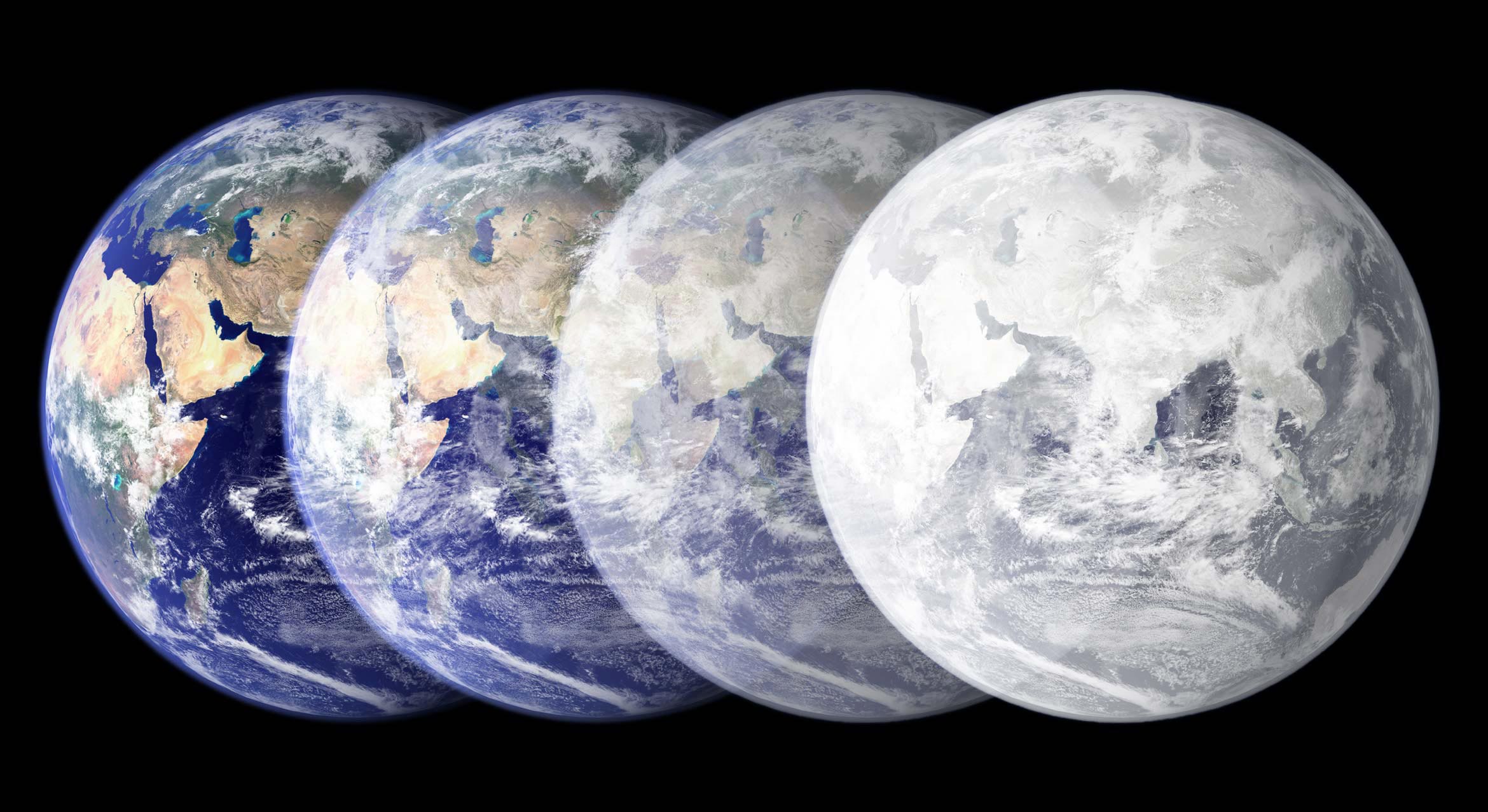
Glacial cycles aren’t random; they follow a predictable rhythm dictated by Earth’s orbit.
A study analyzing climate records from the past 800,000 years found that specific alignments of Earth’s wobble, tilt, and orbital shape determine when ice ages start and end. Precession primarily kickstarts deglaciation, while obliquity locks in warm interglacial periods. Without human-driven climate change, the next ice age would likely begin in 11,000 years.
The Predictable Pattern of Ice Ages
Earth’s ice ages don’t happen at random — they follow a clear, predictable pattern shaped by the way our planet moves through space, according to a new study. Researchers have identified the key roles of precession, obliquity, and eccentricity, which influence the tilt of Earth’s axis, its wobble, and the shape of its orbit around the Sun. These factors, collectively known as orbital forcing, dictate when glaciers advance and retreat, providing a framework for predicting past and future glacial cycles.
The 100,000-Year Climate Mystery
For years, scientists have known that variations in Earth’s orbit drive ice age cycles, but pinpointing the exact influence of each orbital factor has been a challenge. One major issue is that the cycles of precession (~21,000 years) and the second harmonic of obliquity (~20,500 years) are strikingly similar, making it difficult to distinguish their individual effects. Another long-standing mystery — often called the 100,000-year problem — is why ice ages tend to end at intervals matching a key eccentricity cycle (Earth’s orbital shape).
A New Approach to Studying Ice Age Cycles
To resolve these questions, Stephen Barker and colleagues took a fresh approach. Instead of relying solely on age estimates from climate records, they analyzed the shape and sequence of glacial transitions over the past 800,000 years, a period characterized by ~100,000-year ice age cycles. By examining three independent benthic oxygen isotope records, they determined that glacial transitions consistently align with the relative timing of precession and obliquity. Their findings show that precession plays the biggest role in triggering deglaciation, while obliquity is more important for sustaining warm interglacial periods and initiating the next ice age.
Predicting Earth’s Next Ice Age
The study suggests that ice ages typically end when precession reaches a minimum and obliquity is rising — especially following an eccentricity low. Based on these patterns, the researchers estimate that, if not for human-caused greenhouse gas emissions, Earth would be due for another ice age in about 11,000 years as its axial tilt continues to decline.
Reference: “Distinct roles for precession, obliquity, and eccentricity in Pleistocene 100-kyr glacial cycles” by Stephen Barker, Lorraine E. Lisiecki, Gregor Knorr, Sophie Nuber and Polychronis C. Tzedakis, 28 February 2025, Science.
DOI: 10.1126/science.adp3491
Never miss a breakthrough: Join the SciTechDaily newsletter.
Follow us on Google and Google News.
9 Comments
worthless, did they take in to account the axix shift from 2004, and 2022? No. because all this data is fantasy models. take the data and create “YOUR” fantasy story with the data fitting your model, the best written model wins. this is how they taught us at asu. climate change is real, but not man driven carbon footprints are a lie. science was created to prove the christian myth “there is a Abrahamic god”
science like this is false at it’s best.
Can melting Ice at the poles change the weight balance of the Earth sending the Earth into a greater tilt?
Not enough to matter.
I love reading all the schizophrenic comments on this website
“Ice Ages Follow a Hidden Pattern, and Scientists Just Cracked It”
The title is a little over the top!
This is not really new. I’m surprised that there was no explicit mention of the Milankovitch Cycles:
https://en.wikipedia.org/wiki/Milankovitch_cycles
There are some nuances in this work, but it is my recollection that the first proof offered was published in Science Magazine in the 1970s wherein a Discreet Fourier Transform of temperature data, using a computer, revealed periodicities that corresponded to the astronomical periods proposed by Milankovitch in the 1920s.
Sounds like the fossil fuel industry justifying their emissions
Sounds like someone who knows little about the subject rationalizing his poorly supported position. Do you have ANY information that you can cite that demonstrates that the authors have any association with the fossil fuel industry?
James Croll (1821–1890), was probably the first to speculate on astronomical influences on glaciation with two publications in 1864 on orbital dynamics and one on glaciers, followed by numerous later publications up until the year before his death. This was at a time when whales were still being hunted for their oil to fuel lamps and certainly well before the petroleum industry began to flourish. He provided the theoretical framework for the Milankovitch Cycles. Why would he carry water for an industry that didn’t exist at the time? (First oil well was drilled in 1859) https://onlinelibrary.wiley.com/doi/10.1002/jqs.3420
Perhaps more interesting, why would you make unsupported claims about the authors of this research when it is obvious that you are just sharing your ignorance?
Can I assume that you have never driven or ridden in an automobile, or diesel-powered train, or worn clothes made from petroleum-based synthetic fibers, or lived in a building heated by natural gas, or used electricity generated from burning coal or natural gas, or eaten food transported by diesel trucks? If that assumption is wrong, then it seems that you and those like you are part of the problem of CO2 emissions, not the fossil fuel industry.
Regardless of the political blame games it seems to me if we can get a handle on any variable that may enhance our comfort, let alone our survival it would behoove us to crank on that variable as hard as we can, assuming we can model the system well enough to predict all the consequences of those interventions.
First, we must determine if those interventions would be economically feasible, then install risk management measures when we pull the trigger.
Firstly deglaciation is caused by northern hemisphere ice sheet albedo. Low CO2 caused CO2 deserts, which lower the albedo of northern ice sheets, leading to increased insolation absorption.
See: Modulation of ice ages by dust and albedo:
Regards future orbitally-induced climate, we are actually approaching the minimum of the current milankovitch minima (or great winter). And it is a very mild great winter. See the graph below.
I tend to regard peak-summer insolation in the NH as being the primary warming-cooling forcing, and peak-summer has already reached a minimum. But if you think all-summer is a better metric, we have another 15 ky of slight cooling. But whichever way you take it, future milankovitch cooling for the NH is minimal.
So in my view, we are fortuitously locked into a stable (milankovitch / great year) climate for many more tens of thousands of years.
During past interglacials, it was the steep decline in NH milankovitch insolation (a NH great winter) that drove the decline into the next ice age. But that decline is now minimised by this new low eccentricity era. Note that low eccentricity gives reduced precessional effects, so the primary insolation driver becomes obliquity.
Thus low eccentricity results in a mild great winter. This is why the interglacial 400 ky ago was greatly extended (see graph with temperature added). But I think our current interglacial is going to be much longer – extending out to perhaps 100 ky (it goes off the end of my graph here).
See Graphs here:
Links not allowed…….!
Ralph Ellis