
Carbon dioxide makes up 0.04% of the world’s atmosphere. Not 0.4% or 4%, but 0.04%! How can it be so important in global warming if it’s such a small percentage?
I am often asked how carbon dioxide can have an important effect on global climate when its concentration is so small – just 0.041% of Earth’s atmosphere. And human activities are responsible for just 32% of that amount.
I study the importance of atmospheric gases for air pollution and climate change. The key to carbon dioxide’s strong influence on climate is its ability to absorb heat emitted from our planet’s surface, keeping it from escaping out to space.

Early greenhouse science
The scientists who first identified carbon dioxide’s importance for climate in the 1850s were also surprised by its influence. Working separately, John Tyndall in England and Eunice Foote in the United States found that carbon dioxide, water vapor, and methane all absorbed heat, while more abundant gases did not.
Scientists had already calculated that the Earth was about 59 degrees Fahrenheit (33 degrees Celsius) warmer than it should be, given the amount of sunlight reaching its surface. The best explanation for that discrepancy was that the atmosphere retained heat to warm the planet.
Tyndall and Foote showed that nitrogen and oxygen, which together account for 99% of the atmosphere, had essentially no influence on Earth’s temperature because they did not absorb heat. Rather, they found that gases present in much smaller concentrations were entirely responsible for maintaining temperatures that made the Earth habitable, by trapping heat to create a natural greenhouse effect.
A blanket in the atmosphere
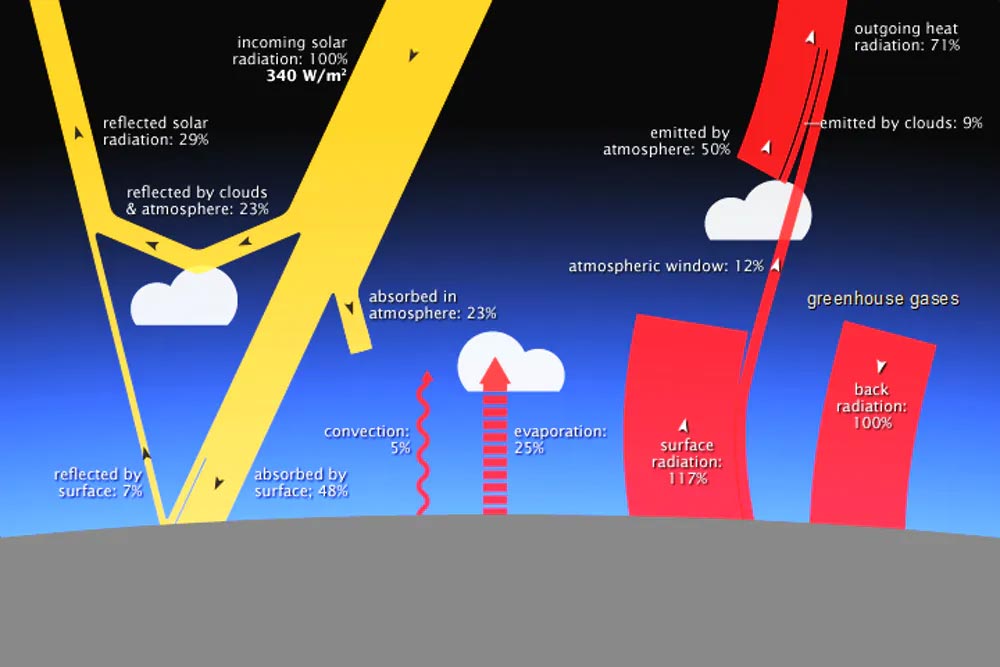
Earth constantly receives energy from the sun and radiates it back into space. For the planet’s temperature to remain constant, the net heat it receives from the sun must be balanced by outgoing heat that it gives off.
Since the sun is hot, it gives off energy in the form of shortwave radiation at mainly ultraviolet and visible wavelengths. Earth is much cooler, so it emits heat as infrared radiation, which has longer wavelengths.
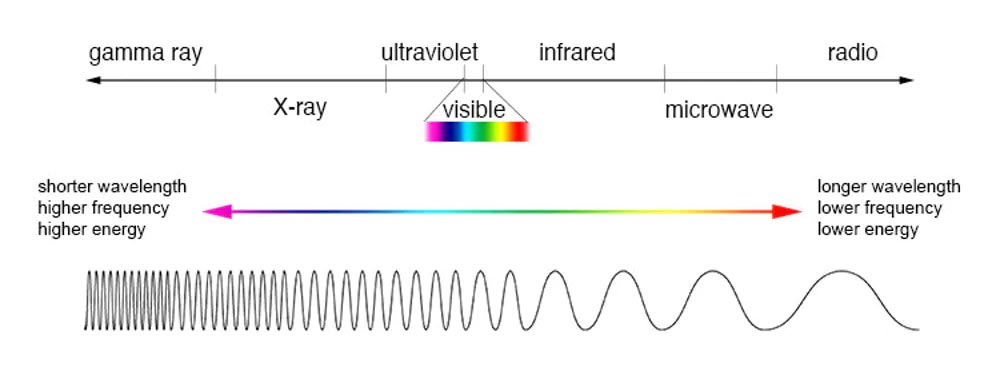
Carbon dioxide and other heat-trapping gases have molecular structures that enable them to absorb infrared radiation. The bonds between atoms in a molecule can vibrate in particular ways, like the pitch of a piano string. When the energy of a photon corresponds to the frequency of the molecule, it is absorbed and its energy transfers to the molecule.
Carbon dioxide and other heat-trapping gases have three or more atoms and frequencies that correspond to infrared radiation emitted by Earth. Oxygen and nitrogen, with just two atoms in their molecules, do not absorb infrared radiation.
Most incoming shortwave radiation from the sun passes through the atmosphere without being absorbed. But most outgoing infrared radiation is absorbed by heat-trapping gases in the atmosphere. Then they can release, or re-radiate, that heat. Some returns to Earth’s surface, keeping it warmer than it would be otherwise.
Research on heat transmission
During the Cold War, the absorption of infrared radiation by many different gases was studied extensively. The work was led by the U.S. Air Force, which was developing heat-seeking missiles and needed to understand how to detect heat passing through air.
This research enabled scientists to understand the climate and atmospheric composition of all planets in the solar system by observing their infrared signatures. For example, Venus is about 870 F (470 C) because its thick atmosphere is 96.5% carbon dioxide.
It also informed weather forecast and climate models, allowing them to quantify how much infrared radiation is retained in the atmosphere and returned to Earth’s surface.
People sometimes ask me why carbon dioxide is important for climate, given that water vapor absorbs more infrared radiation and the two gases absorb at several of the same wavelengths. The reason is that Earth’s upper atmosphere controls the radiation that escapes to space. The upper atmosphere is much less dense and contains much less water vapor than near the ground, which means that adding more carbon dioxide significantly influences how much infrared radiation escapes to space.
Carbon dioxide levels rise and fall around the world, changing seasonally with plant growth and decay.
Observing the greenhouse effect
Have you ever noticed that deserts are often colder at night than forests, even if their average temperatures are the same? Without much water vapor in the atmosphere over deserts, the radiation they give off escapes readily to space. In more humid regions radiation from the surface is trapped by water vapor in the air. Similarly, cloudy nights tend to be warmer than clear nights because more water vapor is present.
The influence of carbon dioxide can be seen in past changes in climate. Ice cores from over the past million years have shown that carbon dioxide concentrations were high during warm periods – about 0.028%. During ice ages, when the Earth was roughly 7 to 13 F (4-7 C) cooler than in the 20th century, carbon dioxide made up only about 0.018% of the atmosphere.
Even though water vapor is more important for the natural greenhouse effect, changes in carbon dioxide have driven past temperature changes. In contrast, water vapor levels in the atmosphere respond to temperature. As Earth becomes warmer, its atmosphere can hold more water vapor, which amplifies the initial warming in a process called the “water vapor feedback.” Variations in carbon dioxide have therefore been the controlling influence on past climate changes.
Small change, big effects
It shouldn’t be surprising that a small amount of carbon dioxide in the atmosphere can have a big effect. We take pills that are a tiny fraction of our body mass and expect them to affect us.
Today the level of carbon dioxide is higher than at any time in human history. Scientists widely agree that Earth’s average surface temperature has already increased by about 2 F (1 C) since the 1880s, and that human-caused increases in carbon dioxide and other heat-trapping gases are extremely likely to be responsible.
Without action to control emissions, carbon dioxide might reach 0.1% of the atmosphere by 2100, more than triple the level before the Industrial Revolution. This would be a faster change than transitions in Earth’s past that had huge consequences. Without action, this little sliver of the atmosphere will cause big problems.
Written by Jason West, Professor of Environmental Sciences and Engineering, University of North Carolina at Chapel Hill.
Jason West receives funding from the EPA, NASA, NSF, the Donald and Jennifer Holzworth Faculty Acceleration Fund in Climate Change, and the State of North Carolina.
Adapted from an article originally published on The Conversation. 
Never miss a breakthrough: Join the SciTechDaily newsletter.
Follow us on Google and Google News.
27 Comments
Climate change is a normal phenomenon governed by solar activity, the moon’s gravitational effect,the jet stream and many other complex factors. CO2 had nothing to do with this. Man made climate change does not exist.(4 percent man-made of 0.04 in nature is irrelevant). To spend a trillion dollars a year on a fictitious fraudulent conclusions from IPCC models is insane. We need more CO2 to encourage the greening of the planet and better crop yields. Just follow the IPCC money grants to isolate the beneficiaries of their corrupt modelling. Greta is barking up the wrong tree like Al Gore. Pity David Attenborough is too old to correct his stance. MAN-MADE CLIMATE CHANGE DOES NOT EXIST.
Have you actually read this article? PUTTING THINGS IN CAPS DOESN’T MAKE THEM TRUE.
You must have known this as well.
“Century-scale changes in the Earth’s magnetic field have a signifcant effect on the upper atmosphere (100-500 km altitude). These are at least as important as changes associated with the increase in greenhouse gas concentrations over the past century, which was previously thought to be the main driver of climate change in the upper atmosphere. Simulations with a whole-atmosphere chemistry-climate model, extending from the surface up to 500 km altitude, demonstrate that magnetic field changes even affect the climate in the middle atmosphere (15-100 km altitude), and regionally also in the troposphere, near the surface.
The Earth’s magnetic field further plays an important role in creating climatic differences between the polar Northern and Southern upper atmosphere.”
https://gtr.ukri.org/projects?ref=NE%2FJ018058%2F1
First 2 comments by deniers, or maybe nlp bots financed by oil companies or Russia.
Both have been found to run disinformation bot farms.
The above comment by an SJW no doubt comes from a nlp bot financed by the Chinese government. Their goal is to change US economic policy to their advantage.
Lol, you said it! I always wondered how the U.S. was the “great Satan of Earth-destroying emissions and therefore must PAY BIG MONEY for climate initiatives & force it’s people into austerity for the sake of saving da planiiit!!” when actually America and Europe are some of the cleanest on energy whilst China is one of the biggest polluters not only of air but water.
Reading the article, there were some elements which seemed to follow some logic and consensus but I’ve always wondered, if “water vapor” seems to be the most abundant greenhouse gas and apparently it’s said to be the biggest issue here which seems to be “exacerbated by CO2 concentrations”, then WHY have we for decades been “equipping MILLIONS of our automobiles with devices which convert combustion gases/unburnt fuel into CO2 and water vapor” – catalytic converters some vehicles having up to 4 such converters…. So with “water vapor/CO2” being so “awful”, why did the “environmental protectors” devise a device to do nothing but “spit” CO2 and water vapor into the atmosphere, if it’s so “harmful” because there’s such an “overabundance” of it…. Some other items are not well-answered by the article either.
Everyone has opinions — even those who are logic impaired. Do you have any citations to support your conspiracy theory claims?
I just read a scientific paper that says the upper atmosphere is cooling dramatically. So I guess your analysis is pushing the IPCC stance and nothing more.
The CO2 level of earth during the most prosperous, biodiverse, Green, life-thriving time on earth was 4,000 to 6,000 ppm. There was Far more GREEN then, far more species, and ZERO EVIDENCE of runaway warming, even at 10x-15x today’s meager near-suffocation levels. To the contrary, we slipped into an ice age.
How are we on the verge of burn-up disaster at a tenth of a tank of ‘gas’, when we fell into ICE AGES at a full tank?
Ridiculous.
The CO2 warming models have failed, and this guy is deeply concerned about the end of the world (of grants) that will surely come to an end if we don’t feed the pigs & fill the climate trough! He he he.
HAPPY THANKSGIVING !
THANK GOD for the current warming period, the current climate Optimum, and for increased CO2, resulting in a massive 15% increased GREENING of the earth.
So much to be THANKFUL for!
If only we could get it from 400 ppm up to an abundant food-supplying 1500 ppm CO2… The gas of life, the food of photosynthesis.
🙂
All true.
Goes hand in hand with history where people in Norway walked over the high mountains on dry land from innland to the west coast during the time of mid winter during the medieval times. No snow at all. Also makes one think of Piri Reis’ map which shows dry land on the south pole. Being aware of significantly warmer periods not too long ago puts things into perspective.
“Piri Reis map is a world map compiled in 1513 by the Ottoman admiral and cartographer Piri Reis. ”
“Some authors have noted visual similarities to parts of the Americas not officially discovered by 1513, but there is no textual or historical evidence that the map represents land south of present-day Cananéia. A disproven 20th-century hypothesis identified the southern landmass with an ice-free Antarctic coast.”
“In 1773, James Cook and his crew crossed the Antarctic Circle for the first time. Although he discovered new islands, he did not sight the continent itself. It is believed that he came as close as 240 km (150 mi) from the mainland. ”
All above from Wiki and easily found in three minutes.
“Being aware of significantly warmer periods not too long ago puts things into perspective.”
The reality:
“The continent we now consider the coldest and most inhospitable on Earth was not always a frozen desert. In fact, Antarctica’s permanent ice cover only began forming relatively late in its geological history. Eric Wolff, a paleoclimatologist at the University of Cambridge, points to around 34 million years ago as the pivotal moment when ice started its dominance over the southernmost landmass.”
Ref:
https://curiosmos.com/antarcticas-ice-free-past-when-did-it-last-happen/
34million years may be “not too long ago” in geological time, but I suspect there’s not many humans old enough to remember standing on a snow and ice free Antarctica,
Strange, water vapor is more than one full percent of the atmosphere 25 times the amount of CO2 with 20 times the effect. So, how does CO2 overcome the 500 pound gorilla effect of H2O?
Plants love the extra CO2. Up to 1600ppm. 400ppm is dangerously low. Plants need a minimum of 150ppm just to survive. It’s easy to tell this guy is manipulating you. The overwhelming number of graphs and charts meant to confuse you and make him look smart. If you look in the past, CO2 levels have always followed temp increases. Submarine crews do just fine with CO2 levels at 4000ppm. AOCs former Chief of staff outed the Democrats that The Green New Deal has nothing to do with climate change.
NASA says all the extra CO2 in the air is greening our country. Remember in the 1970s they said the earth would freeze over. 30 years later it’s Global Warming. Now, they call it Climate Change. It’s all about easy money. Knowledge is power. Don’t give in to the fear mongering of politicians.
https://noqreport.com/2019/07/12/saikat-chakrabarti-green-new-deal-isnt-climate-change/
https://www.naturalnews.com/2019-04-26-nasa-declares-carbon-dioxide-is-greening-the-earth.html
https://principia-scientific.org/evidence-co2-is-not-a-greenhouse-gas/
Why worry about 2100? According to that deranged girl, we’ll all be dead in ten years. Live it up!
lol right
If CO2 is so great at trapping heat, why don’t we see industrial processes using it? I understand how greenhouses work. How does a gas create a greenhouse effect since there is no structure?
How do greenhouse gasses trap ‘some’ of the reflected heat but return 100% as back radiation as per the Energy Budget graphic? I thought that molecules like CO2 emit absorbed Infrared radiation in all directions, not just downwards? Surely, the amount of back radiation has to be less than 50% per particle unless there is another process, unidentified in the graphic, at work?
Yes, we should then make more CO2, for better plant growth hey? Or just plant more trees, perhaps?
Dear Climate Warming deniers, please state your educational achievements. If you don’t have a PhD in Meteorology or a science degree related to climate change AND if you are not currently working at a university, NASA, or other bonafide institutions then spare us your Bulls#!t !
iwarming.i have a degree in chemical engineering with additional studies in advanced engineering mathematics.
Global warming from man’s activities is so minimal as to be ignored.
People don’t need a degree in anything or work at a certain place in order to be educated and have a valid opininon or stating facts. Facts is facts, no matter who you are.
@KeenanSheattle, dear SCIENCE denier, take your theories and try a debate with the likes of doctors like Lindzen, Soon, Michaels, Legates, Curry, Singer, Christie, Spencer, Shaviv, Idso, and a few thousand others that say that they see no problems for humanity. I don’t think you will.
How come Google search doesn’t yield any results for oxygen levels in polluted cities…. Surely toxicity by the multiple gas emissions are more tangible and CO2 concerns …..in any case plant one tree per person on the planet and see the problem disappear….. Oil era is anyways disappearing thanks to electric cars
The atmosphere is not a homogenous gas. When CO2 is added to the atmosphere by car exhaust from thousands of cars in a city it takes years to diffuse into the earth’s atmosphere. That means that local CO2 concentrations in major cities are 50 to 100 times greater than the surrounding countryside. Yet, cities are generally only 2 to 3 degrees warmer than the surrounding areas, and most of that warming can be attributed to the abundance of steel, concrete, asphalt and the heat generated by burning fossil fuels.
Global warming is not a concequence of an increase in atmospheric CO2 but rather the cause of the increased CO2 in the earth’s atmosphere.
Here’s how it works. Increased solar activity, or some other cause increases the earth’s average temperature. The oceans hold large amounts of CO2 gas. Since the oceans are much denser than the air it takes them much longer to heat up. Cooler fluids can hold less dissolved solids and more dissolved gases. As the oceans warm, the dissolved gases, including CO2, are released from the water into the atmosphere. It takes 300 to 800 years for the oceans to warm up during a warming period. There is, therefore, a 300 to 800 year lag between the beginning of a warming period and the observed increase in atmospheric CO2. The ice core records support this explaination of the close correlation between global warming and atmospheric CO2.
What the scientifically illiterate masses are being told is backwards. An increase in atmospheric CO2 is a consequence of global warming and not the cause of global warming.
I think Roy Spencer has a good stance on this, meteorology is not an easy subject & our university lecturer got confused himself; nevertheless having studied the subject of Climate Change as long as the IPCC mascot doom pixie Greta has been alive I currently consider this is another good explanation:
http://www.drroyspencer.com/global-warming-101
Any of you without at least a degree or background in Physics/Engineering theory may not get to grip with all the concepts and this exposes your confirmation bias approach based on what you’ve read which mainly alarmism that seems to be used to promote Climate as a problem rather than dealing with real problems we can actually solve such as human poverty, animal exploitation, plastic pollution of seas, litter of the countryside (I collect 2 to 3 bags of rubbish per day in a mile’s radius to where I live!).
Even if CO2 were a problem there is nothing we can do as without fossil fuels we are back in the middle to stone ages; there is no magic replacement for Coal, Oil, Gas, Nuclear, and even so called renewables need these to be manufactured.
See Roy site: http://www.drroyspencer.com/global-warming-101/
P.S. Do not use Denier word it shows you have no logic other than Ad Hominen attacking.
What effect does the (HAARP) program have on this subject by shooting who really knows what into the ionosphere. They say they are blocking the suns rays but wouldn’t blocking them from letting heat in past the ionosphere also prevent whatever energy that does get passed their so called blocker. Wouldn’t it now be blocked in between the ionosphere and surface of earth as well creating even more of a warming effect???