
Scientists at MIT have discovered a “hidden flux” of material deep in the Earth’s mantle that would make the planet’s overall composition more similar to that of meteorites, supporting the theory that Earth arose from the collision of asteroids.
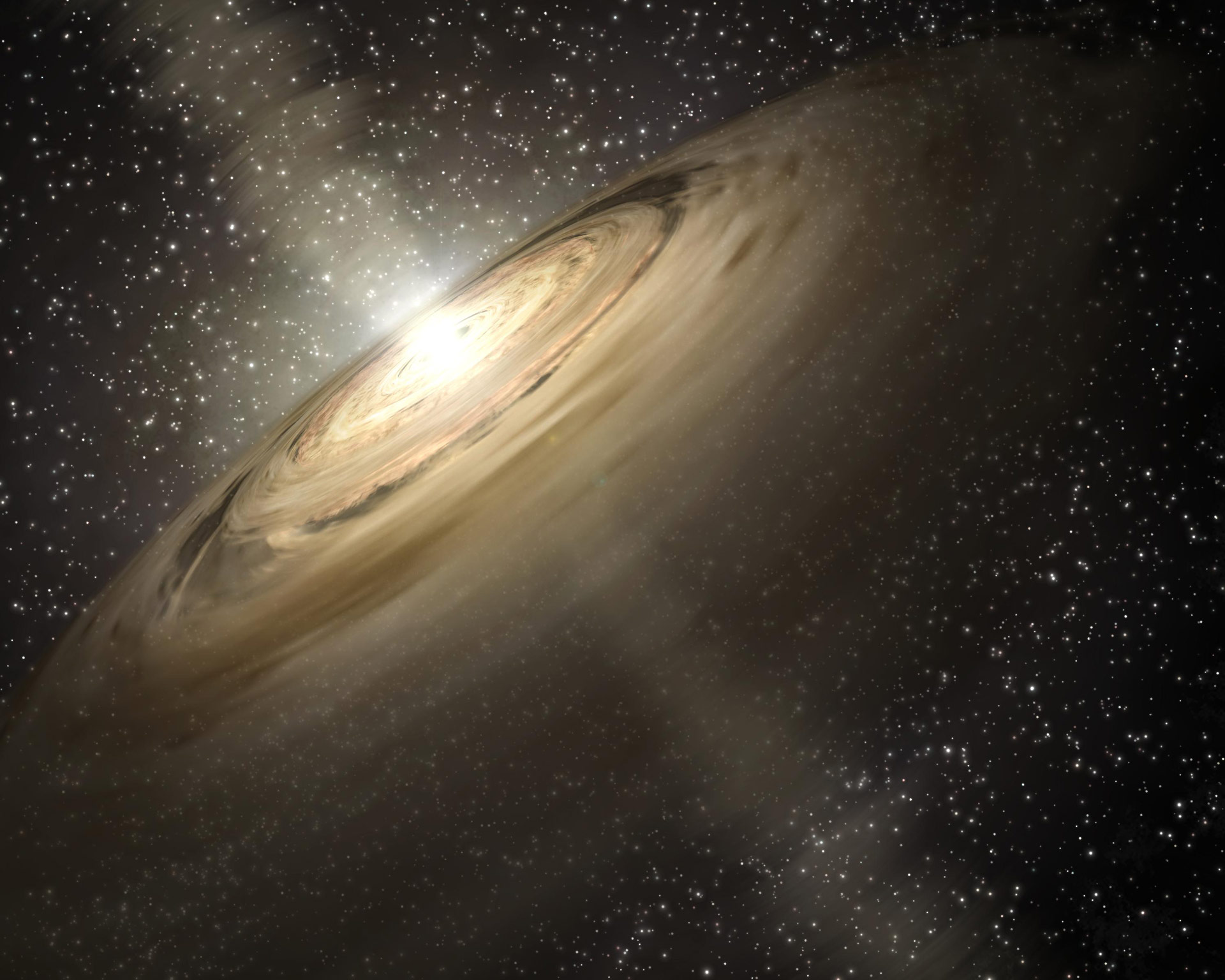
It’s widely thought that the Earth arose from violent origins: Some 4.5 billion years ago, a maelstrom of gas and dust circled in a massive disc around the sun, gathering in rocky clumps to form asteroids. These asteroids, gaining momentum, whirled around a fledgling solar system, repeatedly smashing into each other to create larger bodies of rubble — the largest of which eventually cooled to form the planets.
Countless theories, simulations, and geologic observations support such a scenario. But there remains one lingering mystery: If the Earth arose from the collision of asteroids, its composition should resemble that of meteoroids, the small particles that break off from asteroids.
But to date, scientists have found that, quite literally, something doesn’t add up: Namely, the Earth’s mantle — the layer between the planet’s crust and core — is missing an amount of lead found in meteorites whose composition has been analyzed following impact with the Earth.
Much of the Earth is composed of rocks with a high ratio of uranium to lead (uranium naturally decays to lead over time). However, according to standard theories of planetary evolution, the Earth should harbor a reservoir of mantle somewhere in its interior that has a low ratio of uranium to lead, to match the composition of meteorites. But such a reservoir has yet to be discovered — a detail that leaves Earth’s origins hazy.
Now researchers in MIT’s Department of Earth, Atmospheric and Planetary Sciences have identified a “hidden flux” of material in the Earth’s mantle that would make the planet’s overall composition much more similar to that of meteorites. This reservoir likely takes the form of extremely dense, lead-laden rocks that crystallize beneath island arcs, strings of volcanoes that rise up at the boundary of tectonic plates.
As two massive plates push against each other, one plate subducts, or slides, under the other, pushing material from the crust down into the mantle. At the same time, molten material from the mantle rises up to the crust, and is ejected via volcanoes onto the Earth’s surface.
According to the MIT researchers’ observations and calculations, however, up to 70 percent of this rising magma crystallizes into dense rock—dropping, leadlike, back into the mantle, where it remains relatively undisturbed. The lead-heavy flux, they say, puts the composition of the Earth’s mantle on a par with that of meteorites.
“Now that we know the composition of this flux, we can calculate that there’s tons of this stuff dropping down from the base of the crust into the mantle, so it is likely an important reservoir,” says Oliver Jagoutz, an assistant professor of geology at MIT. “This has a lot of implications for understanding how the Earth evolved through history.”
Jagoutz and his colleague Max Schmidt, of the Swiss Federal Institute of Technology in Zurich, have detailed their results in a paper published in Earth and Planetary Science Letters.
A mantle exposed
Measuring the composition of material that has dropped into the mantle is a nearly impossible task. Jagoutz estimates that such dense rocks would form at a depth of 40 to 50 kilometers (25 to 31 miles) below the surface, beyond the reach of conventional sampling techniques.
There is, however, one place on earth where such a depth of the crust and mantle is exposed: a region of northern Pakistan called the Kohistan arc. Forty million years ago, this island arc was crushed between India and Asia as the two plates collided.
“When India came in, it slammed into the arc, and the arc extended and rotated itself,” Jagoutz says. “Because of that, we now have a cross-section of the mantle-to-crust transition. This is the only place on Earth where this exists.”
On various trips from 2000 to 2007, Jagoutz trekked through the Kohistan arc region, collecting rocks from various parts of the arc’s crust and mantle. Bringing them back to the lab, he analyzed the rocks’ density and composition, discovering that some were “density-unstable” — much denser than the mantle. These denser rocks could potentially sink into the mantle, creating a hidden reservoir.
Adding up to an asteroid origin
The researchers measured the rocks’ composition, and found that the denser rocks contained much more lead than uranium — exactly the ratio predicted for the missing reservoir of material. Jagoutz then performed a mass balance (a simple conservation-of-mass calculation) to determine how much dense rock drops into the mantle, based on the composition of the region’s crust, rocks, and mantle: Essentially, the mass of the Kohistan arc, minus whatever material drops into the mantle, should equal the material that comes out of the mantle.
Jagoutz and Schmidt solved the equation for 10 common elements. From their calculations, they found that 70 percent of the magma that rises from the mantle must ultimately drop back down, relatively heavy with lead. Applying this statistic to other island arcs in the world — such as the Andean volcanic belt and the Cascade Range — they found that the amount of material dropped into the mantle globally equals the composition and quantity of the so-called missing reservoir — a finding that suggests that Earth did indeed form from the collision of meteorites.
Bruce Buffett, a professor of earth and planetary science at the University of California at Berkeley, says a hidden reservoir in the mantle made of dense rocks is “interesting and plausible,” though he points out that there are other competing theories. For example, the subduction of oceanic crust into the mantle may contribute to unknown material. Likewise, material may form from the cooling and solidifying of a large magma ocean.
“There are a large variety of options on the table to explain the complex structure we detect seismically at the bottom of the mantle,” says Buffett, who was not involved in the study. “The attractive aspect of [Jagoutz’s] idea is that it has testable consequences. This is how progress is made.”
“If we are right, one of the questions we have is: Why is the Earth capable of hiding something from us? Why is there never a volcano that brings up these rocks?” Jagoutz adds. “You’d think it’d come back up, but it doesn’t. It’s actually interesting.”
Reference: “The composition of the foundered complement to the continental crust and a re-evaluation of fluxes in arcs” by O. Jagoutz and M. W. Schmidt, 20 May 2012, Earth and Planetary Science Letters.
DOI: 10.1016/j.epsl.2013.03.051
Never miss a breakthrough: Join the SciTechDaily newsletter.
Follow us on Google and Google News.