
Kyoto-Hawai’i team reveals results of study from Ryugu samples.
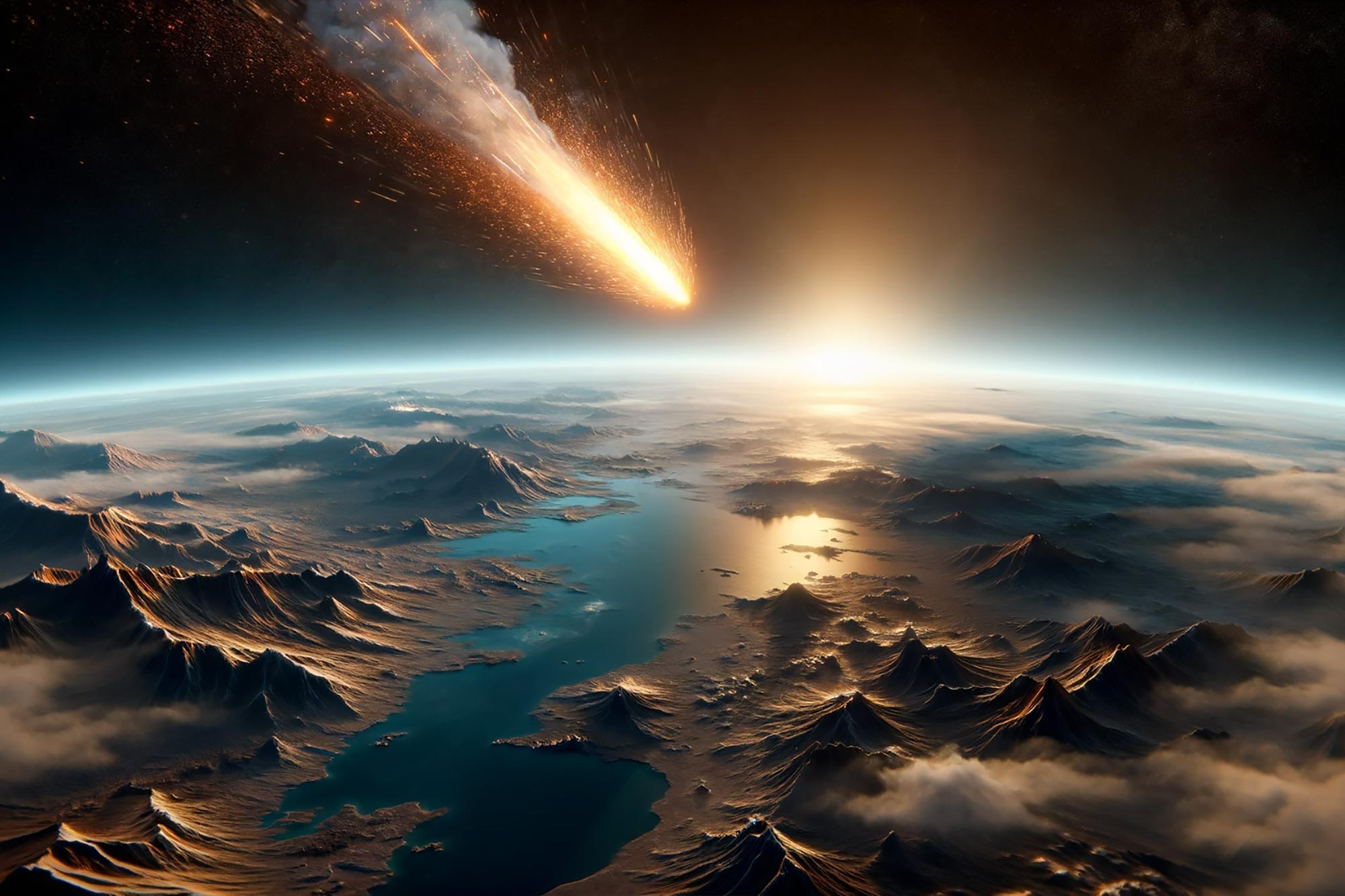
Micrometeorites originating from icy celestial bodies in the outer Solar System may be responsible for transporting nitrogen to the near-Earth region in the early days of our solar system. That discovery was published recently in Nature Astronomy by an international team of researchers, including University of Hawai’i at Manoa scientists, led by Kyoto University.
Nitrogen compounds, such as ammonium salts, are abundant in material born in regions far from the sun, but evidence of their transport to Earth’s orbital region had been poorly understood.
Nitrogen Compounds As Building Blocks for Life
“Our recent findings suggest the possibility that a greater amount of nitrogen compounds than previously recognized was transported near Earth, potentially serving as building blocks for life on our planet,” says Hope Ishii, study co-author and affiliate faculty at the Hawai’i Institute of Geophysics and Planetology in the UH Manoa School of Ocean and Earth Science and Technology (SOEST).
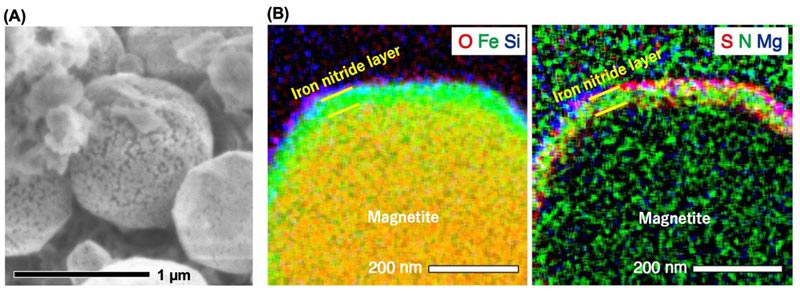
(B) A cross-section image of the round magnetite. The distribution of elements is shown by RGB composite image of oxygen (red), iron (green), and silicon (blue) on the left and that of sulfur (red), nitrogen (green), and magnesium (blue) on the right. A layer rich in iron and nitrogen is observed on the surface (shown in green). Iron nitride covers a thickness of just a few tens of nanometers on the very surface of magnetite.
Credit: KyotoU/Toru Matsumoto
Analysis of Asteroid Ryugu
Like all asteroids, Ryugu is a small, rocky object that orbits the sun. The Japan Aerospace Exploration Agency’s Hayabusa2 spacecraft explored Ryugu and brought material from its surface back to Earth in 2020. This intriguing asteroid is rich in carbon and has undergone significant space weathering caused by micrometeorite collisions and exposure to charged ions streaming from the sun.
In this study, the scientists aimed to discover clues about the materials arriving near Earth’s orbit, where Ryugu is currently located, by examining the evidence of space weathering in Ryugu samples. Using an electron microscope, they found that the surface of the Ryugu samples are covered with tiny minerals composed of iron and nitrogen (iron nitride: Fe4N).
Micrometeorites and Iron Nitride Formation
“We proposed that tiny meteorites, called micrometeorites, containing ammonia compounds were delivered from icy celestial bodies and collided with Ryugu,” said Toru Matsumoto, lead author of the study and assistant professor at Kyoto University. “The micrometeorite collisions trigger chemical reactions on magnetite and lead to the formation of the iron nitride.”
The iron nitride was observed on the surface of magnetite, which consists of iron and oxygen atoms. When magnetite is exposed to the space environment, oxygen atoms are lost from the surface by the irradiation of hydrogen ions from the sun (solar wind) and by heating through micrometeorite impact. These processes form metallic iron on the very surface of the magnetite, which readily reacts with ammonia, creating ideal conditions for synthesis of iron nitride.
Reference: “Influx of nitrogen-rich material from the outer Solar System indicated by iron nitride in Ryugu samples” by Toru Matsumoto, Takaaki Noguchi, Akira Miyake, Yohei Igami, Mitsutaka Haruta, Yusuke Seto, Masaaki Miyahara, Naotaka Tomioka, Hikaru Saito, Satoshi Hata, Dennis Harries, Aki Takigawa, Yusuke Nakauchi, Shogo Tachibana, Tomoki Nakamura, Megumi Matsumoto, Hope A. Ishii, John P. Bradley, Kenta Ohtaki, Elena Dobrica, Hugues Leroux, Corentin Le Guillou, Damien Jacob, Francisco de la Peña, Sylvain Laforet, Maya Marinova, Falko Langenhorst, Pierre Beck, Thi H. V. Phan, Rolando Rebois, Neyda M. Abreu, Jennifer Gray, Thomas Zega, Pierre-M. Zanetta, Michelle S. Thompson, Rhonda Stroud, Kate Burgess, Brittany A. Cymes, John C. Bridges, Leon Hicks, Martin R. Lee, Luke Daly, Phil A. Bland, Michael E. Zolensky, David R. Frank, James Martinez, Akira Tsuchiyama, Masahiro Yasutake, Junya Matsuno, Shota Okumura, Itaru Mitsukawa, Kentaro Uesugi, Masayuki Uesugi, Akihisa Takeuchi, Mingqi Sun, Satomi Enju, Tatsuhiro Michikami, Hisayoshi Yurimoto, Ryuji Okazaki, Hikaru Yabuta, Hiroshi Naraoka, Kanako Sakamoto, Toru Yada, Masahiro Nishimura, Aiko Nakato, Akiko Miyazaki, Kasumi Yogata, Masanao Abe, Tatsuaki Okada, Tomohiro Usui, Makoto Yoshikawa, Takanao Saiki, Satoshi Tanaka, Fuyuto Terui, Satoru Nakazawa, Sei-ichiro Watanabe and Yuichi Tsuda, 30 November 2023, Nature Astronomy.
DOI: 10.1038/s41550-023-02137-z
Never miss a breakthrough: Join the SciTechDaily newsletter.
Follow us on Google and Google News.