
Close Menu
    Facebook X (Twitter) Instagram
    SciTechDaily
    • Biology
    • Chemistry
    • Earth
    • Health
    • Physics
    • Science
    • Space
    • Technology
    Facebook X (Twitter) Pinterest YouTube RSS
    SciTechDaily
    Home»Space»Exploring Comet Thermal History: Observing a Burnt-Out Comet Covered With Talcum Powder
    Space

    Exploring Comet Thermal History: Observing a Burnt-Out Comet Covered With Talcum Powder

    By National Institutes of Natural SciencesMay 10, 2021No Comments3 Mins Read
    Facebook Twitter Pinterest Telegram LinkedIn WhatsApp Email Reddit
    Share
    Facebook Twitter LinkedIn Pinterest Telegram Email Reddit
    Observing a Comet in Thermal Infrared Wavelengths
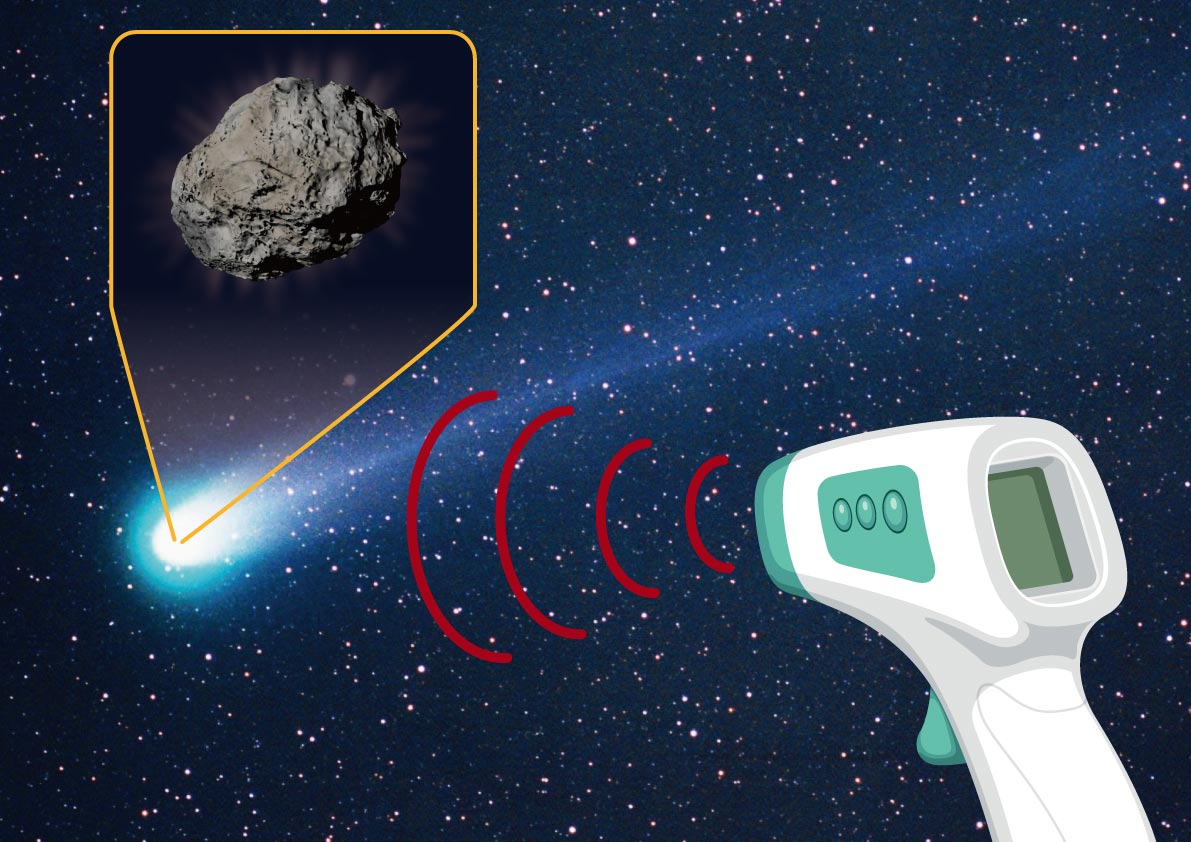
    Conceptual image. By observing a comet in thermal infrared wavelengths, the same wavelengths used by noncontact thermometers, it is possible to determine not only its current temperature, but also the surface composition of the nucleus which contains information about the thermal history of the comet. Credit: Kyoto Sangyo University

    Astronomers discovered talc-like minerals on Comet P/2016 BA14, shedding light on the thermal history and aging process of comets.

    The world’s first ground-based observations of the bare nucleus of a comet nearing the end of its active life revealed that the nucleus has a diameter of 800 meters (2,600 ft) and is covered with large grains of phyllosilicate; on Earth large grains of phyllosilicate are commonly available as talcum powder. This discovery provides clues to piece together the history of how this comet evolved into its current burnt-out state.

    Comet nuclei are difficult to observe because when they enter the inner Solar System, where they are easy to observe from Earth, they heat up and release gas and dust which form a coma obscuring the nuclei. When Comet P/2016 BA14 (PANSTARRS) was discovered in January 2016 it was first mistaken for an asteroid, but subsequent observations revealed weak cometary activity. It is believed that after many trips through the inner Solar System, this comet has burnt off almost all of its ice and is now nearing the end of its cometary life.

    On March 22, 2016, this comet passed within 3.6 million kilometers (2.2 million miles) of Earth, only 9 times farther than the Moon. A team of astronomers from the National Astronomical Observatory of Japan (NAOJ) and Koyama Astronomical Observatory of Kyoto Sangyo University used this unique opportunity to observe the comet with the Subaru Telescope about 30 hours before its closest approach to Earth. They successfully observed the nucleus with minimal interference from dust grains in the coma. Previously, the surface composition of a cometary nucleus has only been observed by a few “in-situ” observations by space missions.

    Clues to a Hotter Past Orbit

    Because the team observed thermal infrared radiation, the same region of the infrared used by contactless thermometers, they were able to find evidence that the nucleus is 800 meters in diameter and covered with organic molecules and large grains of phyllosilicate. This is the first time hydrous silicate minerals such as talc have been found in a comet. Comparison with laboratory measurements of various minerals revealed that the hydrous silicate minerals on the surface of P/2016 BA14 have been heated to more than about 330 degrees Celsius (626 degrees Fahrenheit) in the past. Since the surface temperature of P/2016 BA14 cannot reach higher than about 130 degrees Celsius (266 degrees Fahrenheit) in its current orbit, the comet may have been in an orbit closer to the Sun in the past.

    The next question is whether comets are covered with talcum powder from the start or if they develop over time as they burn out. “This result provides us a precious clue to study the evolution of comets.” comments Dr. Takafumi Ootsubo, the lead author of this research, “We believe that further observations of the comet nuclei will enable us to learn more about the evolution of comets.”

    The target of this research, P/2016 BA14, is a potential backup target for the Comet Interceptor mission, a comet exploration mission being carried out by the ESA and JAXA.

    Reference: “Mid-infrared observations of the nucleus of Comet P/2016 BA14 (PANSTARRS)” by Takafumi Ootsubo, Hideyo Kawakita and Yoshiharu Shinnaka, 15 March 2021, ICARUS.
    DOI: 10.1016/j.icarus.2021.114425

    Never miss a breakthrough: Join the SciTechDaily newsletter.
    Follow us on Google and Google News.

    Astronomy Astrophysics Comet National Institutes of Natural Sciences
    Share. Facebook Twitter Pinterest LinkedIn Email Reddit

    Related Articles

    Second Alignment Plane of Solar System Discovered After Accounting for Galactic Gravity

    NASA Preparing for Comet Siding Spring’s “Close” Flyby of Mars

    Comet-Like Activity Discovered in Near-Earth Object Don Quixote

    ‘Lazarus Comets’ Return to Life after Being Inactive for Millions of Years

    Astronomers Reveal the True Identity of Mysterious Centaurs

    Comet ISON’s Journey Toward the Sun

    NASA’s Swift Helps Astronomers Get a Closer Look at Comet ISON

    Trillions of Comet Collisions Explain 17-Year-Old Stellar Mystery

    Trajectory Models of Refractory Particles Help Solve Two Solar System Puzzles

    Leave A Reply Cancel Reply

    • Facebook
    • Twitter
    • Pinterest
    • YouTube

    Don't Miss a Discovery

    Subscribe for the Latest in Science & Tech!

    Trending News

    Millions Take These IBS Drugs, But a New Study Finds Serious Risks

    Scientists Unlock Hidden Secrets of 2,300-Year-Old Mummies Using Cutting-Edge CT Scanner

    Bread Might Be Making You Gain Weight Even Without Eating More Calories

    Scientists Discover Massive Magma Reservoir Beneath Tuscany

    Europe’s Most Active Volcano Just Got Stranger – Here’s Why Scientists Are Rethinking It

    Alzheimer’s Symptoms May Start Outside the Brain, Study Finds

    Millions Take This Popular Supplement – Scientists Discover a Concerning Link to Heart Failure

    The Universe Is Expanding Too Fast and Scientists Can’t Explain Why

    Follow SciTechDaily
    • Facebook
    • Twitter
    • YouTube
    • Pinterest
    • Newsletter
    • RSS
    SciTech News
    • Biology News
    • Chemistry News
    • Earth News
    • Health News
    • Physics News
    • Science News
    • Space News
    • Technology News
    Recent Posts
    • Simple Blood Test May Predict Alzheimer’s Years Before Brain Scans Show Signs
    • Scientists Say Adding This Unusual Seafood to Your Diet Could Reverse Signs of Aging
    • U.S. Waste Holds $5.7 Billion Worth of Crop Nutrients
    • Scientists Say a Hidden Structure May Exist Inside Earth’s Core
    • Doctors Surprised by the Power of a Simple Drug Against Colon Cancer
    Copyright © 1998 - 2026 SciTechDaily. All Rights Reserved.
    • Science News
    • About
    • Contact
    • Editorial Board
    • Privacy Policy
    • Terms of Use

    Type above and press Enter to search. Press Esc to cancel.