
Close Menu
    Facebook X (Twitter) Instagram
    SciTechDaily
    • Biology
    • Chemistry
    • Earth
    • Health
    • Physics
    • Science
    • Space
    • Technology
    Facebook X (Twitter) Pinterest YouTube RSS
    SciTechDaily
    Home»Space»Mysterious Cosmic Tadpole: A Strange Gas Cloud Dances With a Colossal Black Hole
    Space

    Mysterious Cosmic Tadpole: A Strange Gas Cloud Dances With a Colossal Black Hole

    By National Astronomical Observatory of JapanApril 5, 2023No Comments2 Mins Read
    Facebook Twitter Pinterest Telegram LinkedIn WhatsApp Email Reddit
    Share
    Facebook Twitter LinkedIn Pinterest Telegram Email Reddit
    Tadpole Molecular Cloud
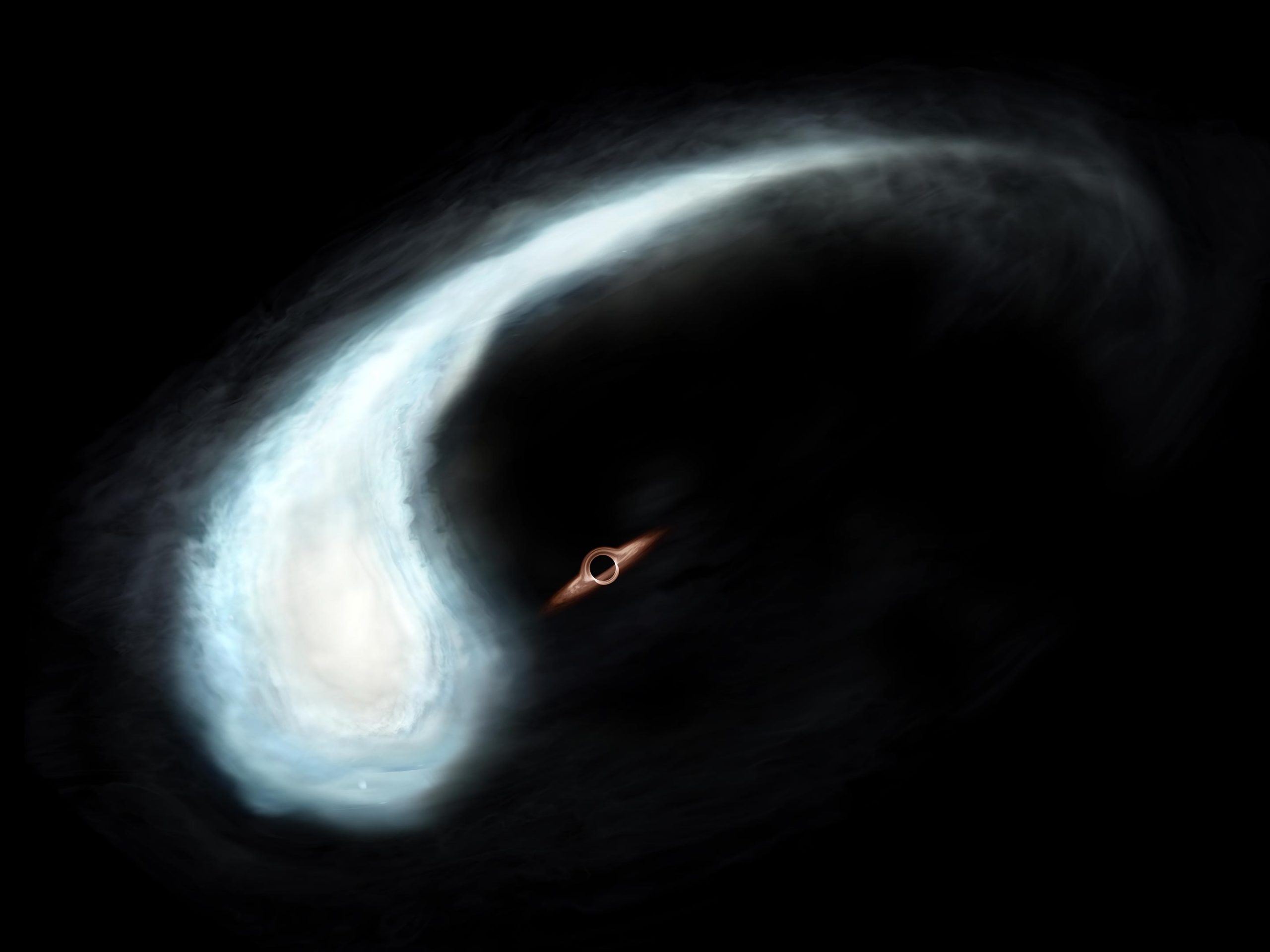
    Artist’s Impression of the “Tadpole” Molecular Cloud and the black hole at the gravitational center of its orbit. Credit: Keio University

    Researchers discovered an unusual gas cloud called the “Tadpole” potentially orbiting a massive black hole 100,000 times the mass of the Sun, and plan to use ALMA to search for signs of the black hole

    A peculiar cloud of gas, nicknamed the Tadpole due to its shape, appears to be revolving around a space devoid of any bright objects. This suggests that the Tadpole is orbiting a dark object, most likely a black hole 100,000 times more massive than the Sun. Future observations will help determine what is responsible for the shape and motion of the Tadpole.

    A team of Japanese researchers led by Miyuki Kaneko at Keio University used data from the James Clerk Maxwell Telescope, operated by the East Asian Observatory, and NAOJ’s Nobeyama 45-m Radio Telescope to identify an unusual cloud of gas about 27,000 light-years away in the constellation Sagittarius. The curved “Tadpole” shape of the molecular gas cloud strongly suggests that it is being stretched as it orbits around a massive compact object. The only problem is, at the center of the Tadpole’s orbit, there are no bright objects which could be massive enough to gravitationally hold the Tadpole. The best candidate for this massive compact invisible object is a black hole.

    Because black holes don’t emit light, the only way to detect them is when they interact with other objects. This leaves astronomers in the dark about just how many black holes, and with what range of masses, might be lurking in the Milky Way.

    Now the team plans to use ALMA (Atacama Large Millimeter/submillimeter Array) to search for faint signs of a black hole, or other object, at the gravitational center of the Tadpole’s orbit.

    Reference: “Discovery of the Tadpole Molecular Cloud near the Galactic Nucleus” by Miyuki Kaneko, Tomoharu Oka, Hiroki Yokozuka, Rei Enokiya, Shunya Takekawa, Yuhei Iwata and Shiho Tsujimoto, 10 January 2023, The Astrophysical Journal.
    DOI: 10.3847/1538-4357/aca66a

    Funding: Japan Society for the Promotion of Science

    Never miss a breakthrough: Join the SciTechDaily newsletter.
    Follow us on Google and Google News.

    Astronomy Astrophysics Black Hole NAOJ National Institutes of Natural Sciences Popular
    Share. Facebook Twitter Pinterest LinkedIn Email Reddit

    Related Articles

    Across Time and Space: Mysterious Star’s Epic Journey to Heart of Milky Way

    Cosmic Alchemy – New Findings Demonstrate That Supermassive Black Holes Alter Galactic Chemistry

    Cosmic Cradles and Graves: Tracing Life and Death of Stars in the Most Distant Galaxy

    Cosmic Shield: How Our Solar System Survived a Supernova

    Unknown Physics on the Cosmic Scale? 1000 Supernova Explosions Chart the Expansion History of the Universe

    Jets of Hot Gas Detected Blasting Out From Black Hole at the Heart of the Phoenix Galaxy Cluster

    Subaru Telescope Reveals Active Supermassive Black Holes in Merging Galaxies

    Intermediate-Mass Black Hole Candidates Discovered at the Center of the Milky Way

    Scientists Convene to Take a Picture of the Supermassive Black Hole at the Center of the Milky Way

    Leave A Reply Cancel Reply

    • Facebook
    • Twitter
    • Pinterest
    • YouTube

    Don't Miss a Discovery

    Subscribe for the Latest in Science & Tech!

    Trending News

    Scientists May Have Found the Key to Jupiter and Saturn’s Moon Mystery

    Scientists Uncover Brain Changes That Link Pain to Depression

    Saunas May Do More Than Raise Body Temperature – They Activate Your Immune System

    Exercise in a Pill? Metformin Shows Surprising Effects in Cancer Patients

    Hidden Oceans of Magma Could Be Protecting Alien Life

    New Study Challenges Alzheimer’s Theories: It’s Not Just About Plaques

    Artificial Sweeteners May Harm Future Generations, Study Suggests

    Splashdown! NASA Artemis II Returns From Record-Breaking Moon Mission

    Follow SciTechDaily
    • Facebook
    • Twitter
    • YouTube
    • Pinterest
    • Newsletter
    • RSS
    SciTech News
    • Biology News
    • Chemistry News
    • Earth News
    • Health News
    • Physics News
    • Science News
    • Space News
    • Technology News
    Recent Posts
    • Physicists Discover a Strange New Kind of One-Dimensional Particle
    • Scientists Discover Unexpected Climate Benefit Hidden in Forest Soils
    • The Grand Canyon’s “Swiss Cheese” Rocks Hold a Critical Secret
    • Scientists Discover 430,000-Year-Old Wooden Tools, Rewriting Human History
    • Scientists Make Breakthrough on 40-Year-Old 2D Physics Puzzle
    Copyright © 1998 - 2026 SciTechDaily. All Rights Reserved.
    • Science News
    • About
    • Contact
    • Editorial Board
    • Privacy Policy
    • Terms of Use

    Type above and press Enter to search. Press Esc to cancel.