
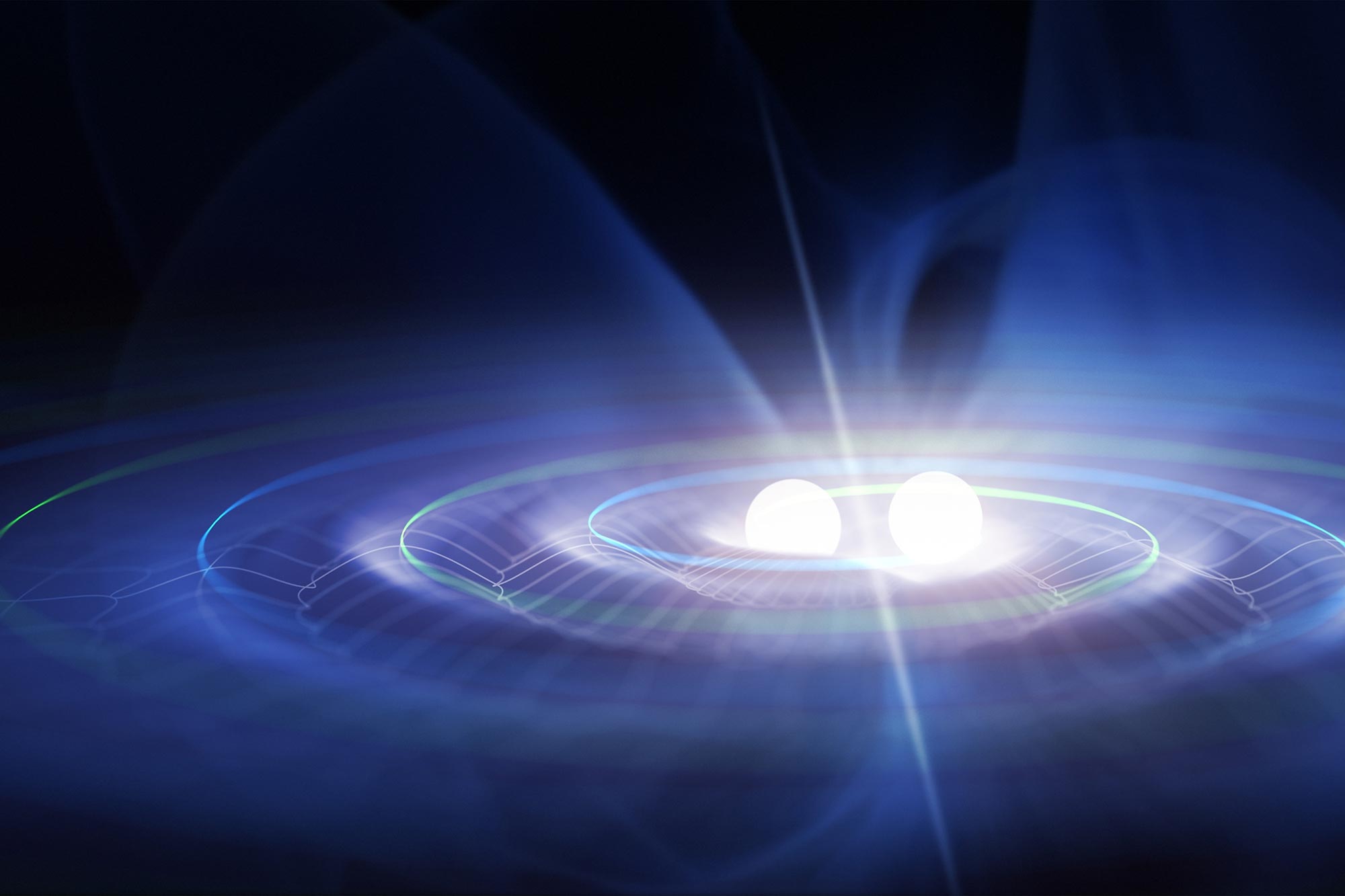
A new gravitational-wave catalogue reports 161 additional black hole mergers, bringing the total to 390 detections.
Scientists at the University of Glasgow’s Institute for Gravitational Research are celebrating the release of a major new collection of gravitational wave discoveries, a milestone that highlights the rapid growth of gravitational astronomy.
The latest Gravitational Wave Transient Catalogue (GWTC-5) was published online alongside scientific papers submitted to The Astrophysical Journal and The Astrophysical Journal Letters.
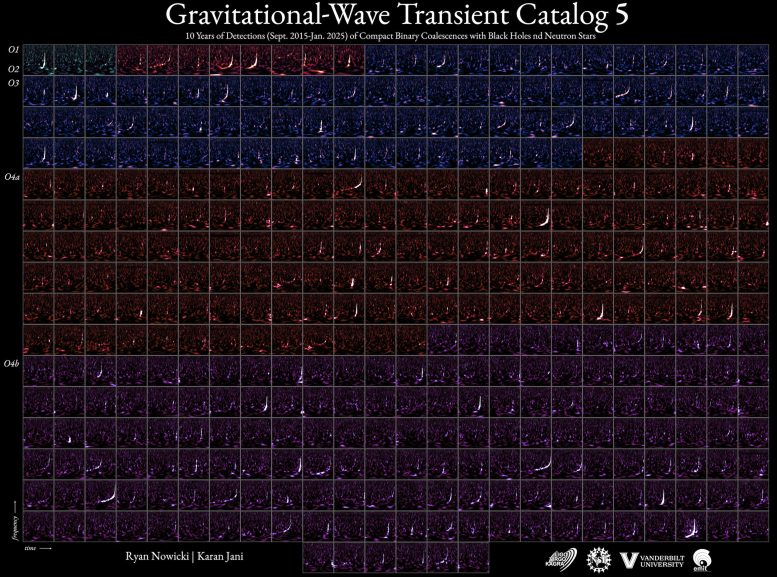
The catalog adds 161 newly identified signals from colliding black holes detected between April 2024 and January 2025 by the LIGO observatories in the United States, the Virgo detector in Italy, and the KAGRA detector in Japan. Together, these facilities make up the LVK Collaboration. With these additions, the total number of gravitational wave detections has risen to 390.
Among the most notable results are evidence for second-generation black holes, the most accurate sky location ever determined for a gravitational wave source, and the first successful measurement of three vibrational modes from a black hole.
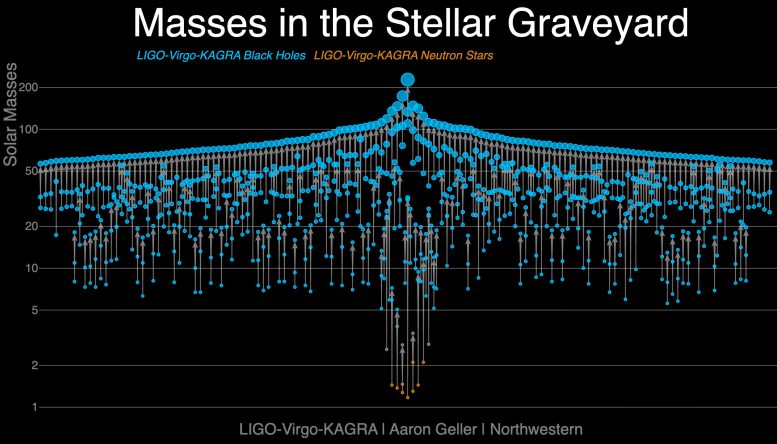
From First Detection to 390 Signals
Researchers at the University of Glasgow have been involved in gravitational wave science since the 1970s. They helped develop the highly sensitive mirror suspension systems used in the National Science Foundation’s Laser Interferometer Gravitational-wave Observatory (NSF LIGO), which are essential for detecting these tiny disturbances in space-time.
Since the first direct observation of gravitational waves in September 2015, Glasgow scientists have continued working with international LVK partners to improve both detector performance and data analysis techniques. As detector sensitivity has increased, discoveries have become more frequent.
During observing periods, the network now detects roughly three to four gravitational wave events each week, and that rate is expected to grow as instruments continue to improve.
The collaboration alternates between observation campaigns and periods dedicated to upgrades and testing. As a result, the gravitational wave catalog, including verified detections and detailed information about their sources, is updated and released to the scientific community about every six months.
Hundreds of Black Hole Collisions Revealed
Dr. Daniel Williams, a research fellow at the Institute for Gravitational Research, is co-chair of the LSC’s Compact Binary Science Working Group. He said: “This bumper update has once again broadened and deepened our knowledge of the universe and given us many more glimpses of its most elusive objects: colliding black holes.
“Just ten years ago, we made the first detection of gravitational waves from one of these events, and it’s a real testament to the work of hundreds of scientists around the world that we’re now detecting and analyzing hundreds of them.
“At Glasgow, we’ve been at the forefront of developing new technology to make the detectors more sensitive, allowing us to see more of these signals more clearly and from collisions much further away than we could a decade ago. We also lead the development of critical analyses that allow us to extract so much information from each signal: decoding the properties of black holes colliding billions of light-years away from Earth, all from a measurement which shifts our detectors by a fraction of the size of an atomic nucleus.
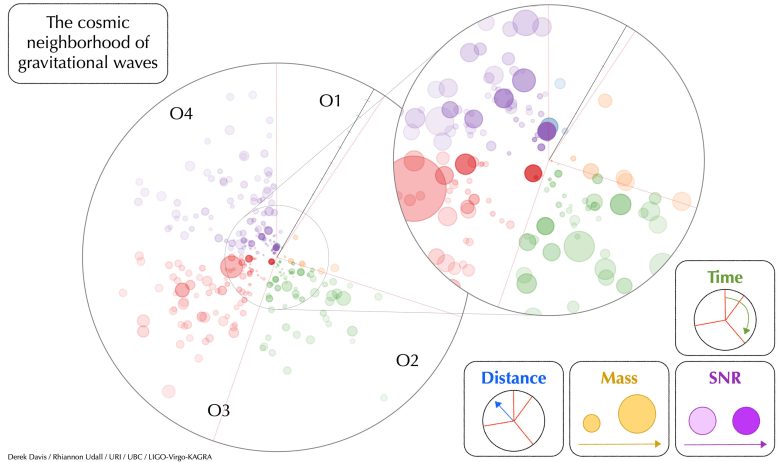
Beyond the sheer number of new detections, the catalog includes several observations that set new records in gravitational wave astronomy. These include the most precise source localization ever achieved, the strongest gravitational wave signal yet detected, and additional evidence supporting the existence of second-generation black holes.
Precision Sky Localization Sets New Record
One event, designated GW240615, was detected by both LIGO observatories in the United States and the Virgo detector in Italy on June 15, 2024. It achieved the most accurate sky localization of any gravitational wave source observed so far, narrowing its origin to an area of only 6 square degrees.
The event was produced when two black holes with masses of about 26 and 30 suns merged more than 3 billion light-years from Earth.
Gravitational Waves and the Hubble Constant
Alex Papadopoulos, a postgraduate researcher at the Institute for Gravitational Research, said, “The updated GWTC-5.0 catalogue gives us a much larger collection of gravitational-wave signals to help answer one of the biggest questions in cosmology: how fast is the Universe expanding?
“The rate of this expansion is described by a value called the Hubble constant. Gravitational waves allow us to measure this by estimating how far away merging objects are, either directly from the signal itself or by identifying the galaxy where the merger took place.
“One of the major improvements in GWTC-5.0 compared to previous catalogues is the inclusion of observations from the Virgo detector, which returned after not participating in the previous observing run. With this additional detector, we can pinpoint the location of gravitational-wave signals on the sky much more accurately, making it easier to identify the host galaxy of each merger. Our expanded library of detections also meant we could use 236 signals, almost double the previous number, in our analyses. Each event contributes a small amount of information, so together these additional signals significantly improve our results.
“Together, these improvements help us measure the Hubble constant more precisely than ever before using gravitational waves, bringing us closer to understanding one of modern physics’ most important open questions.
“In Glasgow, we developed and tested software that allows this analysis to run more than a thousand times faster than before, even with the growing number of gravitational-wave signals in the catalogue. This speed-up meant we could test many more possible scenarios and check that our results were as robust and reliable as possible, with the coordination of this effort led by our Institute for Gravitational Research.”
The Clearest Gravitational Wave Signal Ever Recorded
Finding gravitational waves involves more than detecting a signal. Scientists must separate genuine events from background noise within the instruments. To measure how clearly a signal stands out, researchers use a value called the signal-to-noise ratio (SNR). GWTC-5 includes the strongest gravitational wave signal recorded so far, with an SNR of 76.9.
The event, known as GW250114, reached Earth on January 14, 2025. It originated from the merger of two black holes with masses of 32 and 34 Suns, located more than 1 billion light-years away. Because the signal was exceptionally clear, scientists were able to carry out the most precise test of general relativity to date and confirm Stephen Hawking’s black hole area theorem.
Dr. John Veitch, an academic at the University of Glasgow who analyzes black hole signals, said, “With the loudness of GW250114, we are able to compare the warped space-time before and after the black holes merged and found that the total area of the event horizons (the surface of ‘no return’) increased in accordance with Hawking’s laws of black hole mechanics.
“After the merger the final black hole rings like a bell, giving off gravitational waves instead of sound. Analyzing these waves confirmed that although energy is given off in gravitational waves during the merger, the total entropy of the black holes increases in accordance with the second law of thermodynamics. This shows that even for black holes the laws of thermodynamics still apply, but unlike normal objects, the more energy they hold, the colder they become.”
Evidence for Second-Generation Black Holes
Researchers also identified two particularly unusual black hole mergers, GW241011 and GW241110, detected one month apart in October and November 2024. These events occurred about 700 million and 2.4 billion light-years from Earth, respectively.
The spin properties of the black holes involved suggest they may be second-generation black holes, meaning they were created through earlier black hole mergers. Such objects are thought to form in dense environments such as star clusters, where repeated collisions are more likely.
The growing number of detections is also helping scientists better understand the different populations of black holes found throughout the universe.
Black Hole Populations Reveal New Formation Pathways
Storm Colloms, a postgraduate researcher at the Institute for Gravitational Research, said, “I’ve been part of the team understanding the processes that create merging black holes and neutron stars with the latest set of observations. We studied 267 sources, including 104 new observations. This set of hundreds of observations allows us to confidently measure the masses, spins, and distances of binary black holes and probe the correlations between these properties. In particular, we find that black holes with different mass ranges have different spins, indicating that there are distinct formation pathways that create unique groups of systems.
“This trend was hinted at by previously published observations, GW241011 and GW241110, pairs of black holes with clearly measured high spins and unequal masses. These two observations showed characteristic signs that the larger black hole in each pair was formed not directly from a massive star, but from a previous merger of two black holes. The signatures of black holes formed from previous mergers persist in the population as a whole, indicating that GW241011 and GW241110 are not one-of-a-kind, but trace an underlying trend. Now, we have growing evidence that there are ways that the Universe creates merging black holes in addition to those that come from massive binary stars.
“The latest measurements of the population of gravitational wave sources continue to bring us closer to painting a clear picture of the origins of binary black holes and neutron stars. With upcoming observing runs and more sensitive detectors, we will get more precise measurements of individual sources and increase the number of sources in our catalogues, allowing us to probe more and more detailed astrophysics of compact object formation.”
Mapping the Hidden History of the Universe
Dr. Williams added, “We’re now detecting so many of these signals that we’re not just learning about individual collisions; it’s the astronomical equivalent of uncovering an ancient civilization. Today’s new results are like finding a previously undiscovered hoard, revealing not just individual lives but the structure of an entire lost world.”
Reference: “GWTC-5.0: Population Properties of Merging Compact Binaries”
The University of Glasgow’s research is supported by funding from UKRI’s Science and Technology Facilities Council (STFC), as are other gravitational research groups across the UK including the Universities of Birmingham, Cambridge, Cardiff, Kings College London, Nottingham, Portsmouth, Sheffield, Strathclyde, University College London, Queen Mary University, and the University of the West of Scotland.
Never miss a breakthrough: Join the SciTechDaily newsletter.
Follow us on Google and Google News.
2 Comments
The publication of GWTC-5.0 by the LVK Collaboration is a phenomenal milestone, offering an incredible statistical dataset for population modeling. However, the true goldmines are the specific mechanical anomalies hidden within individual events—specifically the pristine three-mode ringdown captured in GW250114 and the peculiar spin orientations of the second-generation mergers.Mainstream analysis treats the “cosmic bell” ringdown as energy bleeding into a smooth, infinite mathematical singularity. But when a system rings with multiple, discrete vibrational modes, it strongly suggests it has struck a hard geometric boundary. From a structural grid perspective, this looks less like a point-singularity and more like space-time self-organizing under extreme rotational torque into a discrete, geometric standing wave equilibrium state—effectively a mechanical density cap (REF-001 torsion hill framework). Furthermore, the highly unusual spin alignments in the consecutive mergers point to a compound uncoiling effect. Rather than isolated angular momentum in a vacuum, these second-generation anomalies behave exactly like localized torsional vectors ($\omega_{\text{hill}}$) storing and shifting torque across a vector helical path of restoration: $$V_h = \omega \cdot r \cdot \hat{\theta} + v_z \cdot \hat{\z}$$Data releases like GWTC-5.0 prove that our observational tools are flawless. To explain why these black holes ring and spin the way they do, we should open the floor to discussing the underlying mechanical gears of the spatial matrix itself. Would love to hear thoughts from others tracking these specific ringdown profiles!
Very imaginative to begin with and increasingly so it seems. I wonder just what-on-earth are they sensing? In 2012 I uploaded my first of four radiant gravity demonstration videos which rule-out (e.g., the inverse-square law of attraction) any possibility of earthbound detectors sensing any gravity waves from colliding black holes in deep space. In 2015 I found that concurrent with the first LIGO detection there was a volcanic eruption on a Japanese island; no reply to my comments. Now I find there were volcanic eruptions of 6.8 (SE/Japan)/6.2 (SE/Mexico) magnitudes on January 14/12, 2025 (Volcano Discovery dot com); a very interesting coincidence to say the least. About a year ago I devised, performed, recorded and uploaded a video demonstrating two freely spinning aluminum disks of which their own local fields of radiant gravity disengaged and reengaged with earth’s ambient field when I hand spun the aluminum bar they were mounted on, both CW and CCW (https://odysee.com/@charlesgshaver:d/5Gravity:c). I believe I’ve already proved the radiant nature of gravity for more than a decade but, just to be sure, although almost doubling my original $200 US budget, I’m presently doing brief trial runs prior to performing “6GRAVITY,” at ground level, to disprove “time dilation.” An impossible task for today’s scientists, I hope to have, and publish/upload another video, some favorable results within about a month.