
Squeeze leads to stellar-mass black hole collision precision.
Scientists at The Australian National University (ANU) have found a way to better detect all collisions of stellar-mass black holes in the Universe.
Stellar-mass black holes are formed by the gravitational collapse of a star. Their collisions are some of the most violent events in the universe, creating gravitational waves or ripples in space-time.
These ripples are minuscule and detected using laser interferometers. Until now, many signals have been drowned out by so-called quantum noise on the laser light pushing the mirrors of the laser interferometer around – making the measurements fuzzy or imprecise.
The researchers’ new method, called ‘squeezing’, dampens quantum noise, making measurements more precise. The findings were published in Nature Photonics in October 2019.
The breakthrough will be critical for next-generation detectors, which are expected to come online within the next 20 years.
One of the researchers involved, Dr. Robert Ward, said further experiments were being prepared to confirm the team’s proof of concept for a new device to dampen the effect of quantum noise.
“The new-generation LIGO detectors will have the capability to detect every black-hole smash in the Universe at any given moment.” — Min Jet Yap
“The detectors use particles of light called photons from a laser beam to sense the change in position of widely separate mirrors,” said Dr. Ward, from the ANU Research School of Physics and the ARC Center of Excellence for Gravitational Wave Discovery (OzGrav).
“However, the detectors are so sensitive that just the random quantum variability in the number of photons can disturb the mirrors enough to mask the wave-induced motion.”
The researchers have shown that squeezing reduces this variability, making detectors more sensitive.
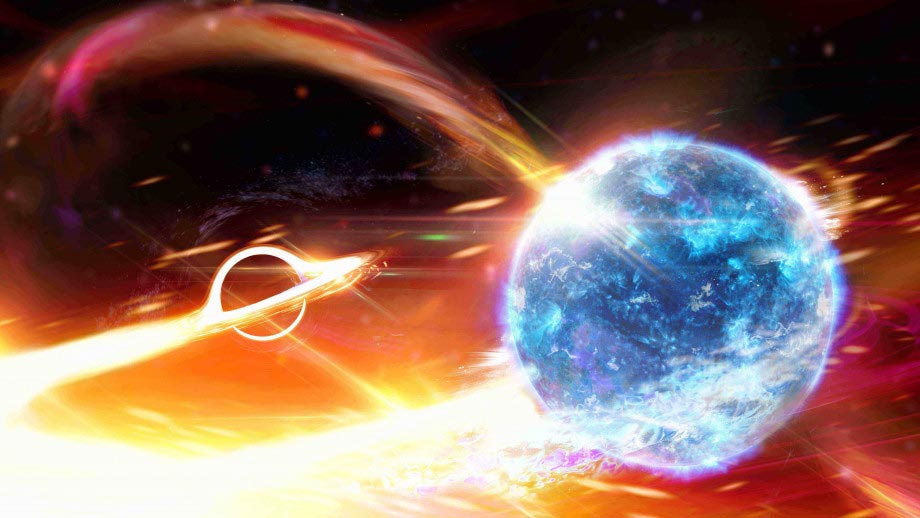
The Advanced Laser Interferometer Gravitational-wave Observatory (LIGO) detectors in the United States and the European Gravitational Observatory’s detector in Italy called Virgo have detected the mergers of two black holes, the collision of two neutron stars and possibly also a black hole eating a neutron star.
ANU plays a lead role in Australia’s partnership with LIGO. Other members of the quantum squeezer team include Professor David McClelland, Ph.D. scholar Min Jet Yap and Dr. Bram Slagmolen.
“The ‘quantum squeezers’ we designed at ANU along with other upgrades for the current LIGO detectors have greatly improved their sensing capabilities,” Dr. Slagmolen said.
Mr. Yap said the latest experiment proves that scientists can cancel out other quantum noise that can affect the sensing capabilities of detectors.
“The new-generation LIGO detectors will have the capability to detect every black-hole smash in the Universe at any given moment,” he said.
The LIGO team plans to design and build the upgraded quantum squeezers within the next few years. The new devices could be retrofitted to the current LIGO detectors, enabling scientists to detect many more violent events much further into the Universe.
Reference: “Broadband reduction of quantum radiation pressure noise via squeezed light injection” by Min Jet Yap, Jonathan Cripe, Georgia L. Mansell, Terry G. McRae, Robert L. Ward, Bram J. J. Slagmolen, Paula Heu, David Follman, Garrett D. Cole, Thomas Corbitt and David E. McClelland, 7 October 2019, Nature Photonics.
DOI: 10.1038/s41566-019-0527-y
The published work was undertaken in collaboration with researchers from Louisiana State University, Crystalline Mirror Solutions and the University of Vienna.
Never miss a breakthrough: Join the SciTechDaily newsletter.
Follow us on Google and Google News.