
Close Menu
    Facebook X (Twitter) Instagram
    SciTechDaily
    • Biology
    • Chemistry
    • Earth
    • Health
    • Physics
    • Science
    • Space
    • Technology
    Facebook X (Twitter) Pinterest YouTube RSS
    SciTechDaily
    Home»Space»Researchers Reveal That Hidden Dimensions Could Influence Gravitational Waves
    Space

    Researchers Reveal That Hidden Dimensions Could Influence Gravitational Waves

    By Max Planck InstituteJune 29, 2017No Comments3 Mins Read
    Facebook Twitter Pinterest Telegram LinkedIn WhatsApp Email Reddit
    Share
    Facebook Twitter LinkedIn Pinterest Telegram Email Reddit
    Hidden Dimensions Could Influence Gravitational Waves
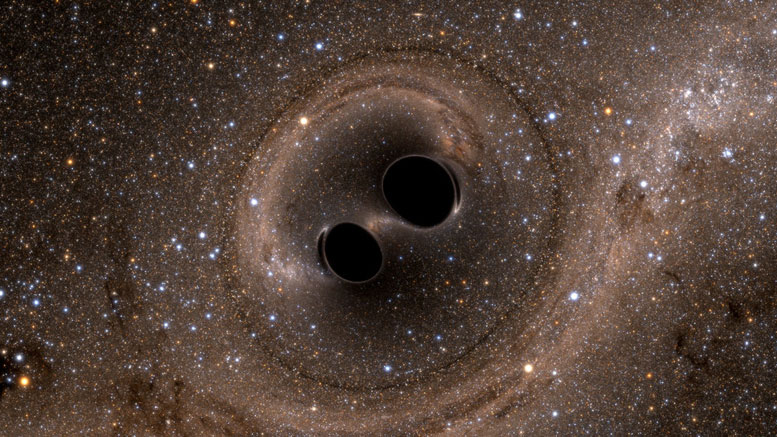
    Merging black holes generate gravitational waves. These ripples in space-time might be used to unveil hidden dimensions. Credit: Simulating eXtreme Spacetimes (SXS)

    A team of scientists at the Max Planck Institute for Gravitational Physics reveal that hidden dimensions – as predicted by string theory – could influence gravitational waves. In a newly published study they study the consequences of extra dimensions on these ripples in space-time, and predict whether their effects could be detected.

    LIGO’s first detection of gravitational waves from a black-hole binary in September 2015 has opened a new window onto the universe. Now it looks like with this new observing tool physicists cannot only trace black holes and other exotic astrophysical objects but also understand gravity itself. “Compared to the other fundamental forces like, e.g. electromagnetism, gravity is extremely weak,” explains Dr. David Andriot, one of the authors of the study. The reason for this weakness could be that gravity interacts with more than the three dimensions in space and one dimension in time that are part of our everyday experience.

    Extra dimensions

    Extra dimensions that are hidden because they are very small are an indispensable part of string theory – one of the promising candidates for a theory of quantum gravity. A theory of quantum gravity, unifying quantum mechanics and general relativity, is sought after in order to understand what happens when very large masses at very small distances are involved, e.g. inside a black hole or at the Big Bang.

    “Physicists have been looking for extra dimensions at the Large Hadron Collider at CERN but up to now this search has yielded no results,” says Dr. Gustavo Lucena Gómez, the second author of the paper. “But gravitational wave detectors might be able to provide experimental evidence.”

    The researchers discovered that extra dimensions should have two different effects on gravitational waves: they would modify the “standard” gravitational waves and would cause additional waves at high frequencies above 1000 Hz. However, the observation of the latter is unlikely since the existing ground-based gravitational wave detectors are not sensitive enough at high frequencies.

    On the other hand, the effect that extra dimensions can make a difference in how “standard” gravitational waves stretch and shrink space-time might be easier to detect by making use of more than one detector. Since the Virgo detector will join the two LIGO detectors for the next observing run this might happen after late 2018/beginning of 2019.

    Reference: “Signatures of extra dimensions in gravitational waves” by David Andriot1 and Gustavo Lucena Gómez, 23 July 2017, Journal of Cosmology and Astroparticle Physics.
    DOI: 10.1088/1475-7516/2017/06/048
    arXiv

    Never miss a breakthrough: Join the SciTechDaily newsletter.
    Follow us on Google and Google News.

    Astronomy Astrophysics Black Hole Gravitational Waves LIGO Max Planck Institute String Theory
    Share. Facebook Twitter Pinterest LinkedIn Email Reddit

    Related Articles

    The Hunt for the Gravitational Wave Background: NASA’s FERMI Searches for Ripples in Spacetime

    Exotic Black Hole Behavior: 10 New Gravitational Waves Found in LIGO-Virgo’s O3a Data

    Black Holes of All Shapes and Sizes in Largest Catalog of Gravitational Wave Events Ever Assembled

    Ripples in Space-Time Detected – Caused by the Death Spiral of a Neutron Star and a Black Hole

    The Odd Couple: Groundbreaking New Discovery From Gravitational Whispers

    Gravitational-Wave Observatories Detect Rare Mergers of Black Holes With Neutron Stars for the First Time

    The Final Dance of Mixed Neutron Star-Black Hole Pairs: A New Type of Cataclysmic Event in the Cosmos

    Hawking’s Black Hole Theorem Confirmed Observationally for the First Time

    A New Type of Cataclysmic Event in the Cosmos: Astrophysicists Detect First Black Hole-Neutron Star Mergers

    Leave A Reply Cancel Reply

    • Facebook
    • Twitter
    • Pinterest
    • YouTube

    Don't Miss a Discovery

    Subscribe for the Latest in Science & Tech!

    Trending News

    Beyond Pain Relief: Scientists Discover a Protein That Could Stop Osteoarthritis in Its Tracks

    Scientists Discover Why Alcohol Prevents the Liver From Healing, Even After You Quit

    Scientists Stunned As Volcano Removes Methane From the Air

    Scientists Discover Signs Africa May Be Splitting Apart Beneath Zambia

    Common Blood Pressure Drug Supercharges Cancer Treatment in Surprising New Study

    540-Million-Year-Old Fossils Reveal a Huge Surprise About Early Life on Earth

    Scientists Reverse Stroke Damage Using Stem Cells in Breakthrough Study

    Eating One Egg a Day Could Cut Alzheimer’s Risk by 27%

    Follow SciTechDaily
    • Facebook
    • Twitter
    • YouTube
    • Pinterest
    • Newsletter
    • RSS
    SciTech News
    • Biology News
    • Chemistry News
    • Earth News
    • Health News
    • Physics News
    • Science News
    • Space News
    • Technology News
    Recent Posts
    • Too Much Sleep May Age Your Body Faster, New Study Warns
    • Scientists Uncover Promising New Strategy To Stop Parkinson’s in Its Tracks
    • New Study Reveals How Vitamin D Could Calm Gut Inflammation
    • Experts Reveal the Surprising Cancer Link Behind a Common Vitamin
    • NASA’s Roman Space Telescope Could Finally Find the Milky Way’s Missing Neutron Stars
    Copyright © 1998 - 2026 SciTechDaily. All Rights Reserved.
    • Science News
    • About
    • Contact
    • Editorial Board
    • Privacy Policy
    • Terms of Use

    Type above and press Enter to search. Press Esc to cancel.