
Close Menu
    Facebook X (Twitter) Instagram
    SciTechDaily
    • Biology
    • Chemistry
    • Earth
    • Health
    • Physics
    • Science
    • Space
    • Technology
    Facebook X (Twitter) Pinterest YouTube RSS
    SciTechDaily
    Home»Space»NASA Researchers Simulate Life-Threatening Asteroid Impacts
    Space

    NASA Researchers Simulate Life-Threatening Asteroid Impacts

    By Kimberly Minafra, Ames Research CenterJune 30, 2017No Comments2 Mins Read
    Facebook Twitter Pinterest Telegram LinkedIn WhatsApp Email Reddit
    Share
    Facebook Twitter LinkedIn Pinterest Telegram Email Reddit

    NASA Simulates Asteroid Impacts to Help Identify Possible Life-Threatening Events

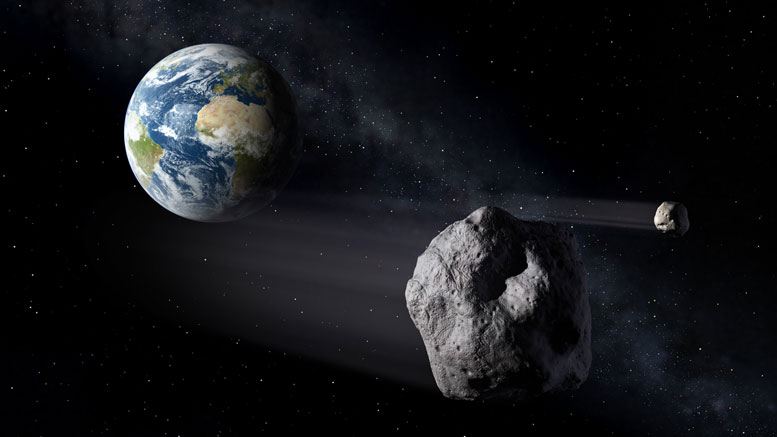
    Using the Pleiades supercomputer, NASA scientists are simulating asteroid impacts to help identify possible life-threatening events.

    When an asteroid struck the Russian city of Chelyabinsk in 2013, the blast from the asteroid’s shock wave broke windows and damaged buildings as far away as 58 miles (93 kilometers), injuring more than 1,200 people.

    In support of NASA’s Planetary Defense Coordination Office, researchers are creating 3D models and using one of NASA’s most powerful supercomputers to produce simulations of hypothetical asteroid impact scenarios. Their results help first responders and other agencies to identify and make better informed decisions for how best to defend against life-threatening asteroid events.


    The animation above from an ALE3D simulation shows a Chelyabinsk-like asteroid breaking up during atmospheric entry at about 45,000 miles per hour, with a high-pressure shock wave that forms around the asteroid causing it to fracture and flatten like a pancake. Credit: NASA Ames/Darrel Robertson

    High-fidelity simulations of potential asteroids covering a wide range of sizes were run on the Pleiades supercomputer using NASA’s Cart3D and Lawrence Livermore National Lab’s ALE3D modeling software by experts on the Asteroid Threat Assessment Project at the NASA Advanced Supercomputing facility at Ames Research Center in California’s Silicon Valley.

    The NASA team was able to run large-scale simulations of the Chelyabinsk asteroid event on Pleiades to produce many impact scenarios quickly, because Cart3D is dozens of times faster than typical 3D numerical modeling used for aerodynamic analysis. The detailed simulations allowed the team to model the fluid flow that occurs when asteroids melt and vaporize as they break up in the atmosphere.

    NASA’s asteroid research is shared with scientists at universities, national labs, and government agencies who develop assessment and response plans to look at damage to infrastructure, warning times, evacuations, and other options for protecting lives and property.

    For more information on NASA’s Asteroid Threat Assessment Project work, visit: www.nas.nasa.gov/publications/articles/feature_asteroid_simulations.html

    Never miss a breakthrough: Join the SciTechDaily newsletter.
    Follow us on Google and Google News.

    Ames Research Center Asteroid Astronomy Popular
    Share. Facebook Twitter Pinterest LinkedIn Email Reddit

    Related Articles

    The Moon Was Hit Again: NASA Scientists Discover a Newly Formed Crater

    Asteroid Nine Times Larger Than Cruise Ship Set to Fly Past Earth

    New Astronomical Tool Traces the Evolution of Cosmic Carbon

    Finding the Asteroids That Threaten Earth

    Near-Earth Asteroid 2012 DA14 Makes a Preview Appearance

    Q & A and Video Animations from NASA on Asteroid 2012 DA14 and Its Near Earth Approach

    NASA’s Dawn Gets a Close Up View of the Canuleia Crater on Vesta

    NASA’s WISE Uncovers New Clues on Jovian Trojans

    Trajectory Models of Refractory Particles Help Solve Two Solar System Puzzles

    Leave A Reply Cancel Reply

    • Facebook
    • Twitter
    • Pinterest
    • YouTube

    Don't Miss a Discovery

    Subscribe for the Latest in Science & Tech!

    Trending News

    Scientists Warn That This Common Pet Fish Can Wreck Entire Ecosystems

    Scientists Make Breakthrough in Turning Plastic Trash Into Clean Fuel Using Sunlight

    This Popular Supplement May Interfere With Cancer Treatment, Scientists Warn

    Scientists Finally Solved One of Water’s Biggest Mysteries

    Could This New Weight-Loss Pill Disrupt the Entire Market? Here’s What You Should Know About Orforglipron

    Earth’s Crust Is Tearing Open in Africa, and It Could Form a New Ocean

    Breakthrough Bowel Cancer Trial Leaves Patients Cancer-Free for Nearly 3 Years

    Natural Compound Shows Powerful Potential Against Rheumatoid Arthritis

    Follow SciTechDaily
    • Facebook
    • Twitter
    • YouTube
    • Pinterest
    • Newsletter
    • RSS
    SciTech News
    • Biology News
    • Chemistry News
    • Earth News
    • Health News
    • Physics News
    • Science News
    • Space News
    • Technology News
    Recent Posts
    • The Most Effective Knee Arthritis Treatments Aren’t What You Expect
    • Scientists Develop Bioengineered Chewing Gum That Could Help Fight Oral Cancer
    • Popular Weight-Loss Drugs Found To Cut Heart Attack and Stroke Risk
    • After 37 Years, the World’s Longest-Running Soil Warming Experiment Uncovers a Startling Climate Secret
    • NASA Satellite Captures First-Ever High-Res View of Massive Pacific Tsunami
    Copyright © 1998 - 2026 SciTechDaily. All Rights Reserved.
    • Science News
    • About
    • Contact
    • Editorial Board
    • Privacy Policy
    • Terms of Use

    Type above and press Enter to search. Press Esc to cancel.