
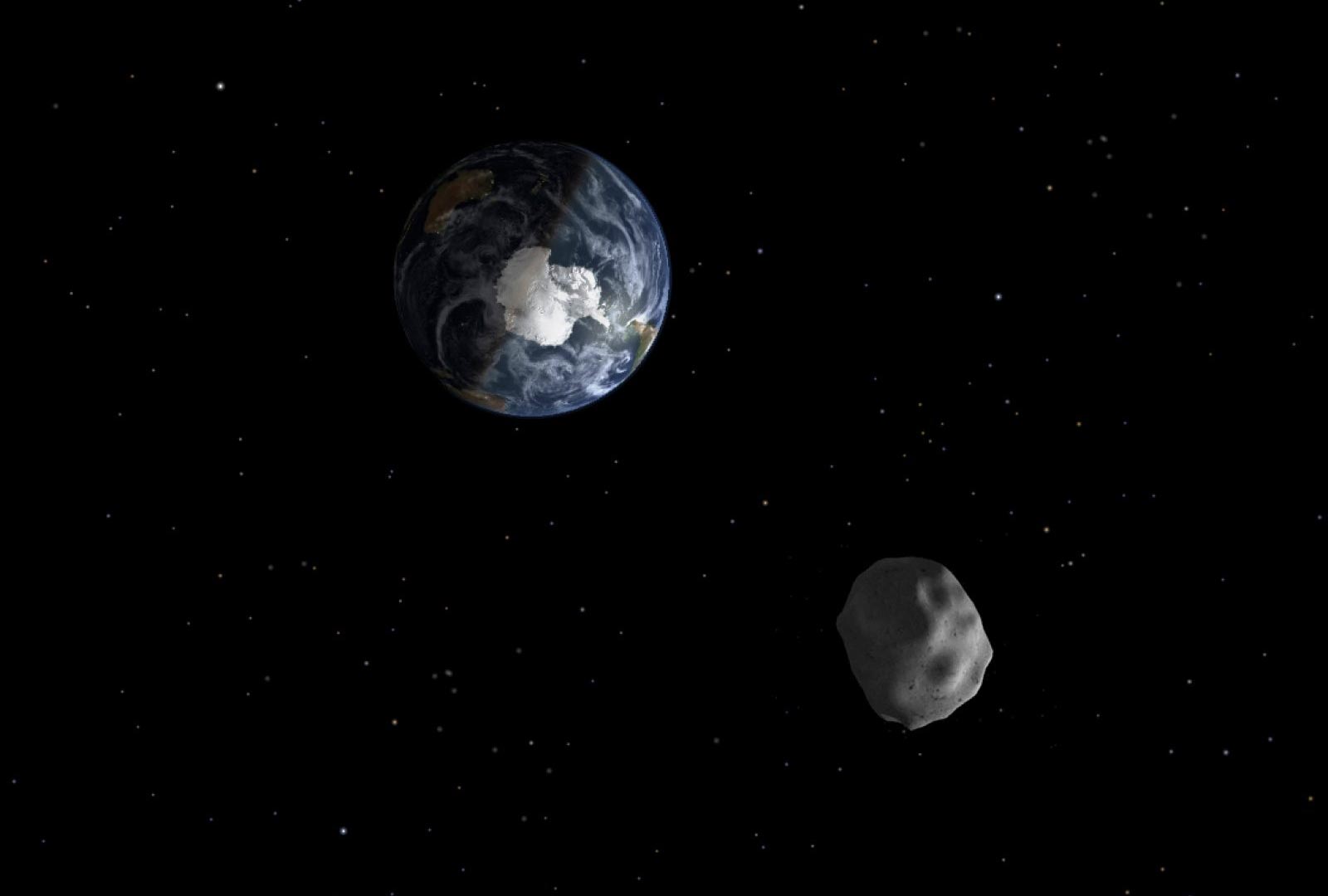
By building an asteroid-hunting space telescope called Sentinel, the B612 Foundation aims to track down the thousands of unknown asteroids that could pose a threat to Earth.
On Saturday, an asteroid the size of one and a half football fields flew within 240,000 miles (386,000 kilometers) of Earth. If the space rock had hit land, it would have leveled an area the size of San Francisco Bay. If it had hit the Pacific Ocean, the impact would have sent a tsunami to every facing shore.
But what is perhaps most alarming about this particular asteroid, called 2013 ET, is that, until March 3, no one had any idea it was headed toward Earth.
Scott Hubbard, a consulting professor of aeronautics and astronautics at Stanford, thinks we can do something about that. Hubbard, a former director of NASA Ames Research Center, is also the program architect for the B612 Foundation, which aims to track down the hundreds of thousands of unknown asteroids that could pose a threat to Earth.
Many asteroids that come near Earth – such as 2013 ET, or 2012 DA14, the football stadium-size asteroid that passed inside the orbit of Earth’s communication satellites in February – have unusually long orbits.
There are an estimated million of these near-Earth asteroids longer than 100 meters, or about 300 feet. But because they are relatively small and spend so much time far from Earth, scientists tend to find them only by chance.
“We know about 90 to 95 percent of the asteroids larger than a kilometer,” Hubbard said. “But we know only maybe 1 percent of the asteroids in the 100-meter range.”
This is worrisome, considering that an impact from a 100-meter asteroid would be equal to detonating a 100-megaton hydrogen bomb.
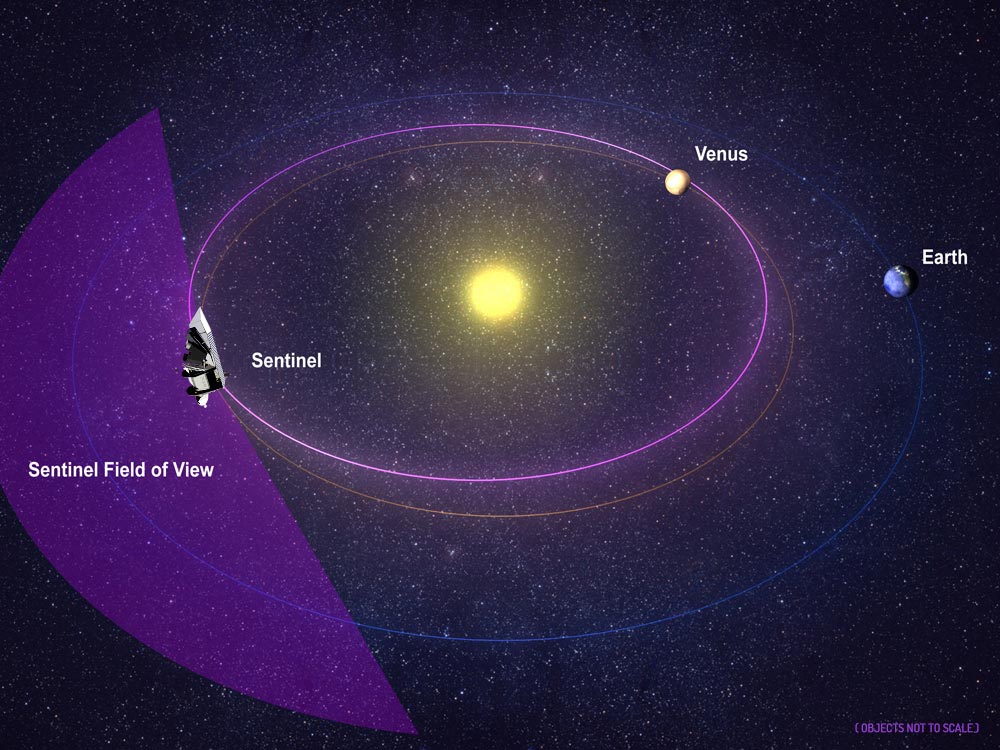
The first step toward protecting the planet from these asteroids, Hubbard said, is to detect them. To that end, B612 is in the process of raising public funds to build an asteroid-hunting space telescope called Sentinel.
Near-Earth asteroids are particularly difficult to spot. In addition to being relatively small, they are comprised mostly of black carbon, so they blend in with the equally black background of space. The upside to being dark is that the rocks absorb a decent amount of heat, which will make them obvious to Sentinel’s planned array of infrared detectors.
“Once we detect an asteroid and track it long enough to know what the orbit is, then we can just apply the laws of physics and know exactly where it will be 50 to 100 years from now,” Hubbard said.
Using this method, Sentinel, which will cost around $450 million to build and launch, should discover nearly all the asteroids larger than 140 meters (460 feet), and about half of those between 50 and 140 meters (160 to 460 feet).
“The fundamental technology needed to achieve this exists, we just need to demonstrate that the detectors are sensitive enough and scale up to what we need,” he said. “We’re drawing on the heritage from two previous space telescopes, Kepler, which was used to detect exoplanets, and Spitzer, an infrared telescope. So far it all looks very doable, but we need a prototype to confirm the design.”
Should Sentinel find an asteroid on a crash course with Earth, the Hayabusa and Deep Impact spacecraft (asteroid and comet impactors, respectively) would provide a basic strategy for deflecting the rock: run something into it.
“We just need to alter its velocity by about the speed of an ant walking, and over the years its course will be changed enough so that it will miss Earth,” Hubbard said. “You don’t need a nuclear bomb to do that.”
Another plan calls for a gravity tractor, a process that involves placing an object in the vicinity of the rock. The gravitational interaction between the asteroid and the object throws off the asteroid’s velocity by a tiny amount that multiplies over time so that it misses Earth.
But neither of these solutions is possible unless we know an asteroid is bearing down on us a few years in advance, making efforts such as Sentinel all the more important.
Never miss a breakthrough: Join the SciTechDaily newsletter.
Follow us on Google and Google News.
3 Comments
Canada has just placed a microsat (NEOSSat) in orbit, via an ISRO launch, that will search for NEO’s that are within Earth’s orbit (Atens). It’s optics are limited so it is limited to asteroids 1km in size, but it is a start.
Thank You Mr. Hubbard and B612 Foundation for taking on this monumental task that should have been embraced by the governments of the world a long time ago. The next step is for the United Nations to procure the means to deflect or destroy asteroids on a collision course with earth. Breaking up one 100 meter asteroid into ten or more 10 meter or less asteroids is preferable, as earth’s atmosphere is an excellent defense against smaller objects from space.
Deflecting asteroids into the Sun may have an additional benefit of prolonging the Sun’s hydrogen burning phase by one or more solar cycles. This will be very important to any of earth’s future evacuees trying to escape out of the solar system before the Sun runs out of hydrogen and explodes as a Nova.
Find and prevent an asteroid is more complex than initially thought. Destroy it may be more worse than just leaving it to hit the earth