
Close Menu
    Facebook X (Twitter) Instagram
    SciTechDaily
    • Biology
    • Chemistry
    • Earth
    • Health
    • Physics
    • Science
    • Space
    • Technology
    Facebook X (Twitter) Pinterest YouTube RSS
    SciTechDaily
    Home»Space»Number of Potentially Habitable Planets Is Greater Than Previously Thought
    Space

    Number of Potentially Habitable Planets Is Greater Than Previously Thought

    By Anne Danahy, Penn State UniversityMarch 13, 2013No Comments3 Mins Read
    Facebook Twitter Pinterest Telegram LinkedIn WhatsApp Email Reddit
    Share
    Facebook Twitter LinkedIn Pinterest Telegram Email Reddit
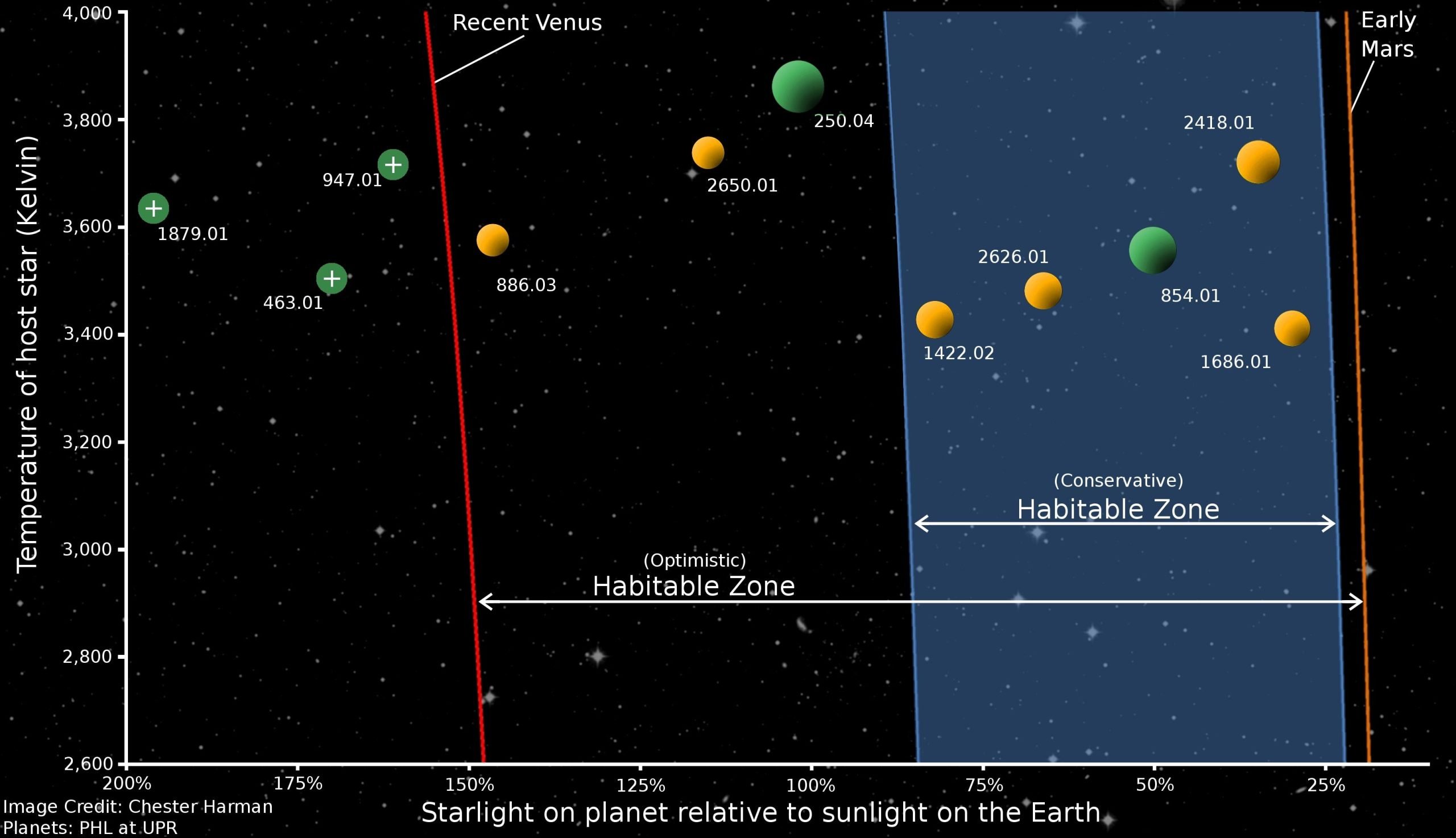
    Optimistic and Conservative Habitable Zone Boundaries
    The graphic shows optimistic and conservative habitable zone boundaries around cool, low-mass stars. The numbers indicate the names of known Kepler planet candidates. Yellow color represents candidates with less than 1.4 times Earth-radius. The green color represents planet candidates between 1.4 and 2 Earth radius. Planets with “+” are not in the habitable zone. Credit: Penn State

    New research from Penn State suggests that the number of Earth-sized planets in the habitable zones of low-mass stars is more common than previously thought.

    The number of potentially habitable planets is greater than previously thought, according to a new analysis by a Penn State researcher, and some of those planets are likely lurking around nearby stars.

    “We now estimate that if we were to look at 10 of the nearest small stars we would find about four potentially habitable planets, give or take,” said Ravi Kopparapu, a post-doctoral researcher in geosciences. “That is a conservative estimate,” he added. “There could be more.”

    Kopparapu detailed his findings in a paper accepted for publication in Astrophysical Journal Letters. In it, he recalculated the commonness of Earth-sized planets in the habitable zones of low-mass stars, also known as cool stars or M-dwarfs.

    Scientists focus on M-dwarfs for several reasons, he explained. The orbit of planets around M-dwarfs is very short, which allows scientists to gather data on a greater number of orbits in a shorter period of time than can be gathered on Sun-like stars, which have larger habitable zones. M-dwarfs are also more common than stars like the Earth’s Sun, which means more of them can be observed.

    According to his findings, “The average distance to the nearest potentially habitable planet is about seven light years. That is about half the distance of previous estimates,” Kopparapu said. “There are about eight cool stars within 10 light-years, so conservatively, we should expect to find about three Earth-size planets in the habitable zones.”

    The work follows up on a recent study by researchers at the Harvard-Smithsonian Center for Astrophysics which analyzed 3,987 M-dwarf stars to calculate the number of Earth-sized planet candidates in cool stars’ habitable zones—a region around a star where rocky planets are capable of sustaining liquid water and therefore life. That study used habitable zone limits calculated in 1993 by Jim Kasting, now an Evan Pugh Professor in Penn State’s Department of Geosciences. Kopparapu noticed that its findings, based on data from NASA’s Kepler satellite, didn’t reflect the most recent estimates for determining whether planets fall within a habitable zone.

    These newer estimates are based on an updated model developed by Kopparapu and collaborators, using information on water and carbon dioxide absorption that was not available in 1993. Kopparapu applied those findings to the Harvard team’s study, using the same calculation method, and found that there are additional planets in the newly determined habitable zones.

    “I used our new habitable zone calculations and found that there are nearly three times as many Earth-sized planets in the habitable zones around these low-mass stars as in previous estimates,” Kopparapu said. “This means Earth-sized planets are more common than we thought, and that is a good sign for detecting extraterrestrial life.”

    Reference: “A revised estimate of the occurrence rate of terrestrial planets in the habitable zones around kepler m-dwarfs” by Ravi Kumar Kopparapu, 25 March 2013, The Astrophysical Journal Letters.
    DOI: 10.1088/2041-8205/767/1/L8

    Never miss a breakthrough: Join the SciTechDaily newsletter.
    Follow us on Google and Google News.

    Astronomy Astrophysics Geoscience Penn State University Planetary Science
    Share. Facebook Twitter Pinterest LinkedIn Email Reddit

    Related Articles

    New Infrared Technique Detects Water in the Atmosphere of a Planet Outside Our Solar System

    A Close Star System Discovered, Only 6.5 Light-Years Away

    An Updated Model for Identifying Habitable Zones Around Stars

    New Study Revives Doubted Exoplanet Fomalhaut b

    NASA’s Kepler Mission Discovers Multiple Transiting Planets Orbiting Two Suns

    Vaporization Simulation of Earth Helps Explain the Atmospheres of Super-Earths

    Diogenites Provide Clues of the Earliest Days of Our Solar System

    Astronomers Obtain Precise Measurements of the Two Kepler-16 Stars

    Astronomers Discover Radio Emissions From a Brown Dwarf

    Leave A Reply Cancel Reply

    • Facebook
    • Twitter
    • Pinterest
    • YouTube

    Don't Miss a Discovery

    Subscribe for the Latest in Science & Tech!

    Trending News

    Artificial Sweeteners May Harm Future Generations, Study Suggests

    Splashdown! NASA Artemis II Returns From Record-Breaking Moon Mission

    What If Consciousness Exists Beyond Your Brain

    Scientists Finally Crack the 100-Million-Year Evolutionary Mystery of Squid and Cuttlefish

    Beyond “Safe Levels”: Study Challenges What We Know About Pesticides and Cancer

    Researchers Have Found a Dietary Compound That Increases Longevity

    Scientists Baffled by Bizarre “Living Fossil” From 275 Million Years Ago

    Your IQ at 23 Could Predict Your Wealth at 27, Study Finds

    Follow SciTechDaily
    • Facebook
    • Twitter
    • YouTube
    • Pinterest
    • Newsletter
    • RSS
    SciTech News
    • Biology News
    • Chemistry News
    • Earth News
    • Health News
    • Physics News
    • Science News
    • Space News
    • Technology News
    Recent Posts
    • What if Dark Matter Has Two Forms? Bold New Hypothesis Could Explain a Cosmic Mystery
    • Researchers Expose Hidden Chemistry of “Ore-Forming” Elements in Biology
    • Geologists Reveal the Americas Collided Earlier Than We Thought
    • 20x Difference: Study Reveals True Source of Airborne Microplastics
    • Scientists Uncover Hidden Force Powering Yellowstone’s Supervolcano
    Copyright © 1998 - 2026 SciTechDaily. All Rights Reserved.
    • Science News
    • About
    • Contact
    • Editorial Board
    • Privacy Policy
    • Terms of Use

    Type above and press Enter to search. Press Esc to cancel.