
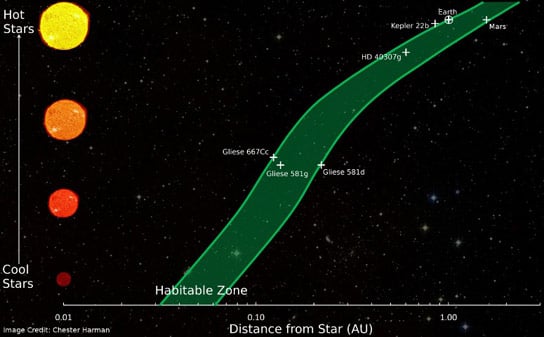
Scientists at Penn State have developed an updated model for determining whether discovered planets fall within a habitable zone.
Researchers searching the galaxy for planets that could pass the litmus test of sustaining water-based life must find whether those planets fall in what’s known as a habitable zone. New work, led by a team of Penn State researchers, will help scientists in that search.
Using the latest data, the Penn State Department of Geosciences team developed an updated model for determining whether discovered planets fall within a habitable zone – where they could be capable of having liquid water and thus sustaining life. The work, described in a paper accepted for publication in Astrophysical Journal, builds on a prior model by James Kasting, Evan Pugh Professor of Geosciences at Penn State, to offer a more precise calculation of where habitable zones around a star can be found.
Comparing the new estimates with the previous model, the team found that habitable zones are actually farther away from the stars than previously thought.
“This has implications for finding other planets with life on them,” said post-doctoral researcher Ravi Kumar Kopparapu, a lead investigator on the study.
For the paper, Kopparapu and graduate student Ramses Ramirez used updated absorption databases of greenhouse gases (HITRAN and HITEMP). The databases have more accurate information on water and carbon dioxide than previously was available and allowed the research team to build new estimates from the groundbreaking model Kasting created 20 years ago for other stars.
Using that data and supercomputers at Penn State and the University of Washington, the team was able to calculate habitable zones around other stars. In the previous model, water and carbon dioxide were not being absorbed as strongly, so the planets had to be closer to the star to be in the habitable zone.
The new model has already found that some extrasolar planets previously believed to be in habitable zones may, in fact, not be.
The new model could also help scientists with research that is already underway. For example, the model could be used to see if planets the NASA Kepler mission discovers are within a habitable zone. The Kepler mission has found more than 2,000 potential systems that could be investigated.
The data could assist with the Habitable Zone Planet Finder that a team of scientists in the Department of Astronomy and Astrophysics in Penn State’s Eberly College of Science is building. In 2011, that team received a National Science Foundation grant to develop an instrument to find planets in habitable zones. The precision spectrograph, which is under construction, will help scientists find Earth-sized planets in the Milky Way that could sustain liquid water.
In the future, the model could also be useful for research done with Terrestrial Planet Finder telescopes, which would guide users of the supersized telescopes on where to look.
While in the new model, Earth appears to be situated at the very edge of the habitable zone, the model doesn’t take into account feedback from clouds, which reflect radiation away from the Earth and stabilize the climate.
Reference: “Habitable Zones Around Main-Sequence Stars: New Estimates” by Ravi Kumar Kopparapu, Ramses Ramirez, James F. Kasting, Vincent Eymet, Tyler D. Robinson, Suvrath Mahadevan, Ryan C. Terrien, Shawn Domagal-Goldman, Victoria Meadows and Rohit Deshpande, 26 February 2013, The Astrophysical Journal.
DOI: 10.1088/0004-637X/765/2/131
In addition to Kopparapu, Ramirez, and Kasting, researchers on the project are Vincent Eymet, with the Laboratoire d’Astrophysique de Bordeaux at the Universite de Bordeaux (France); Tyler D. Robinson, University of Washington; Suvrath Mahadevan at Penn State; Ryan C. Terrien at Penn State; Shawn Domagal-Goldman at NASA Goddard Space Flight Center; Victoria Meadows at the University of Washington; and Rohit Deshpande, at Penn State.
Support for the research comes from NASA Astrobiology Institute’s Virtual Planetary Laboratory.
Never miss a breakthrough: Join the SciTechDaily newsletter.
Follow us on Google and Google News.
2 Comments
Habitable zone chart impressive. Seems Earth is on the “hot side”
of it. How about Habitable Gravity and Atmosphere, and Seasonal zone
affects. Also Star’s own tempermant, and companions effects, also, billiard ball planetoids, etc. Lots to ponder. Good stuff! Aloha
In my opinion, this “habitable zone” given by this model is too optimistic, at least for finding planets that could manage an ecosystem like Earth’s. While it may be counterintuitive for a reader who doesn’t understand the reason for it, planets in the habitable zone of a redder (cooler) star will tend to be hotter, while planets in the habitable zone of a bluer (hotter) star will tend to be cooler. This is because as a star gets redder (cooler), its light becomes less energetic and any habitable planet will have to be closer to the star to sustain crops, and global temperatures will likely be warmer than Earth’s in order to produce the same crop yields. Conversely, stars bluer than the Sun produce more energetic (and dangerous) radiation, so that in order to far enough from the star to make living there safe for humans, a planet will likely have global temperatures much cooler than Earth’s. Therefore the practical habitable zone (as far as human life is concerned, anyway) should become more narrow as the temperature (color) of the star departs in either direction from that of the Sun’s. I haven’t read the paper, but from the looks of that chart, the researchers here don’t seem to have taken that into account.