
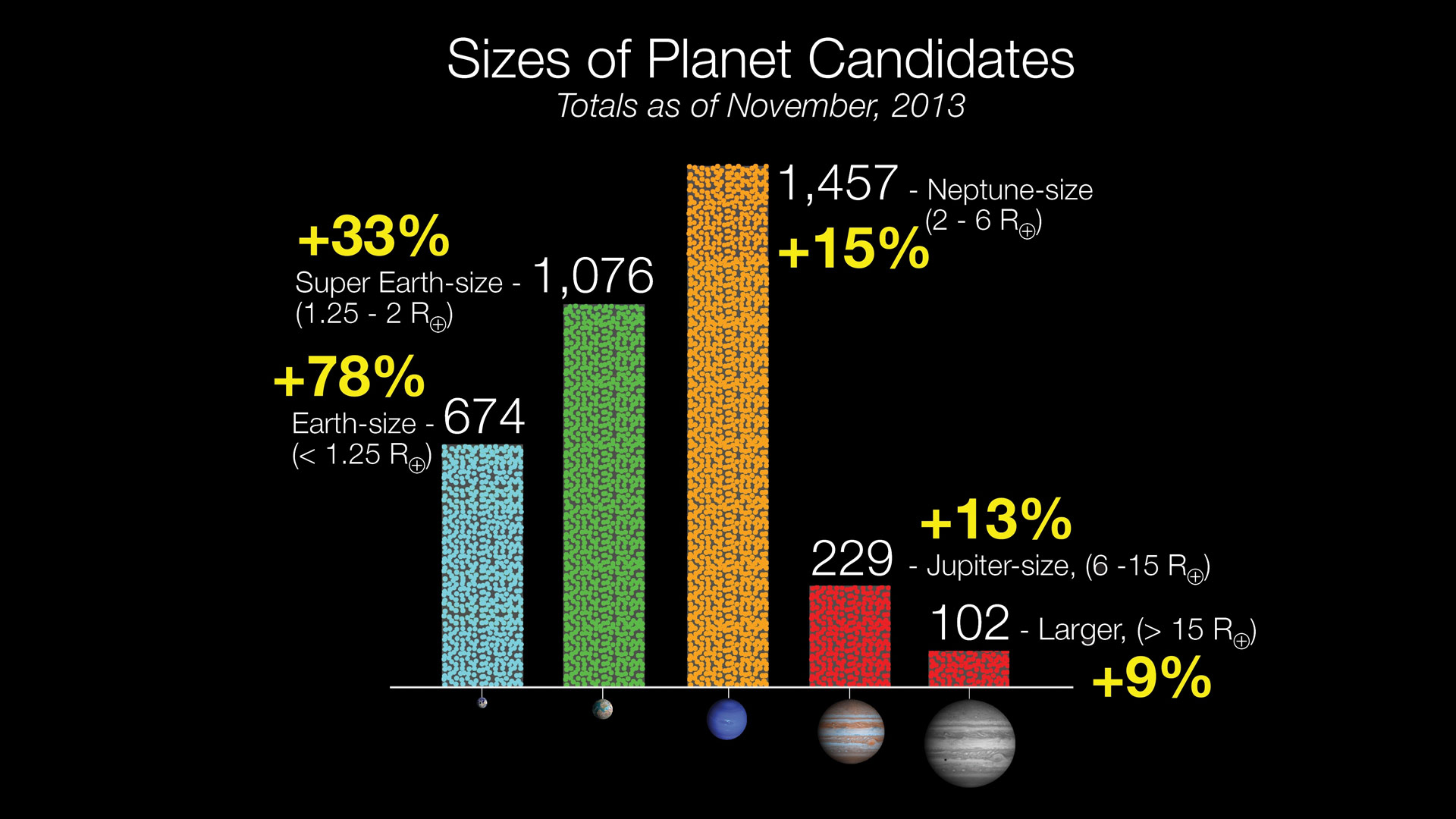
The latest analysis of Kepler Space Telescope data has revealed the discovery of 833 new candidate planets; ten of these candidates are less than twice the size of Earth and orbit in their sun’s habitable zone.
Scientists from around the world are gathered this week at NASA’s Ames Research Center in Moffett Field, California, for the second Kepler Science Conference, where they will discuss the latest findings resulting from the analysis of Kepler Space Telescope data.
Included in these findings is the discovery of 833 new candidate planets, which will be announced today by the Kepler team. Ten of these candidates are less than twice the size of Earth and orbit in their sun’s habitable zone, which is defined as the range of distance from a star where the surface temperature of an orbiting planet may be suitable for liquid water.

At this conference two years ago, the Kepler team announced its first confirmed habitable zone planet, Kepler-22b. Since then, four more habitable zone candidates have been confirmed, including two in a single system.
New Kepler data analysis and research also show that most stars in our galaxy have at least one planet. This suggests that the majority of stars in the night sky may be home to planetary systems, perhaps some like our solar system.
“The impact of the Kepler mission results on exoplanet research and stellar astrophysics is illustrated by the attendance of nearly 400 scientists from 30 different countries at the Kepler Science Conference,” said William Borucki, Kepler science principal investigator at Ames. “We gather to celebrate and expand our collective success at the opening of a new era of astronomy.”
Kepler media briefing.
From the first three years of Kepler data, more than 3,500 potential worlds have emerged. Since the last update in January, the number of planet candidates identified by Kepler increased by 29 percent and now totals 3,538. Analysis led by Jason Rowe, research scientist at the SETI Institute in Mountain View, California, determined that the largest increase of 78 percent was found in the category of Earth-sized planets, based on observations conducted from May 2009 to March 2012. Rowe’s findings support the observed trend that smaller planets are more common.
An independent statistical analysis of nearly all four years of Kepler data suggests that one in five stars like the sun is home to a planet up to twice the size of Earth, orbiting in a temperate environment. A research team led by Erik Petigura, doctoral candidate at University of California, Berkeley, used publicly accessible data from Kepler to derive this result.
Kepler data also fueled another field of astronomy dubbed asteroseismology — the study of the interior of stars. Scientists examine sound waves generated by the boiling motion beneath the surface of the star. They probe the interior structure of a star just as geologists use seismic waves generated by earthquakes to probe the interior structure of Earth.
“Stars are the building blocks of the galaxy, driving its evolution and providing safe harbors for planets. To study the stars, one truly explores the galaxy and our place within it,” said William Chaplin, professor for astrophysics at the University of Birmingham in the United Kingdom. “Kepler has revolutionized asteroseismology by giving us observations of unprecedented quality, duration, and continuity for thousands of stars. These are data we could only have dreamt of a few years ago.”
Kepler’s mission is to determine what percentage of stars like the sun harbor small planets the approximate size and temperature of Earth. For four years, the space telescope simultaneously and continuously monitors the brightness of more than 150,000 stars, recording a measurement every 30 minutes. More than a year of the collected data remains to be fully reviewed and analyzed.
Ames is responsible for the Kepler mission concept, ground system development, mission operations, and science data analysis. NASA’s Jet Propulsion Laboratory in Pasadena, California, managed Kepler mission development.
Ball Aerospace & Technologies Corp. in Boulder, Colorado, developed the Kepler flight system and supports mission operations with the Laboratory for Atmospheric and Space Physics at the University of Colorado in Boulder.
The Space Telescope Science Institute in Baltimore archives, hosts, and distributes Kepler science data. Kepler is NASA’s 10th Discovery Mission and was funded by the agency’s Science Mission Directorate.
Download .PDF of slides from Jason Rowe [8 MB]
Never miss a breakthrough: Join the SciTechDaily newsletter.
Follow us on Google and Google News.