
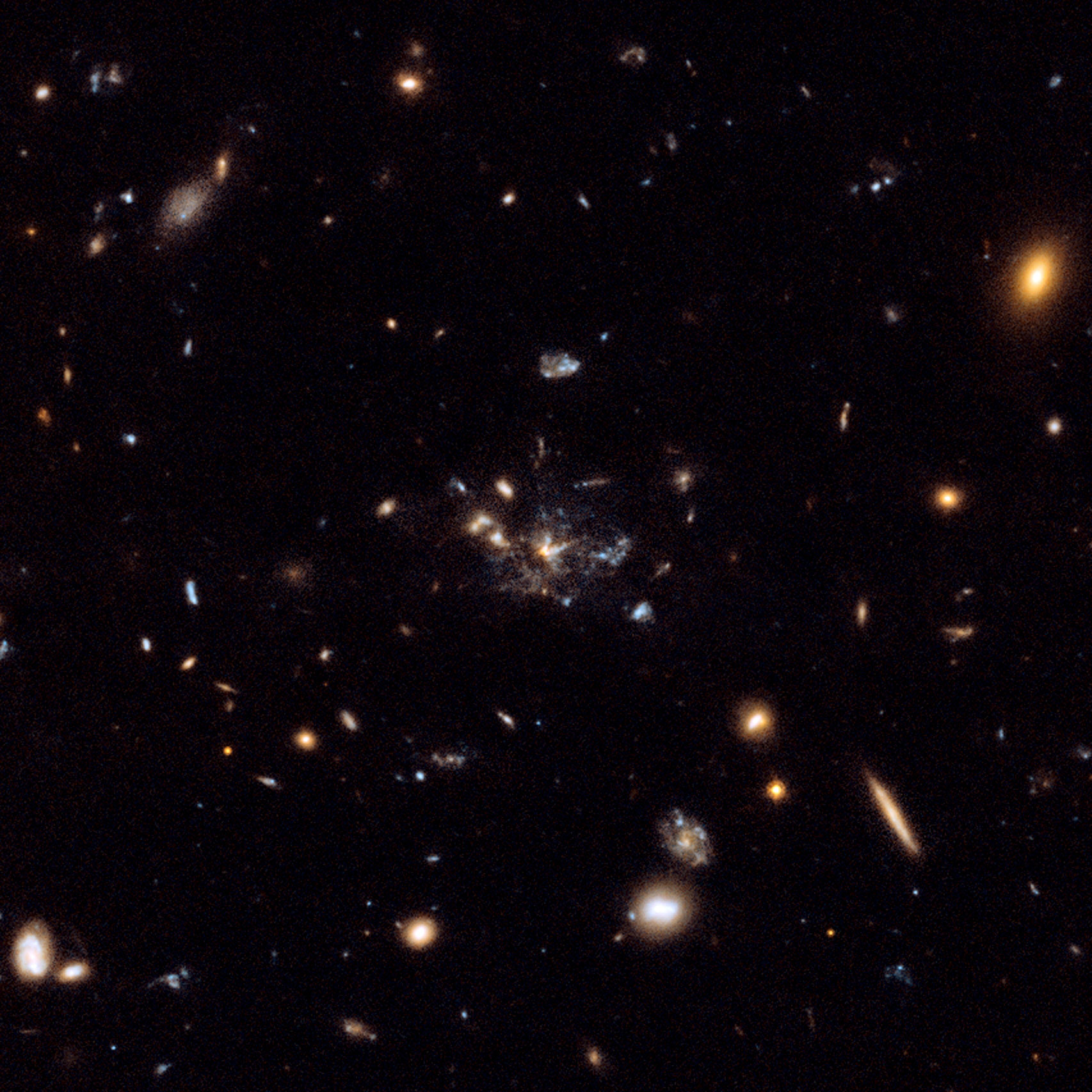
Using the Australia Telescope Compact Array, two new studies detail the discovery of raw materials used in the making of stars.
A CSIRO radio telescope has detected the raw material for making the first stars in galaxies that formed when the Universe was just three billion years old — less than a quarter of its current age. This opens the way to studying how these early galaxies made their first stars.
The telescope is CSIRO’s Australia Telescope Compact Array telescope near Narrabri, NSW. “It is one of very few telescopes in the world that can do such difficult work, because it is both extremely sensitive and can receive radio waves of the right wavelengths,” says CSIRO astronomer Professor Ron Ekers.
The raw material for making stars is cold molecular hydrogen gas, H2. It can’t be detected directly but its presence is revealed by a ‘tracer’ gas, carbon monoxide (CO), which emits radio waves.
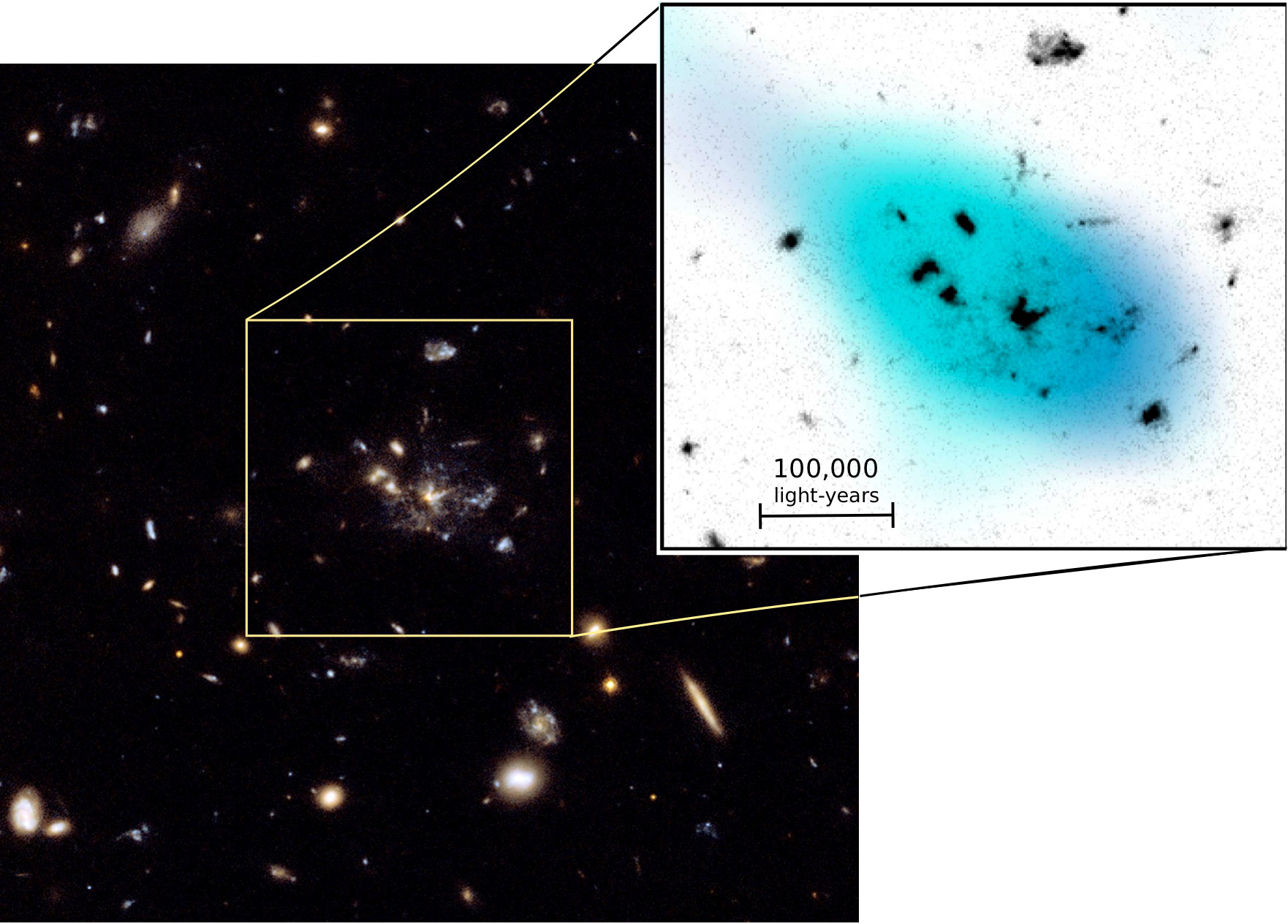
In one project published in MRAS, astronomer Dr. Bjorn Emonts (CSIRO Astronomy and Space Science) and his colleagues used the Compact Array to study a massive, distant conglomerate of star-forming ‘clumps’ or ‘proto-galaxies’ that are in the process of coming together as a single massive galaxy. This structure, called the Spiderweb, lies more than ten thousand million light-years away [at a redshift of 2.16].
Dr. Emonts’ team found that the Spiderweb contains at least sixty thousand million [6 x 10¹⁰] times the mass of the Sun in molecular hydrogen gas, spread over a distance of almost a quarter of a million light-years. This must be the fuel for the star formation that has been seen across the Spiderweb. “Indeed, it is enough to keep stars forming for at least another 40 million years,” says Emonts.
In a second set of studies, Dr. Manuel Aravena (European Southern Observatory) and colleagues measured CO, and therefore H2, in two very distant galaxies [at a redshift of 2.7].
The faint radio waves from these galaxies were amplified by the gravitational fields of other galaxies — ones that lie between us and the distant galaxies. This process, called gravitational lensing, “acts like a magnifying lens and allows us to see even more distant objects than the Spiderweb,” says Dr. Aravena.
Dr. Aravena’s team was able to measure the amount of H2 in both galaxies they studied. For one (called SPT-S 053816-5030.8), they could also use the radio emission to estimate how rapidly the galaxy is forming stars — an estimate independent of the other ways astronomers measure this rate.
The Compact Array’s ability to detect CO is due to an upgrade that has boosted its bandwidth — the amount of radio spectrum it can see at any one time — sixteen-fold [from 256 MHz to 4 GHz], and made it far more sensitive.
“The Compact Array complements the new ALMA telescope in Chile, which looks for the higher-frequency transitions of CO,” says Ron Ekers.
References:
“CO(1–0) detection of molecular gas in the massive Spiderweb Galaxy (z = 2)” by B. H. C. Emonts, I. Feain, H. J. A. Röttgering, G. Miley, N. Seymour, R. P. Norris, C. L. Carilli, M. Villar-Martín, M. Y. Mao, E. M. Sadler, R. D. Ekers, G. A. van Moorsel, R. J. Ivison, L. Pentericci, C. N. Tadhunter and D. J. Saikia, 1 March 2013, Monthly Notices of the Royal Astronomical Society.
DOI: 10.1093/mnras/stt147
arXiv:1301.6012
Reference: “Large gas reservoirs and free–free emission in two lensed star-forming galaxies at z = 2.7” by M. Aravena, E. J. Murphy, J. E. Aguirre, M. L. N. Ashby, B. A. Benson, M. Bothwell, M. Brodwin, J. E. Carlstrom, S. C. Chapman, T. M. Crawford, C. de Breuck, C. D. Fassnacht, A. H. Gonzalez, T. R. Greve, B. Gullberg, Y. Hezaveh, G. P. Holder, W. L. Holzapfel, R. Keisler, M. Malkan, D. P. Marrone, V. McIntyre, C. L. Reichardt, K. Sharon, J. S. Spilker, B. Stalder, A. A. Stark, J. D. Vieira and A. Weiß, 21 May 2013, Monthly Notices of the Royal Astronomical Society.
DOI: 10.1093/mnras/stt741
arXiv:1305.0614
Never miss a breakthrough: Join the SciTechDaily newsletter.
Follow us on Google and Google News.
1 Comment
But what if they are wrong! The fact is, the distances are so vast here that movement cannot be detected precisely so the material in question could be just as easily expanding and therefore never have the opportunity of merging.