
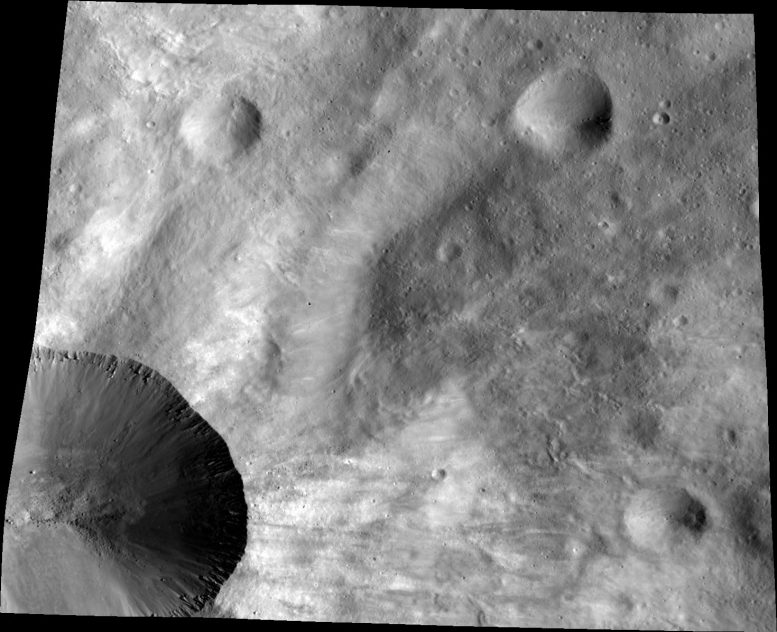
New data from NASA’s Dawn spacecraft shows a close up of the Canuleia Crater on the asteroid Vesta, illustrating the structure of the interior of the crater and complex details of the soil of Vesta.
Like a Hollywood starlet constantly retouching her makeup, the giant asteroid Vesta is constantly stirring its outermost layer to present a young face. Data from NASA’s Dawn mission show that a form of weathering that occurs on the moon and other airless bodies we’ve visited in the inner solar system does not alter Vesta’s outermost layer in the same way. Carbon-rich asteroids have also been splattering dark material on Vesta’s surface over a long span of the body’s history. The results are described in two papers released today in the journal Nature.
“Dawn’s data allow us to decipher how Vesta records fundamental processes that have also affected Earth and other solar system bodies,” said Carol Raymond, Dawn deputy principal investigator at NASA’s Jet Propulsion Laboratory, Pasadena, California. “No object in our solar system is an island. Throughout solar system history, materials have exchanged and interacted.”
Over time, soils on Earth’s moon and asteroids such as Itokawa have undergone extensive weathering in the space environment. Scientists see this in the accumulation of tiny metallic particles containing iron, which dulls the fluffy outer layer. Dawn’s visible and infrared mapping spectrometer (VIR) and framing camera detected no accumulation of such tiny particles on Vesta, and this particular protoplanet, or almost-planet, remains bright and pristine.
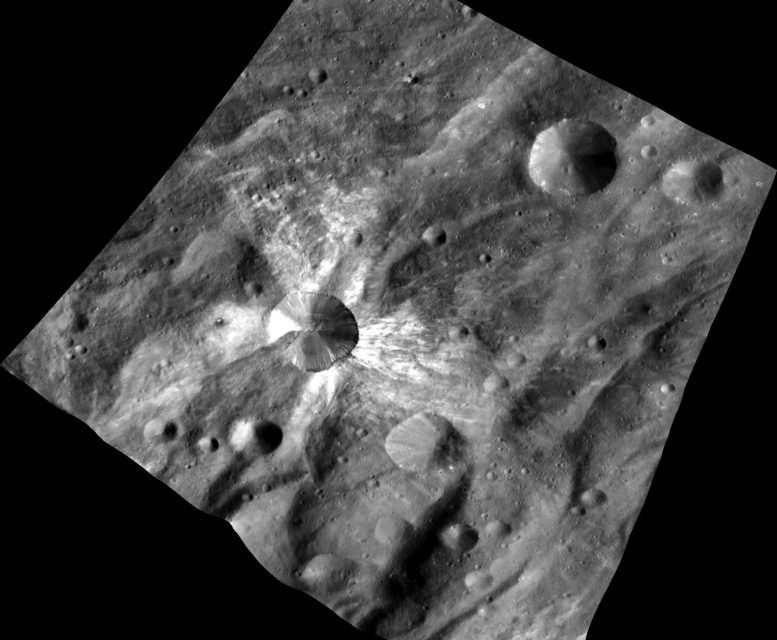
Nevertheless, the bright rays of the youngest features on Vesta are seen to degrade rapidly and disappear into background soil. Scientists know frequent, small impacts continually mix the fluffy outer layer of broken debris. Vesta also has unusually steep topography relative to other large bodies in the inner solar system, which leads to landslides that further mix surface material.
“Getting up close and familiar with Vesta has reset our thinking about the character of the uppermost soils of airless bodies,” said Carle Pieters, one of the lead authors and a Dawn team member based at Brown University, Providence, R.I. “Vesta ‘dirt’ is very clean, well mixed and highly mobile.”
Early pictures of Vesta showed a variety of dramatic light and dark splotches on Vesta’s surface. These light and dark materials were unexpected and now show the brightness range of Vesta is among the largest observed on rocky bodies in our solar system.
Dawn scientists suspected early on that bright material is native to Vesta. One of their first hypotheses for the dark material suggested it might come from the shock of high-speed impacts melting and darkening the underlying rocks or from recent volcanic activity. An analysis of data from VIR and the framing camera has revealed, however, that the distribution of dark material is widespread and occurs both in small spots and in diffuse deposits, without correlation to any particular underlying geology. The likely source of the dark material is now shown to be the carbon-rich material in meteoroids, which are also believed to have deposited hydrated minerals from other asteroids on Vesta.
To get the amount of darkening we now see on Vesta, scientists on the Dawn team estimate about 300 dark asteroids with diameters between 0.6 to 6 miles (1 and 10 kilometers) likely hit Vesta during the last 3.5 billion years. This would have been enough to wrap Vesta in a blanket of mixed material about 3 to 7 feet (1 to 2 meters) thick.
“This perpetual contamination of Vesta with material native to elsewhere in the solar system is a dramatic example of an apparently common process that changes many solar system objects,” said Tom McCord, the other lead author and a Dawn team member based at the Bear Fight Institute, Winthrop, Wash. “Earth likely got the ingredients for life – organics and water – this way.”
Launched in 2007, Dawn spent more than a year investigating Vesta. It departed in September 2012 and is currently on its way to the dwarf planet Ceres.
References:
“Distinctive space weathering on Vesta from regolith mixing processes” by C. M. Pieters, E. Ammannito, D. T. Blewett, B. W. Denevi, M. C. De Sanctis, M. J. Gaffey, L. Le Corre, J.-Y. Li, S. Marchi, T. B. McCord, L. A. McFadden, D. W. Mittlefehldt, A. Nathues, E. Palmer, V. Reddy, C. A. Raymond and C. T. Russell, 31 October 2012, Nature.
DOI: 10.1038/nature11534
“Dark material on Vesta from the infall of carbonaceous volatile-rich material” by T. B. McCord, J.-Y. Li, J.-P. Combe, H. Y. McSween, R. Jaumann, V. Reddy, F. Tosi, D. A. Williams, D. T. Blewett, D. Turrini, E. Palomba, C. M. Pieters, M. C. De Sanctis, E. Ammannito, M. T. Capria, L. Le Corre, A. Longobardo, A. Nathues, D. W. Mittlefehldt, S. E. Schröder, H. Hiesinger, A. W. Beck, F. Capaccioni, U. Carsenty, H. U. Keller, B. W. Denevi, J. M. Sunshine, C. A. Raymond and C. T. Russell, 31 October 2012, Nature.
DOI: 10.1038/nature11561
Never miss a breakthrough: Join the SciTechDaily newsletter.
Follow us on Google and Google News.