
Close Menu
    Facebook X (Twitter) Instagram
    SciTechDaily
    • Biology
    • Chemistry
    • Earth
    • Health
    • Physics
    • Science
    • Space
    • Technology
    Facebook X (Twitter) Pinterest YouTube RSS
    SciTechDaily
    Home»Space»NASA’s “Eyes on Asteroids” Reveals Our Near-Earth Object Neighborhood in Real-Time 3D
    Space

    NASA’s “Eyes on Asteroids” Reveals Our Near-Earth Object Neighborhood in Real-Time 3D

    By Jet Propulsion LaboratoryDecember 13, 20211 Comment4 Mins Read
    Facebook Twitter Pinterest Telegram LinkedIn WhatsApp Email Reddit
    Share
    Facebook Twitter LinkedIn Pinterest Telegram Email Reddit
    NASA Eyes on Asteroids
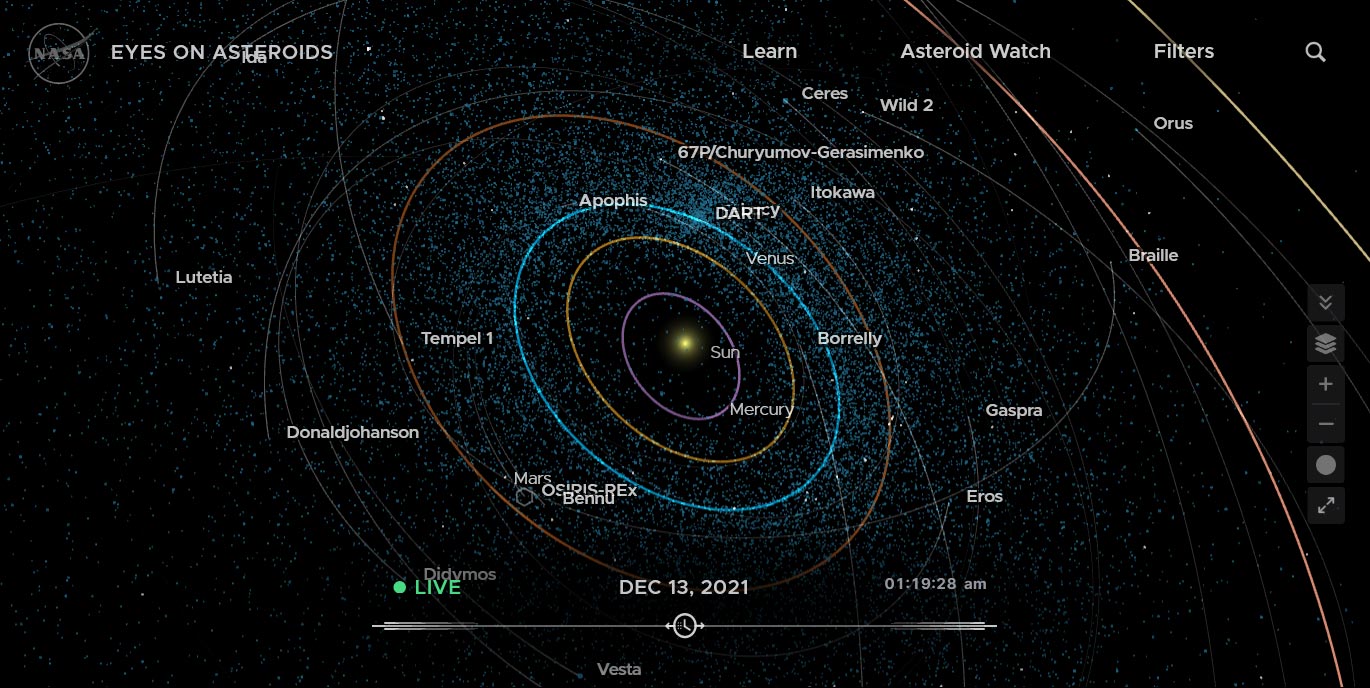
    Fully interactive, Eyes on Asteroids uses science data to help visualize asteroid and comet orbits around the Sun. Zoom in to travel along with your favorite spacecraft as they explore these fascinating near-Earth objects in beautiful 3D. Credit: NASA

    Learn more about the growing population of near-Earth objects with NASA’s new 3D real-time web-based application.

    Through a new 3D real-time visualization tool, you can now explore the asteroids and comets that approach Earth’s orbital neighborhood – and the spacecraft that visit these objects – with a click or a swipe. NASA’s Eyes on Asteroids brings this data to any smartphone, tablet, or computer with an internet connection – no download required.

    Thousands of asteroids and dozens of comets are discovered every single year, some of which – called near-Earth objects (NEOs) – follow orbits that pass through the inner solar system. Now totaling about 28,000, their numbers rising daily, these objects are tracked carefully by NASA-funded astronomers in case any might pose an impact threat to our planet.

    NASA OSIRIS REx Eyes on Asteroids
    Many asteroid missions can be explored within the app, including NASA’s OSIRIS-REx, which scooped samples from asteroid Bennu’s surface in 2020. The spacecraft’s “Touch-And-Go” maneuver is precisely animated by Eyes using pictures captured by the mission. Credit: NASA/JPL-Caltech

    The new web-based app depicts the orbits of every known NEO, providing detailed information on those objects. Using the slider at the bottom of the screen, you can travel quickly forward and backward through time to see their orbital motions. The visualization receives twice-daily updates with the latest data, so as soon as a new object is discovered and its orbit is calculated, it’s added to the app.

    The profiles for many NEO missions can also be explored. Select the “events” tab to view detailed animated models of those spacecraft and their asteroid or comet encounters. For example, search for NASA’s OSIRIS-REx (short for Origins, Spectral Interpretation, Resource Identification, Security-Regolith Explorer) spacecraft to view an animated re-creation of the mission’s October 20, 2020, Touch-And-Go (TAG) sample collection event. Or view NASA’s Double Asteroid Redirect Test (DART) mission, which recently launched as NASA’s first planetary defense demonstration, and even fast-forward to September 26, 2022, when it will impact the asteroid Dimorphos, the small moonlet of the Didymos binary asteroid system.
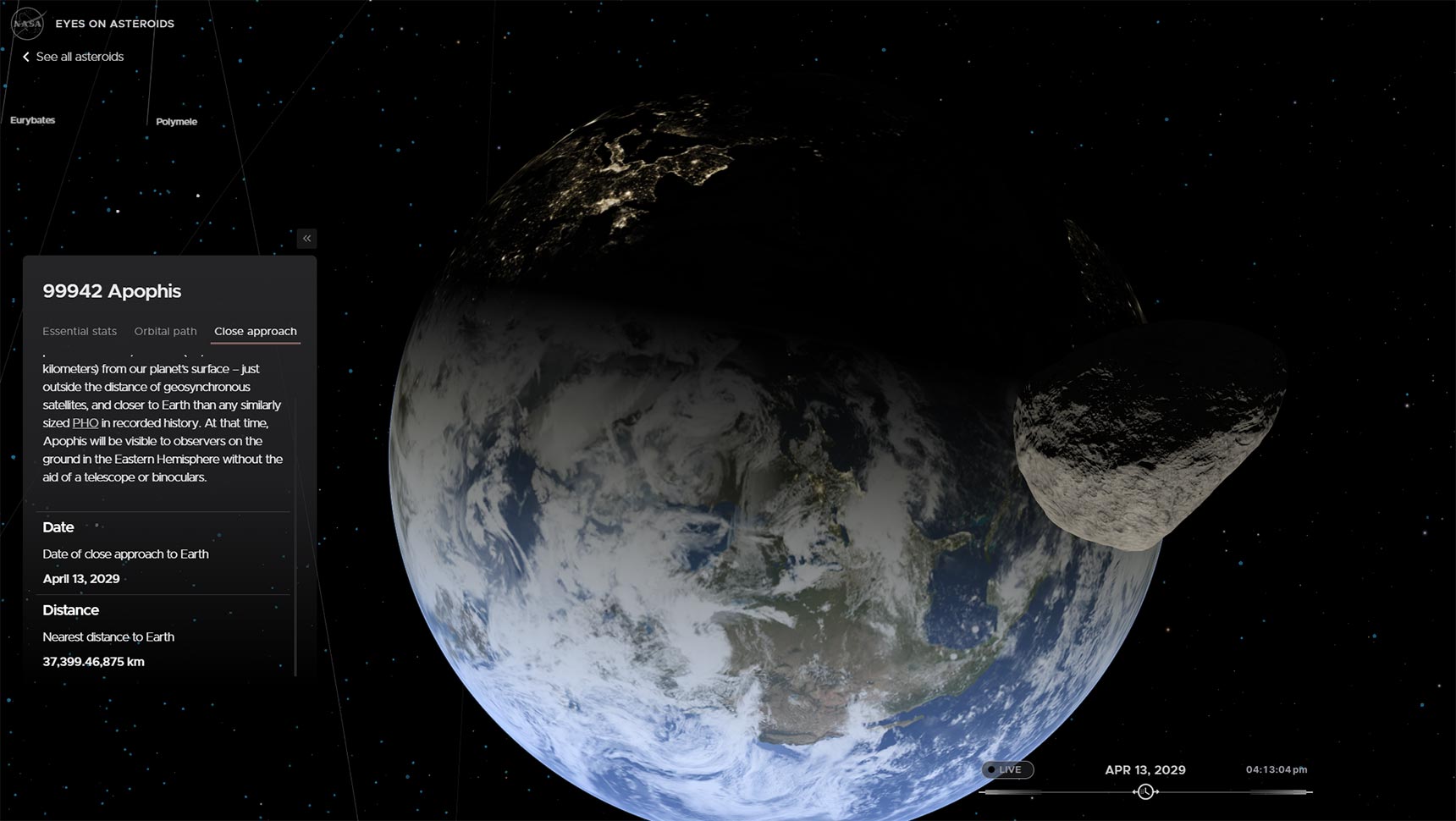
    Apophis NASA Eyes on Asteroids
    Eyes on Asteroids visualizes close approaches, such as asteroid Apophis’ future encounter with Earth. Simply query “Apophis” in the app’s search function and fast forward to April 13, 2029, to see how near the asteroid will get to our planet. Credit: NASA/JPL-Caltech

    “We wanted Eyes on Asteroids to be as user-friendly as possible while telling the stories about humanity’s exploration of these fascinating objects,” said Jason Craig, technical producer of the Visualization Technology Applications and Development team at NASA’s Jet Propulsion Laboratory in Southern California, which developed Eyes. “Every NEO can be found inside the app, as can most of the spacecraft that have visited these objects.”

    There’s also plenty of detail on the fascinating science behind NEOs and the importance of tracking potentially hazardous objects. Just select “Learn” for details on topics like asteroid close approaches to Earth or to fly along with the dramatic close approach of asteroid Apophis on April 13, 2029.

    Asteroid Watch Eyes on Asteroids
    Want to know about the next five asteroid close approaches? Select the “Asteroid Watch” tab to learn more about which near-Earth objects will zoom past our planet in the coming days and weeks. Credit: NASA/JPL-Caltech

    While you’re on the topic, choose the “Asteroid Watch” tab to see the next five asteroid close approaches. “We were keen to include this feature, as asteroid close approaches often generate a lot of interest,” said Craig. “The headlines often depict these close approaches as ‘dangerously’ close, but users will see by using Eyes just how distant most of these encounters really are.”

    Eyes on Asteroids was developed with support from NASA’s Planetary Defense Coordination Office at the agency’s headquarters in Washington and from JPL’s Center for Near-Earth Object Studies. Eyes gathers its data from JPL’s Solar System Dynamics database, which provides real-time data for the orbits, characteristics, and discovery of most known natural bodies (including NEOs) in our solar system.

    Never miss a breakthrough: Join the SciTechDaily newsletter.
    Follow us on Google and Google News.

    Asteroid Astronomy JPL NASA Popular
    Share. Facebook Twitter Pinterest LinkedIn Email Reddit

    Related Articles

    Small Asteroid Strikes Earth’s Atmosphere – Discovered Just Two Hours Before Impact

    1,000th Near-Earth Asteroid Observed by Planetary Radar Since 1968

    NASA’s NEOWISE Asteroid-Hunting Space Telescope Gets Two-Year Mission Extension

    NASA Analysis: Earth Is Safe From Asteroid Apophis Impact for at Least 100 Years

    NASA’s Planetary Defense: “Potentially Hazardous Asteroid” Predicted to Safely Pass by Earth on March 21

    Near-Earth Asteroid 2012 DA14 Makes a Preview Appearance

    Q & A and Video Animations from NASA on Asteroid 2012 DA14 and Its Near Earth Approach

    NASA’s Dawn Gets a Close Up View of the Canuleia Crater on Vesta

    NASA’s WISE Uncovers New Clues on Jovian Trojans

    1 Comment

    1. Pat on December 15, 2021 4:29 pm

      If it sounds to good?????

      Reply
    Leave A Reply Cancel Reply

    • Facebook
    • Twitter
    • Pinterest
    • YouTube

    Don't Miss a Discovery

    Subscribe for the Latest in Science & Tech!

    Trending News

    Bone-Strengthening Discovery Could Reverse Osteoporosis

    Scientists Uncover Hidden Trigger Behind Stem Cell Aging

    Scientists Find Way to Reverse Fatty Liver Disease Without Changing Diet

    Could Humans Regrow Limbs? New Study Reveals Promising Genetic Pathway

    Scientists Reveal Eating Fruits and Vegetables May Increase Your Risk of Lung Cancer

    Scientists Reverse Brain Aging With Simple Nasal Spray

    Scientists Uncover Potential Brain Risks of Popular Fish Oil Supplements

    Scientists Discover a Surprising Way To Make Bread Healthier and More Nutritious

    Follow SciTechDaily
    • Facebook
    • Twitter
    • YouTube
    • Pinterest
    • Newsletter
    • RSS
    SciTech News
    • Biology News
    • Chemistry News
    • Earth News
    • Health News
    • Physics News
    • Science News
    • Space News
    • Technology News
    Recent Posts
    • Europe’s Most Active Volcano Just Got Stranger – Here’s Why Scientists Are Rethinking It
    • Why Are Giant Ants Letting Tiny Ants Crawl All Over Them?
    • Revolutionary Technique Sends Healthy Mitochondria Exactly Where They’re Needed
    • This Student Recreated the Universe in a Bottle. What She Discovered Could Help Reveal How Life Started on Earth
    • Alzheimer’s Symptoms May Start Outside the Brain, Study Finds
    Copyright © 1998 - 2026 SciTechDaily. All Rights Reserved.
    • Science News
    • About
    • Contact
    • Editorial Board
    • Privacy Policy
    • Terms of Use

    Type above and press Enter to search. Press Esc to cancel.