
Close Menu
    Facebook X (Twitter) Instagram
    SciTechDaily
    • Biology
    • Chemistry
    • Earth
    • Health
    • Physics
    • Science
    • Space
    • Technology
    Facebook X (Twitter) Pinterest YouTube RSS
    SciTechDaily
    Home»Space»Near-Earth Asteroid 2012 DA14 Makes a Preview Appearance
    Space

    Near-Earth Asteroid 2012 DA14 Makes a Preview Appearance

    By DC Agle, Jet Propulsion Laboratory; NASAFebruary 15, 20132 Comments3 Mins Read
    Facebook Twitter Pinterest Telegram LinkedIn WhatsApp Email Reddit
    Share
    Facebook Twitter LinkedIn Pinterest Telegram Email Reddit
    mages-depicts-asteroid-2012-DA14
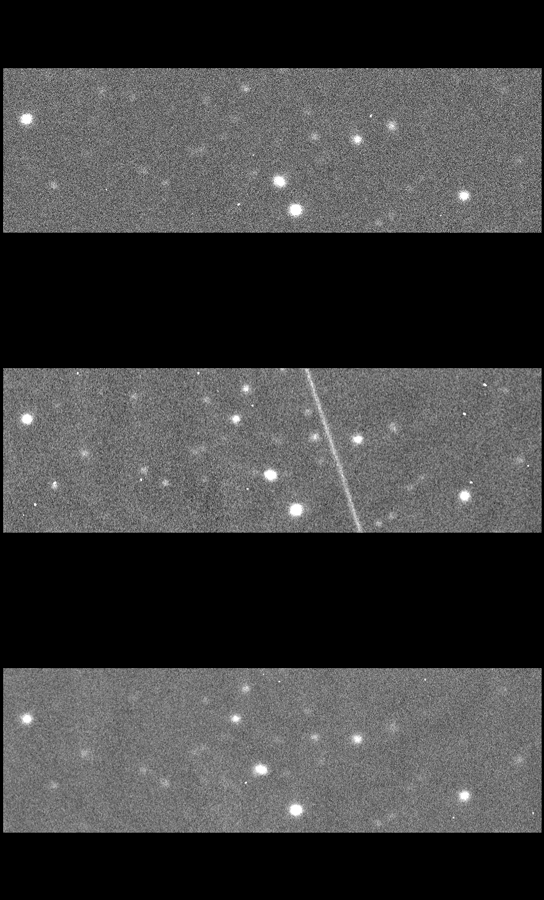
    This animated set of three images depicts asteroid 2012 DA14 as it was seen on February 14, 2013, at a distance of 465,000 miles (748,000 kilometers). Credit: LCOGT/Faulkes

    A new set of animated images show asteroid 2012 DA14 as it nears its record-close approach to Earth on February 15, 2013.

    Like trailers for the coming attraction, new images show asteroid 2012 DA14 on its way to a record-close approach to Earth on February 15. One image, taken by amateur astronomer Dave Herald of Murrumbateman, Australia, on February 13, shows the asteroid as a tiny white dot in the field of view. Another set of animated images, obtained by the Faulkes Telescope South in Siding Springs, Australia, on February 14, and animated by the Remanzacco Observatory in Italy, shows the asteroid as a bright spot moving across the night sky.

    These are some of many images that may be taken of the asteroid during its close — but safe — encounter with Earth. It will be observed by numerous optical observatories worldwide in an attempt to determine its rough shape, spin rate, and composition. NASA scientists will use NASA’s Goldstone Solar System Radar, located in California’s Mojave Desert, to take radar images of the asteroid to determine its precise size and shape on February 16, 18, 19, and 20. The NASA Near Earth Object Observation (NEOO) Program will continue to track the asteroid and predict its future orbit.

    Asteroid 2012 DA14 is about 150 feet (45 meters) in diameter. It is expected to fly about 17,200 miles (27,000 kilometers) above Earth’s surface at the time of closest approach, which is about 11:25 a.m. PST (2:25 p.m. EST) on February 15. This distance is well away from Earth and the swarm of low Earth-orbiting satellites, including the International Space Station, but it is inside the belt of satellites in geostationary orbit (about 22,200 miles, or 35,800 kilometers, above Earth’s surface.) The flyby of 2012 DA14 is the closest-ever predicted approach to Earth for an object this large.

    The NASA Near Earth Object Observation (NEOO) Program detects and tracks asteroids and comets passing close to Earth using ground- and space-based telescopes. The network of projects supported by this program, commonly called “Spaceguard,” discovers these objects, characterizes a subset of them, and plots their orbits to determine if any could be potentially hazardous to our planet.

    The Near-Earth Object Program Office at JPL manages the technical and scientific activities for NASA’s Near-Earth Object Observation Program of the Science Mission Directorate in Washington. JPL is a division of the California Institute of Technology in Pasadena. The NEOO Program Office performs more precise orbit determination on the objects, and predicts whether any will become an impact hazard to the Earth, or any other planet in the solar system.

    Never miss a breakthrough: Join the SciTechDaily newsletter.
    Follow us on Google and Google News.

    Asteroid Astronomy JPL NASA Popular
    Share. Facebook Twitter Pinterest LinkedIn Email Reddit

    Related Articles

    Small Asteroid Strikes Earth’s Atmosphere – Discovered Just Two Hours Before Impact

    NASA’s “Eyes on Asteroids” Reveals Our Near-Earth Object Neighborhood in Real-Time 3D

    1,000th Near-Earth Asteroid Observed by Planetary Radar Since 1968

    NASA’s NEOWISE Asteroid-Hunting Space Telescope Gets Two-Year Mission Extension

    NASA Analysis: Earth Is Safe From Asteroid Apophis Impact for at Least 100 Years

    NASA’s Planetary Defense: “Potentially Hazardous Asteroid” Predicted to Safely Pass by Earth on March 21

    Q & A and Video Animations from NASA on Asteroid 2012 DA14 and Its Near Earth Approach

    NASA’s Dawn Gets a Close Up View of the Canuleia Crater on Vesta

    NASA’s WISE Uncovers New Clues on Jovian Trojans

    2 Comments

    1. Madanagopal.V.C on February 16, 2013 3:19 am

      The companion of this nearby asteroid, could have been the cause of the Russian Meteor shower which lambasted yesterday. Such big asteroid need not
      travel alone. After its fly-past the earth, its destination should be the Sun naturally. Thank YOu.

      Reply
      • Budoy on February 19, 2013 4:55 am

        BOBO ka

        Reply
    Leave A Reply Cancel Reply

    • Facebook
    • Twitter
    • Pinterest
    • YouTube

    Don't Miss a Discovery

    Subscribe for the Latest in Science & Tech!

    Trending News

    Largest-Ever Study Finds Medicinal Cannabis Ineffective for Anxiety, Depression, PTSD

    250-Million-Year-Old Egg Solves One of Evolution’s Biggest Mysteries

    Living With Roommates Might Be Changing Your Gut Microbiome Without You Knowing

    Century-Old Cleaning Chemical Linked to 500% Increased Risk of Parkinson’s Disease

    What if Your Memories Never Happened? Physicists Take a New Look at the Boltzmann Brain Paradox

    One of the Universe’s Largest Stars May Be Getting Ready To Explode

    Scientists Discover Enzyme That Could Supercharge Ozempic-Like Weight Loss Drugs

    Popular Sweetener Linked to DNA Damage – “It’s Something You Should Not Be Eating”

    Follow SciTechDaily
    • Facebook
    • Twitter
    • YouTube
    • Pinterest
    • Newsletter
    • RSS
    SciTech News
    • Biology News
    • Chemistry News
    • Earth News
    • Health News
    • Physics News
    • Science News
    • Space News
    • Technology News
    Recent Posts
    • Scientists Prove There Are Just Six Degrees of Separation in a Social Network
    • Bee Bacteria Could Fix a Major Flaw in Plant-Based Milk
    • Scientists Discover a Surprising Way To Make Bread Healthier and More Nutritious
    • Natural Compounds Boost Bone Implant Success While Killing Bacteria and Cancer Cells
    • After 60 Years, Scientists Uncover Unexpected Brain Effects of Popular Diabetes Drug Metformin
    Copyright © 1998 - 2026 SciTechDaily. All Rights Reserved.
    • Science News
    • About
    • Contact
    • Editorial Board
    • Privacy Policy
    • Terms of Use

    Type above and press Enter to search. Press Esc to cancel.