
Close Menu
    Facebook X (Twitter) Instagram
    SciTechDaily
    • Biology
    • Chemistry
    • Earth
    • Health
    • Physics
    • Science
    • Space
    • Technology
    Facebook X (Twitter) Pinterest YouTube RSS
    SciTechDaily
    Home»Space»NASA’s Cassini Spacecraft Views Three of Saturn’s Small Ring Moon
    Space

    NASA’s Cassini Spacecraft Views Three of Saturn’s Small Ring Moon

    By SciTechDailyJune 29, 2017No Comments2 Mins Read
    Facebook Twitter Pinterest Telegram LinkedIn WhatsApp Email Reddit
    Share
    Facebook Twitter LinkedIn Pinterest Telegram Email Reddit
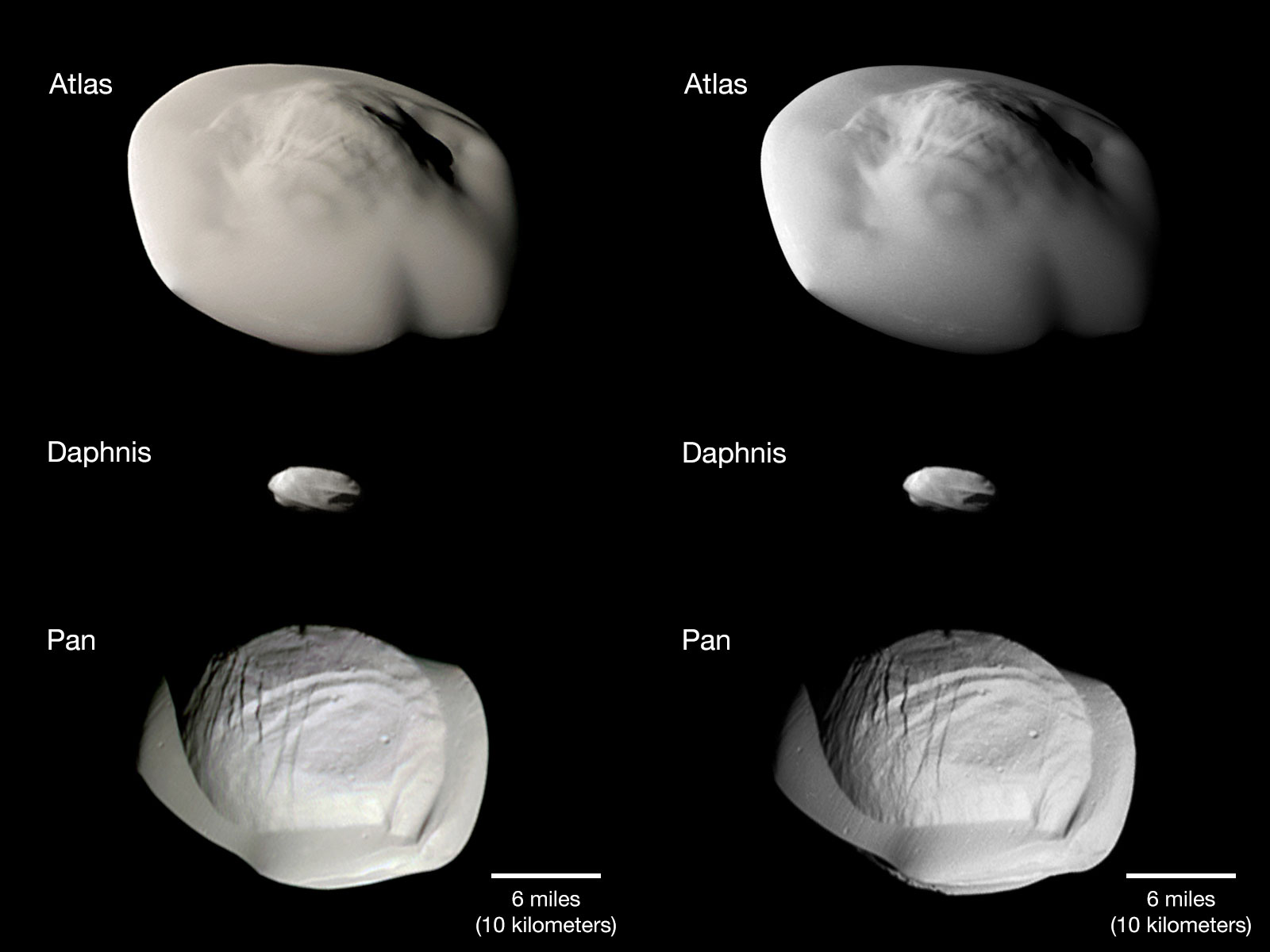
    NASA's Cassini Spacecraft Shows Three of Saturn's Small Ring Moon
    A compilation of images captured by the Cassini Spacecraft displays three of Saturn’s small ring moons: Atlas, Daphnis, and Pan. Credit: NASA/JPL-Caltech/Space Science Institute

    This newly released montage of views from the Cassini Spacecraft shows three of Saturn’s small ring moons: Atlas, Daphnis, and Pan at the same scale for ease of comparison.

    Two differences between Atlas and Pan are obvious in this montage. Pan’s equatorial band is much thinner and more sharply defined, and the central mass of Atlas (the part underneath the smooth equatorial band) appears to be smaller than that of Pan.

    Images of Atlas and Pan taken using infrared, green and ultraviolet spectral filters were combined to create enhanced-color views (left side), which highlight subtle color differences across the moons’ surfaces at wavelengths not visible to human eyes. (The Daphnis image in Figure 1 (left) was colored using the same green filter image for all three color channels, adjusted to have a realistic appearance next to the other two moons.)

    A version of the montage using only monochrome images is also provided (right side).

    All of these images were taken using the Cassini spacecraft narrow-angle camera. The images of Atlas were acquired on April 12, 2017, at a distance of 10,000 miles (16,000 kilometers) and at a sun-moon-spacecraft angle (or phase angle) of 37 degrees. The images of Pan were taken on March 7, 2017, at a distance of 16,000 miles (26,000 kilometers) and a phase angle of 21 degrees. The Daphnis image was obtained on January 16, 2017, at a distance of 17,000 miles (28,000 kilometers) and at a phase angle of 71 degrees. All images are oriented so that north is up.

    Never miss a breakthrough: Join the SciTechDaily newsletter.
    Follow us on Google and Google News.

    Astronomy ATLAS Cassini-Huygens Mission Daphnis Saturn
    Share. Facebook Twitter Pinterest LinkedIn Email Reddit

    Related Articles

    New Findings Emerge About Tiny Moons Nestled In Saturn’s Rings

    Cassini Views Outer Edge of Saturn’s Main Rings

    NASA’s Cassini Spacecraft Views Saturn’s ‘Flying-Saucer’ Moon Atlas Up Close

    New Cassini Image of Saturn’s Ring-Embedded Moon Daphnis

    New Cassini Image of Small Moon Daphnis

    NASA’s Cassini Spots Lightning in Saturn’s Northern Hemisphere

    Cassini Changes Orbit, Saturn’s Rings Visible Again

    Cassini Data Reveals Likely Subsurface Ocean on Titan

    Heat from Within the Planet Powers Saturn’s Jet Streams

    Leave A Reply Cancel Reply

    • Facebook
    • Twitter
    • Pinterest
    • YouTube

    Don't Miss a Discovery

    Subscribe for the Latest in Science & Tech!

    Trending News

    Black Hole Collisions May Follow a Surprisingly Simple Rule

    The Eye Has a Hidden Cleanup System and Scientists Just Discovered It

    The Truth About Vikings Is More Complicated Than Museums Admit

    New Catalyst Turns Stubborn Plant Waste Into Valuable Chemicals

    Quantum Gravity May Be Far Less Quantum Than Physicists Expected

    New Tool Supercharges Immunotherapy Against Prostate Cancer

    The Hidden Cancer Risk of Ketogenic Diets

    One Asteroid Collision May Have Rocked Earth, Mars, and the Moon

    Follow SciTechDaily
    • Facebook
    • Twitter
    • YouTube
    • Pinterest
    • Newsletter
    • RSS
    SciTech News
    • Biology News
    • Chemistry News
    • Earth News
    • Health News
    • Physics News
    • Science News
    • Space News
    • Technology News
    Recent Posts
    • Scientists Crack the Code for Making “Impossible” Nanocrystals
    • Earth’s Hidden Thermostat Has Regulated Climate for 60 Million Years
    • This 518-Million-Year-Old Creature Reveals How Spiders Got Their Bite
    • Forgotten for 20 Years, This 240-Million-Year-Old Fossil Reveals a New Reptile Species
    • 190-Year-Old Museum Specimen Solves a Pangolin Mystery
    Copyright © 1998 - 2026 SciTechDaily. All Rights Reserved.
    • Science News
    • About
    • Contact
    • Editorial Board
    • Privacy Policy
    • Terms of Use

    Type above and press Enter to search. Press Esc to cancel.