
Close Menu
    Facebook X (Twitter) Instagram
    SciTechDaily
    • Biology
    • Chemistry
    • Earth
    • Health
    • Physics
    • Science
    • Space
    • Technology
    Facebook X (Twitter) Pinterest YouTube RSS
    SciTechDaily
    Home»Technology»Photosynthesis Design Principles Could Improve Solar Technology
    Technology

    Photosynthesis Design Principles Could Improve Solar Technology

    By Jim Shelton, Yale UniversityJune 28, 2017No Comments3 Mins Read
    Facebook Twitter Pinterest Telegram LinkedIn WhatsApp Email Reddit
    Share
    Facebook Twitter LinkedIn Pinterest Telegram Email Reddit
    Researchers Identify Process to Improve Solar Technology
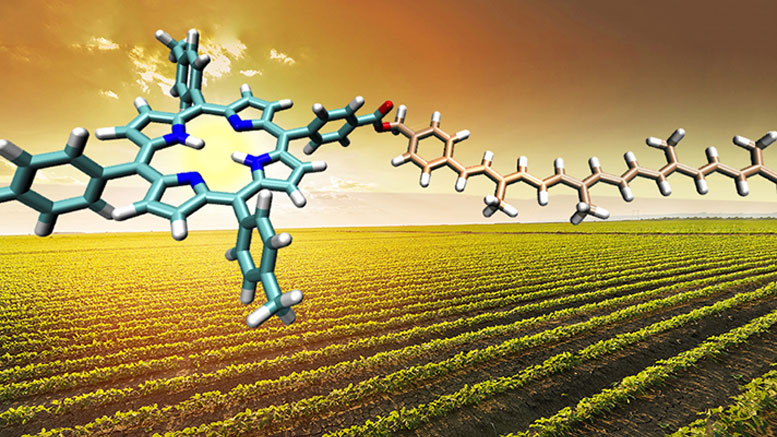
    Yale researchers have identified a natural process for energy transfer using carotenoids that could improve energy transfer systems and sustainable crop plant photosynthesis.

    Researchers from Yale University have identified natural design principles in photosynthesis that could improve energy efficiency in new solar technology.

    In photosynthesis, green plants use sunlight to convert carbon dioxide and water into sugars and oxygen. It is a highly complex series of reactions, scientists say — reactions that researchers increasingly try to mimic when creating renewable energy alternatives, such as solar cells that use sunlight to synthesize fuels rather than to produce electricity.

    One of the more intriguing features of photosynthesis, scientists say, is how it makes use of visible and infrared solar light. This is accomplished in natural photosynthetic systems by light-harvesting molecular frameworks — photosynthetic antennas — that trigger the quick removal of electrons from water to fix carbon dioxide. But in order for photosynthetic antennas to work smoothly, they need the protection of chemical pigments called carotenoids.

    In a new study in the Proceedings of the National Academy of Sciences, researchers from Yale and five other institutions have identified the vibrational fingerprints of pigments responsible for protecting photosynthetic antennas. The study will be published online the week of June 26.

    “Our study has revealed a fundamental process for energy transfer,” said Yale chemistry professor Victor Batista, a co-corresponding author of the research. “The same way that paintings get bleached by light, materials for photo conversion also suffer from detrimental processes. Nature has evolved these systems with carotenoids that pick up the excess energy and protect the antennas from decomposition reactions.”

    Understanding this process and having a “fingerprint” to identify the specific pigments involved have the potential to help scientists engineer better energy transfer systems in solar technologies, including in crop plant photosynthesis for more sustainable farming.

    The idea for the research grew out of discussions at a Telluride summer program for graduate students organized by the Yale Energy Sciences Institute. The principal investigators are Batista and Bruno Robert of the Institute of Biology and Technology Saclay.

    Lead authors are former Batista lab members Junming Ho, now a faculty member at UNSW Sydney, and Dalvin Mendez-Hernandez, now a faculty member at the University of Puerto Rico-Cayey, and Elizabeth Kish of the Institute of Biology and Technology Saclay. Additional authors are Katherine WongCarter, Smitha Pillai, Gerdenis Kodis, Devens Gust, Thomas A. Moore, and Ana L. Moore of Arizona State University, and Oleg Poluektov and Jens Niklas of Argonne National Laboratory.

    Support for the research came from the European Research Council, the National Research Agency, the French Infrastructure for Integrated Structural Biology, the U.S. Department of Energy, the Singapore Agency for Science, Technology and Research, and Yale.

    Reference: “Triplet–triplet energy transfer in artificial and natural photosynthetic antennas” PNAS.
    DOI: 10.1073/pnas.1614857114

    Never miss a breakthrough: Join the SciTechDaily newsletter.
    Follow us on Google and Google News.

    Green Technology Photosynthesis Solar Energy Solar Power Yale University
    Share. Facebook Twitter Pinterest LinkedIn Email Reddit

    Related Articles

    DMSO Treatment Could Transform Solar Cells, Boosts Efficiency

    Light-Capturing Nanomaterials to Boost Efficiency of Photovoltaic Solar Cells

    MIT Energy Initiative Report Highlights the Future of Solar Energy

    World Record in Solar Efficiency, Over 40% of Sunlight Converted Into Electricity

    Teaming Up to Slash Solar Cell Cost

    Polymer Solar Cell Efficiency Improved With Infrared-Absorbing Polymer

    Lithium Iron Phosphate Batteries Could Lead to Cheaper, More Efficient Solar Energy

    Researchers Develop IE2 for Analyzing Solar Cell Materials

    Researchers Study the Use of Photosystem-I as Photovoltaic Panels

    Leave A Reply Cancel Reply

    • Facebook
    • Twitter
    • Pinterest
    • YouTube

    Don't Miss a Discovery

    Subscribe for the Latest in Science & Tech!

    Trending News

    Monster Storms on Jupiter Unleash Lightning Beyond Anything on Earth

    Scientists Create “Liquid Gears” That Spin Without Touching

    The Simple Habit That Could Help Prevent Cancer

    Millions Take These IBS Drugs, But a New Study Finds Serious Risks

    Scientists Unlock Hidden Secrets of 2,300-Year-Old Mummies Using Cutting-Edge CT Scanner

    Bread Might Be Making You Gain Weight Even Without Eating More Calories

    Scientists Discover Massive Magma Reservoir Beneath Tuscany

    Europe’s Most Active Volcano Just Got Stranger – Here’s Why Scientists Are Rethinking It

    Follow SciTechDaily
    • Facebook
    • Twitter
    • YouTube
    • Pinterest
    • Newsletter
    • RSS
    SciTech News
    • Biology News
    • Chemistry News
    • Earth News
    • Health News
    • Physics News
    • Science News
    • Space News
    • Technology News
    Recent Posts
    • Simple Blood Test May Predict Alzheimer’s Years Before Brain Scans Show Signs
    • Scientists Say Adding This Unusual Seafood to Your Diet Could Reverse Signs of Aging
    • U.S. Waste Holds $5.7 Billion Worth of Crop Nutrients
    • Scientists Say a Hidden Structure May Exist Inside Earth’s Core
    • Doctors Surprised by the Power of a Simple Drug Against Colon Cancer
    Copyright © 1998 - 2026 SciTechDaily. All Rights Reserved.
    • Science News
    • About
    • Contact
    • Editorial Board
    • Privacy Policy
    • Terms of Use

    Type above and press Enter to search. Press Esc to cancel.