

Purdue researcher Yulia Pushkar is building an artificial leaf that mimics plant photosynthesis to create clean, storable hydrogen fuel. This breakthrough could surpass current solar efficiency and reshape the renewable energy landscape within the next decade.
Humans can do lots of things that plants can’t do. We can walk around, we can talk, we can hear and see and touch. But plants have one major advantage over humans: They can make energy directly from the sun.
That process of turning sunlight directly into usable energy – called photosynthesis – may soon be a feat humans are able to mimic to harness the sun’s energy for clean, storable, efficient fuel. If so, it could open a whole new frontier of clean energy. Enough energy hits the earth in the form of sunlight in one hour to meet all human civilization’s energy needs for an entire year.
Yulia Puskhar, a biophysicist and professor of physics in Purdue’s College of Science, may have a way to harness that energy by mimicking plants.
A Third Frontier of Renewable Energy
Wind power and solar power, harnessed by photovoltaic cells, are the two major forms of clean energy available. Adding a third — synthetic photosynthesis — would dramatically change the renewable energy landscape. The ability to store energy easily, without requiring bulky batteries, would dramatically improve humans’ ability to power society cleanly and efficiently.
Both wind turbines and photovoltaics have a downside in terms of environmental effects and complicating factors. Pushkar hopes that artificial photosynthesis might be able to bypass those pitfalls.
“We and other researchers around the world are working incredibly hard to try to come up with accessible energy,” Pushkar said. “Energy that is clean and sustainable that we can create with nontoxic, easily available elements. Our artificial photosynthesis is the way forward.”
Photosynthesis is a complex dance of processes whereby plants convert the sun’s radiance and water molecules into usable energy in the form of glucose. To do this, they use a pigment, usually the famous chlorophyll, as well as proteins, enzymes, and metals.
The closest process to artificial photosynthesis humans have today is photovoltaic technology, where a solar cell converts the sun’s energy into electricity. That process is famously inefficient, able to capture only about 20% of the sun’s energy. Photosynthesis, on the other hand, is radically more efficient; it is capable of storing 60% of the sun’s energy as chemical energy in associated biomolecules.
The efficiency of simple photovoltaic cells – solar panels – is limited by semiconductors’ ability to absorb light energy and by the cell’s ability to produce power. That limit is something scientists could surpass with synthetic photosynthesis.
Breaking Barriers with Water-Splitting Technology
“With artificial photosynthesis, there are no fundamental physical limitations,” Pushkar said. “You can very easily imagine a system that is 60% efficient because we already have a precedent in natural photosynthesis. And if we get very ambitious, we could even envision a system of up to 80% efficiency.
“Photosynthesis is massively efficient when it comes to splitting water, a first step of artificial photosynthesis. Photosystems II proteins in plants do this a thousand times a second. Blink, and it’s done.”
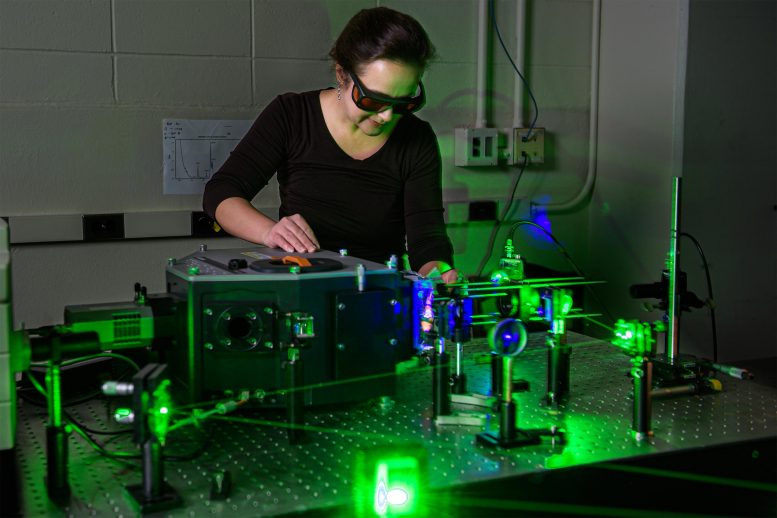
Pushkar’s group is mimicking the process by building her own artificial leaf analog that collects light and splits water molecules to generate hydrogen. Hydrogen can be used as a fuel by itself via fuel cells or be added to other fuels such as natural gas, or built into fuel cells to power everything from vehicles to houses to small electronic devices, laboratories and hospitals. Her most recent discovery, an insight into the way water molecules split during photosynthesis, was recently published in the journal Chem Catalysis: Cell Press.
Scientists in Pushkar’s lab experiment with natural photosystem II proteins and synthetic catalysts combinations in attempts to understand what works best – and why. She also puts a priority on using compounds and chemicals that are readily abundant on Earth, easily accessible and nontoxic to the planet.
Progress in artificial photosynthesis is complicated, though, by the fact that photosynthesis is so multifaceted, a fact bemoaned by biochemistry students everywhere.
“The reaction is very complex,” Pushkar said. “The chemistry of splitting water molecules is extremely intricate and difficult.”
From Evolution to Innovation
Scientists have been working on artificial photosynthesis since the 1970s. That’s a long time, but not when you remember that photosynthesis took millions of years to evolve. Not only that, but scientists believe that, unlike flight, communication or intelligence, photosynthesis has evolved only once – about 3 billion years ago, only about 1.5 billion years into Earth’s existence.
Pushkar posits that within the next 10-15 years, enough progress will have been made that commercial artificial photosynthesis systems may begin to come online. Her research is funded by the National Science Foundation.
Reference: “Do multinuclear 3d metal catalysts achieve O–O bond formation via radical coupling or via water nucleophilic attack? WNA leads the way in [Co4O4]n+” by Roman Ezhov, Alireza Karbakhsh Ravari, Gabriel Bury, Paul F. Smith and Yulia Pushkar, 3 May 2021, Chem Catalysis: Cell Press.
DOI: 10.1016/j.checat.2021.03.013
Never miss a breakthrough: Join the SciTechDaily newsletter.
Follow us on Google and Google News.
12 Comments
So no specific technology announcement with details of costs or energy outputs. The usual claim of biomass energy eff is closer to 1% so solar at 20% already looks much better despite the storage issue. Even if the photo synthesis technology existed in a real device, it has the same problem that PV has, seasonal output varies enormously, summer is 5* that of winter in the US NE.
We already have a process that splits water at 50% eff using high temperature heat and with cheap catalysts, Sulfur & Iodine ie the S-I process 24/365. We already have a dense source of heat too, one that is not depending on covering zillions of acres of land but can be done in a small compact reactor, an MSR. So an acre of land could easily produce a GW of hydrogen for known cost. Why don’t we use it, probably because fossil fuel won’t go away until their CO2 emission costs are included.
The claimed 60 percent efficiency of biological photosynthesis is utter nonsense. The author is breathtakingly ignorant of the subject matter.
It also has to do with infrastructure and customer knowhow and thus demand! I recently read that electic vehicles were out and being commercially sold a century ago but the oil industry was powerful and wealthy and so bought them out of business! Now the “powers that be” (like those running things from Davos) want everything online so electric is a must. Nevermind the carbon monoxide/ozone cycle of combustion and the lie of it ever being incomplete! By the way the CO2 thing is also a myth since all plants respire at night and produce far more CO2 then anything little Man can; not to mention what volcanoes produce like all the ones going off relatively recently. I’m not saying fossil fuel is good granted as it puts other far deadlier actual poisons to biological life into the only atmosphere we have. But the real power of the future is so-called “zero point” energy or as I theorize it to be, infinite points energy! Energy is all around us in so many various forms (just think about all our electronics just “wasting” energy) we just have yet to figure out how to haress them and efficiently or at least us the masses don’t know yet! They can’t hide the truth forever though!
I read actual photosynthesis is around upper 20s in efficiency
Evolution is a scam. Now with that being said, I am convinced that this may be the only way that electric vehicles may stand a chance, provided that this sort of battery is significantly less harmful to the environment than conventional solar powered batteries.
It’s tiresome when some 15 year old “reporter” tells me all about green energy sources when they can’t even add two three digit numbers together without their smartphone.
Jam – the oil industry was rich and powerful because they could provide all of the power people wanted WHEN they wanted it. Now California with their billions in “green energy” is telling us that we are going to have rolling blackouts so that the air conditioning in retirement homes will go out and your mother and father can die. There is a reason why oil is powerful. It is because the environmentalists convinced you that nuclear power is dangerous. You had your chance and decided that following is better than leading.
Why you can’t start mapping with zero, where would it be if nothing, null, is impossible, so start with one, by one, by one. Cubit. A square, cubed, is representative of the least measure of accuracy, in order to define one. One in relativity, 2 by 2, then not decimals but smaller more precise measurements. 15 picometers, by 2 is the approximate radius of an atom of helium, helium because it’s an identifiable isotope of hydrogen. The measure of the protons temperature, that which most closely represents cosmic background radiation. Thus the expellatikn of the rotation of the protons energy, to give force to the matter which it must move in order to creatrcentifugal effect allowing the visual motion of its magnetic momentum, the greater light and the lesser light, reflecting upon the density of the matter in which the proton is put, or where we exist. The gaining of sufficiency is related to the matters requirements for the either temporary creation of atmospheric qualities or more permanent, self sustaining, nuclear ar architectures supported proposed life. The drawing of a subset of the set… hydrogen from the oxygen, waters energy. And for aleph, is a spiderweb spun like a snowflake or does it coincide with the moment of its manifestation in its manifested state of location, or both, as a map being copied from a map. Have fun.
This research and study is very worthwhile and will probably be useful in many areas. Please keep up the great work.
Tom K and John Mak > The author is listed as Purdue university.
This sounds like it’s going to consume inordinate amounts of water – probably the last thing we need, and not exactly what I’d call environmentally friendly.
The world is in the dire paucity of clean energy. We must convert our way of fulfilling energy to clean ones.Hopefully the researchers like Yulia are working hard. Thanks to them.