

Summer Haag and Clyde Kertzer made major news in the math world while working on a summer research project.
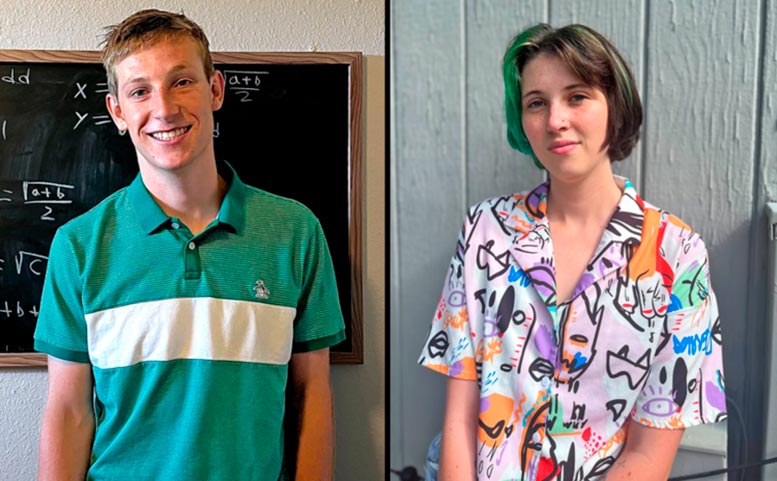
Prior to the end of the 2022-2023 academic year, graduate student Summer Haag and junior Clyde Kertzer were looking for summer research opportunities in mathematics, their subject of study.
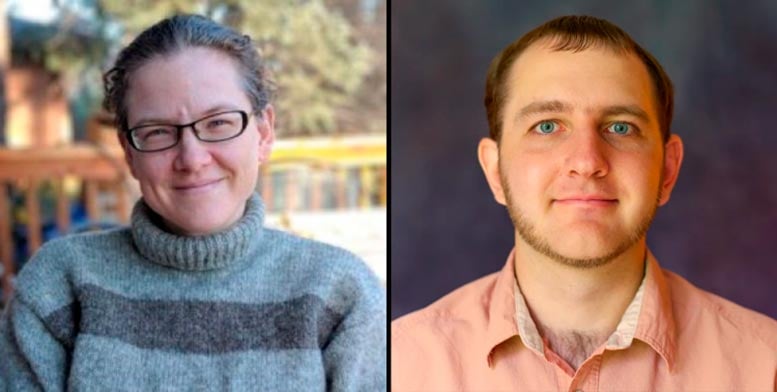
It was an REU (Research Experience for Undergrads) with Katherine (Kate) Stange, CU Boulder associate professor in the Department of Mathematics, and James Rickards, a postdoctoral researcher in the same department, that caught their eye, as it dealt with a topic in which they both had an abiding interest: number theory.
“I knew in undergrad that number theory is what I wanted to do,” says Haag. “When I saw Kate and James were doing a number theory REU, I said, ‘That one! I want that one!’”
“I’ve taken a bunch of number theory courses here at CU that I’ve really enjoyed,” says Kertzer, who withdrew his applications to other REUs when he was accepted into the one with Stange and Rickards. “I was super excited.”
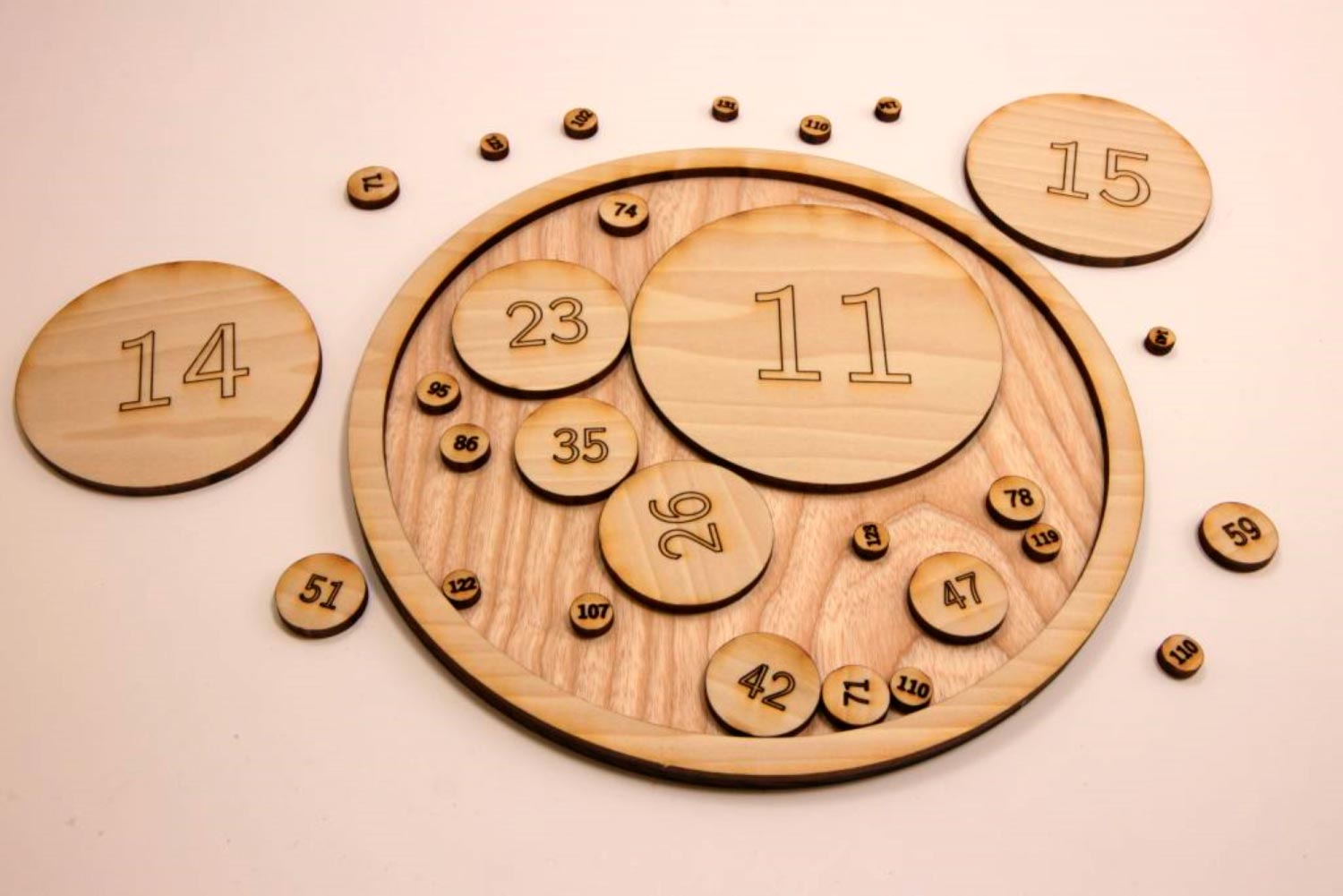
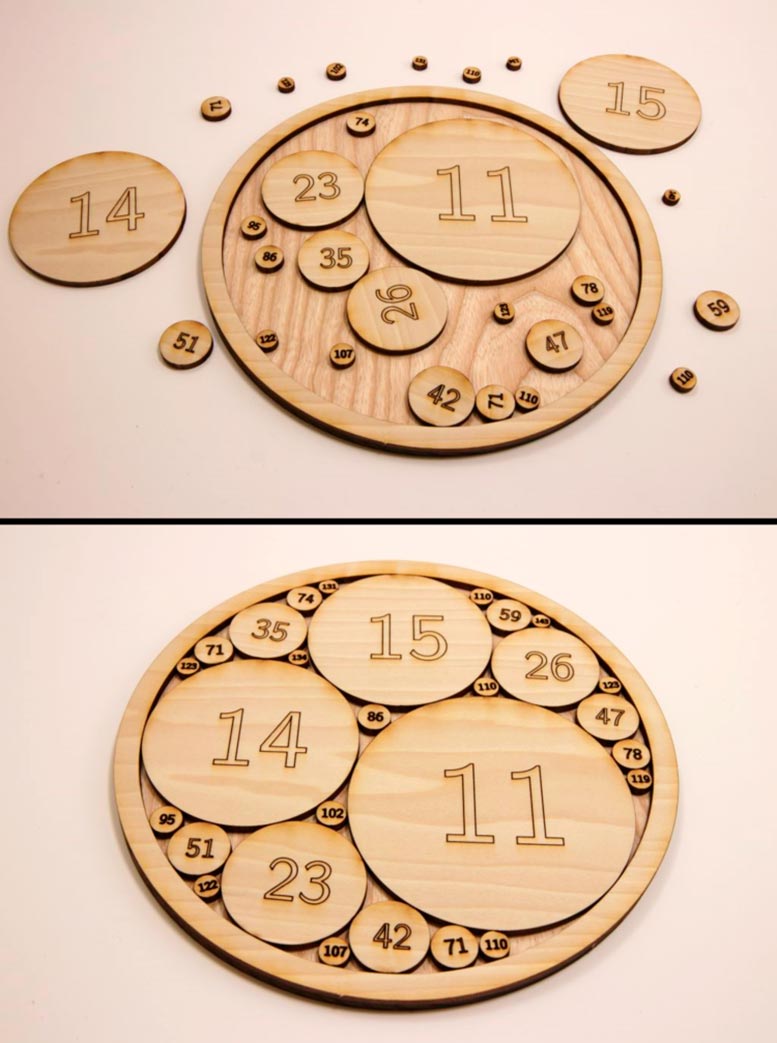
The REU would explore a branch of number theory called Apollonian circle packings, which are fractals, or never-ending patterns, made up of infinite circles just touching each other but never overlapping.
Neither Haag nor Kertzer had much experience with circle packings.
“I’d seen quadratic forms before, and I’d seen Mobius inversions, but I’d never seen them pertaining to circle packings,” says Haag. “I was excited to learn that stuff.”
“I went to the library and got a book, the only book I could find on circle packings, and started reading,” says Kertzer.
Room to Explore
For the first few weeks of the REU, Stange and Rickards gave Haag and Kertzer the background information they’d need for the project and taught them how to use code that Rickards had developed to gather data on circle packings. After that, they gave Haag and Kertzer room to explore.
“We set out with a fun project idea that would give students a chance to experience research by collecting data, looking for patterns and proving them,” says Stange. “We didn’t have a very definitive goal.”
“We had a long list of possible problems to explore,” Rickards adds. “There was no real end goal in sight.”
That changed, however, when Haag and Kertzer’s explorations produced data that called a well-known math conjecture into question.
The local-global conjecture, widely accepted for the better part of two decades, predicts the curvatures of the circles inside a circle packing. According to this conjecture, if a researcher knows the curvatures of a few circles in a packing (the “local” circles), that researcher can then predict the curvatures of the circles in the rest of the packing (the “global” circles).
Time and again, evidence seemed to support the local-global conjecture, to the point that pretty much everyone familiar with it assumed it was true.
“Even though it hadn’t been proven, it was almost guaranteed to be true,” says Haag.
Two Numbers Instead of One
But then, while entering numbers into Rickards’ code, Haag and Kertzer decided to do something that hadn’t yet been done. Instead of entering one number into the code, they entered two and looked at the resultant packings.
That’s when things got interesting. Numbers that, according to the local-global conjecture, should have appeared together in the same packings didn’t.
Stange likens the situation to a jail. It was as though the numbers that were supposed to be locked up had dug a tunnel when no one was looking and escaped.
Haag, Kertzer, Stange and Rickards all knew what this data meant for the local-global conjecture, which is why Rickards’ immediate reaction was to double-check his code for errors. But there were none. The code was correct. The local-global conjecture, on the other hand, was not.
Over the next few days, Stange and Rickards put together a proof of their findings, working so fast, so feverishly and so precisely that Haag and Kertzer couldn’t help but be inspired.
“It was really impressive,” says Kertzer. “That’s the point where we want to be as mathematicians.”
The four published a paper in the preprint server arXiv with a title as unambiguous as its content is eye-opening: “The Local-Global Conjecture for Apollonian Circle Packings Is False.”
Not bad for a summer research project.
The Playful Side of Math
But what Haag and Kertzer found even more gratifying than disproving a major outstanding conjecture was experiencing first-hand the creative side of mathematics research. It wasn’t all formulas and rules. It was intuition, exploration, play.
“Some advice Kate gave me will stick with me for a while,” Kertzer recalls. “‘If you’re not sure, just follow your nose.’”
Math research, Stange explains, “often feels like exploring a jungle. You aren’t sure what you’ll find, but the creativity comes in deciding what leaf to turn over, which path to take, what questions you are trying to answer, and how you will go about answering them. Some of the deepest insights in mathematics come from creative leaps connecting apparently unconnected ideas.”
Luckily for Haag and Kertzer, there is plenty more jungle to explore.
“Some of my students are so thoroughly confused that I want to do research in math,” Haag says. “They’re like, ‘Isn’t math done? How many questions could possibly be unsolved in math?’”
Haag smiles when she answers: “So many.”
Never miss a breakthrough: Join the SciTechDaily newsletter.
Follow us on Google and Google News.