
An EPFL and UNIGE team demonstrates how motivation affects the neural circuits of perception and influences decision-making.
Whether we are in a good mood or a bad mood, focused or distracted, in need or not in need, our internal states have a direct impact on our perceptions and decisions. Thanks to the research of psychologists Robert Yerkes and John Dillingham Dodson, the influence of motivation on behavioral task performance has been understood for more than a century. However, the precise impact of motivation on the brain is still unknown.
Researchers from the University of Geneva (UNIGE) and the EPFL have shown how motivation changes the brain circuits in mice that control sensory perception before making decisions. The research explains why having too much or too little motivation might impact our perception and therefore our decisions. These findings, which were published in the journal Neuron, provide new insight into learning strategies.
Many of our choices, like picking a restaurant for lunch or getting up early to go to work, are driven by demands like making money or sating our hunger. But making decisions is a complicated process that may also be impacted by outside factors like the environment or other people as well as by internal variables like our mood, attention, or degree of motivation.
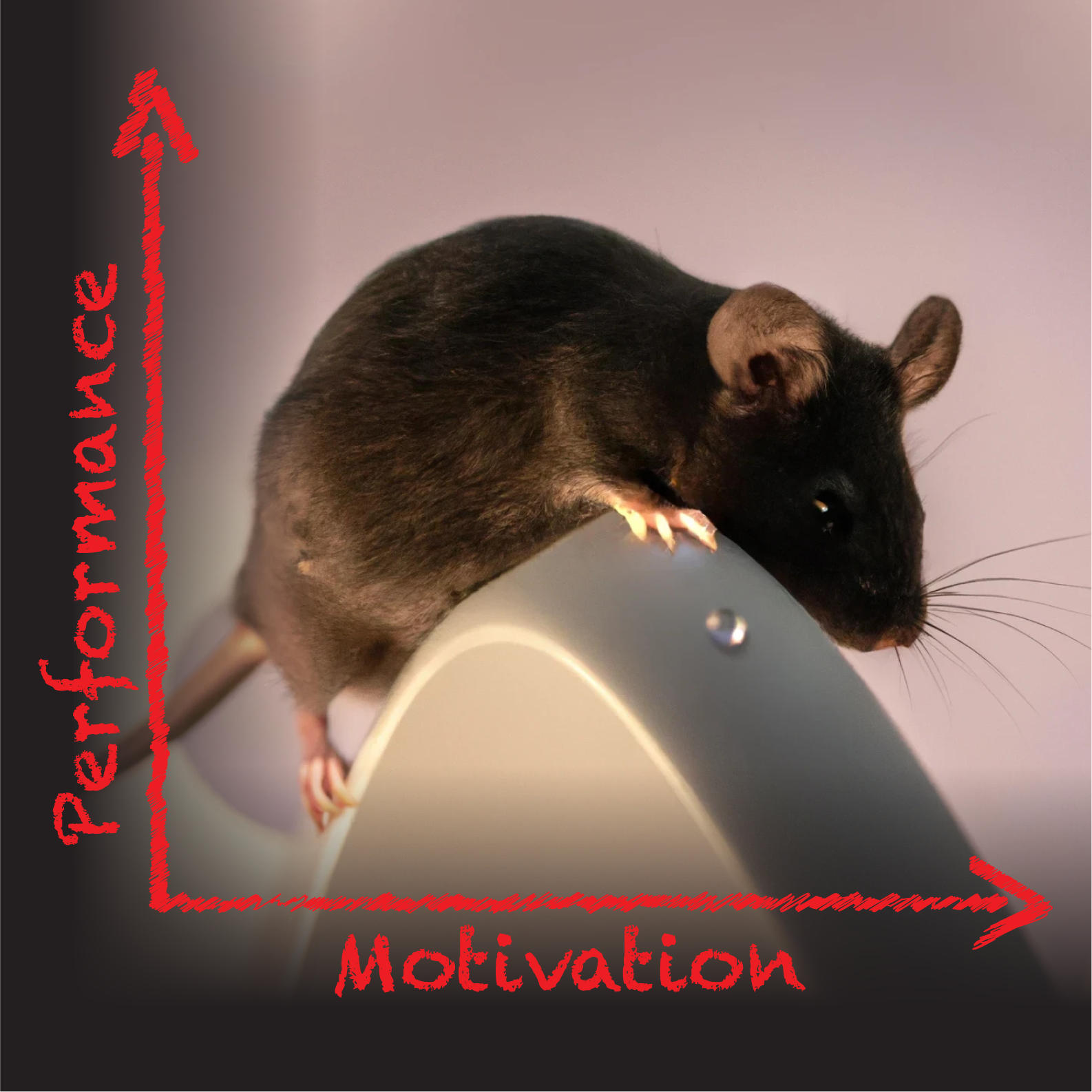
The laboratory of Sami El-Boustani, Assistant Professor in the Department of Basic Neurosciences at the Faculty of Medicine of the UNIGE and recipient of an Eccellenza fellowship (SNSF), is studying the neural circuits involved in decision-making. In recent work, carried out in collaboration with Professor Carl Petersen’s team at EPFL, his lab has studied the role played by a specific internal state – motivation – in perception and decision-making. For more than a century it has been known that a relationship between motivation and performance exists thanks to the work of American psychologists Robert Yerkes and John Dillingham Dodson.
Too much or too little motivation is detrimental to performance. However, the way in which this impacts our neural circuits remains unclear. ‘‘We wanted to observe how sensory information transmitted by neurons in the cortex is altered by the degree of motivation and to what extent the latter can have an effect on learning and performance in a decision-making task,’’ explains Sami El-Boustani, the lead author of the study.
The research team developed a behavioral paradigm involving mice in a controlled water consumption regime. They first trained these rodents to respond to tactile stimuli via two whiskers (A and B) and to produce an action – licking a spout – only for whisker A in order to obtain a drop of water. Following this training, these mice reacted mainly to the stimulation of whisker A, thus indicating their ability to discriminate between these two sensations. Finally, the researchers conducted these experiments at decreasing levels of thirst in order to vary the motivation of the rodents to participate in the task.
State of Hyper-Motivation Blurs Sensory Information
In a state of great thirst – therefore of great motivation – rodents performed poorly. They licked the spout indiscriminately, without distinguishing between the whiskers stimulated. In contrast, in a state of moderate thirst, the choice of their action became optimal. They mainly licked the spout when whisker A was stimulated. Finally, when they were not very thirsty, their performance in the task dropped again.
By observing the activity of neuronal populations responsible for perceptual decision-making in these mice, the researchers discovered that neurons in these circuits were flooded with electrical signals when mice were hyper-motivated. Conversely, in a state of low motivation, the signals were too weak. ‘‘Hyper-motivation leads to strong stimulation of cortical neurons, which causes a loss of precision in the perception of tactile stimuli,’’ says Giulio Matteucci, a Postdoctoral Fellow in Sami El-Boustani’s laboratory and the study’s first author.
In contrast, in the low-motivation state, the accuracy of the sensory information was recovered, but the strength of the signal was too low for it to be transferred correctly. As a result, the perception of the stimuli was also impaired.
A New Understanding of Learning
These results open up new perspectives. They provide a possible neural basis for the Yerkes-Dodson Law. ‘‘They also reveal that the level of motivation does not only impact decision-making but also the perception of sensory information, which leads to the decision’’, explains Carl Petersen, Full Professor at the Brain Mind Institute of EPFL and co-senior author in the study.
This work also suggests that it is necessary to decouple the acquisition and expression of new knowledge. ‘‘We observed that mice understood the rule very quickly but could only express this learning much later, depending on an altered perception linked to their level of motivation.’’ This unraveling of the role of motivation in learning opens the way to new adaptive methods that aim to maintain an optimal level of motivation during learning.
Reference: “Cortical sensory processing across motivational states during goal-directed behavior” by Giulio Matteucci, Maëlle Guyoton, Johannes M. Mayrhofer, Matthieu Auffret, Georgios Foustoukos, Carl C.H. Petersen and Sami El-Boustani, 13 October 2022, Neuron.
DOI: 10.1016/j.neuron.2022.09.032
Never miss a breakthrough: Join the SciTechDaily newsletter.
Follow us on Google and Google News.