

LCRD Is On Its Way!
The Laser Communications Relay Demonstration (LCRD) mission has successfully launched, completed two Centaur engine burns, and is on its way! The Department of Defense’s (DOD) Space Test Program 3 (STP-3) mission sent two satellites including the Space Test Program Satellite-6 (STPSat-6) spacecraft, which hosted two NASA payloads – LCRD and the NASA-U.S. Naval Research Laboratory Ultraviolet Spectro-Coronagraph (UVSC) Pathfinder – to space. STPSat-6 is scheduled to separate from Centaur into geosynchronous orbit in about 6 hours.
Previous update:
First Main Engine Cutoff
The first main engine cutoff, or MECO-1, is confirmed for the United Launch Alliance (ULA) Atlas V rocket’s Centaur upper stage. It will coast in this preliminary Earth orbit for the next hour before the second burn begins.
The Atlas launched the Department of Defense’s (DOD) Space Test Program 3 (STP-3), which hosts NASA’s Laser Communications Relay Demonstration (LCRD) and the NASA-U.S. Naval Research Laboratory Ultraviolet Spectro-Coronagraph (UVSC) Pathfinder.
Previous update:
Solid Rocket Booster Separation
The United Launch Alliance (ULA) Atlas V 551 rocket has jettisoned its five solid rocket boosters and is approaching payload fairing jettison.
At this point in its ascent, the Atlas V is burning propellant at a rate of 2,000 pounds (900 kilograms) per second, traveling more than 7,500 miles (12,000 kilometers) per hour and located 64 miles (103 kilometers) in altitude and 150 miles (240 kilometers) down range.
Main engine cutoff will occur about a minute after booster jettison, followed shortly by Atlas Centaur separation.
We have liftoff! At 5:19 a.m., United Launch Alliance’s Atlas V 551 rocket is on its way to orbit, carrying satellites and technology experiments on the Department of Defense and U.S. Space Force’s Space Test Program 3 mission.
Previous update:
Liftoff!
We have liftoff! At 5:19 a.m., United Launch Alliance’s Atlas V 551 rocket is on its way to orbit, carrying satellites and technology experiments on the Department of Defense and U.S. Space Force’s Space Test Program 3 mission.
Previous update:
Five Minutes to Launch – Everything Looking Good to Go
Launch preparations are underway, and we are still on track for liftoff at 5:19 a.m. for the Department of Defense’s (DOD) Space Test Program 3 (STP-3) mission, managed by the U.S. Space Force (USSF) Space Systems Command (SSC), from Launch Complex 41 on Cape Canaveral Space Force Station in Florida.
The United Launch Alliance (ULA) Atlas V 551 rocket will carry satellites and technology experiments, including NASA payload Laser Communications Relay Demonstration (LCRD) and the NASA-U.S. Naval Research Laboratory Ultraviolet Spectro-Coronagraph (UVSC) Pathfinder.
Currently, no issues are being tracked, and there is a 90% chance of favorable weather for liftoff.
Previous update:
Updated Launch Time
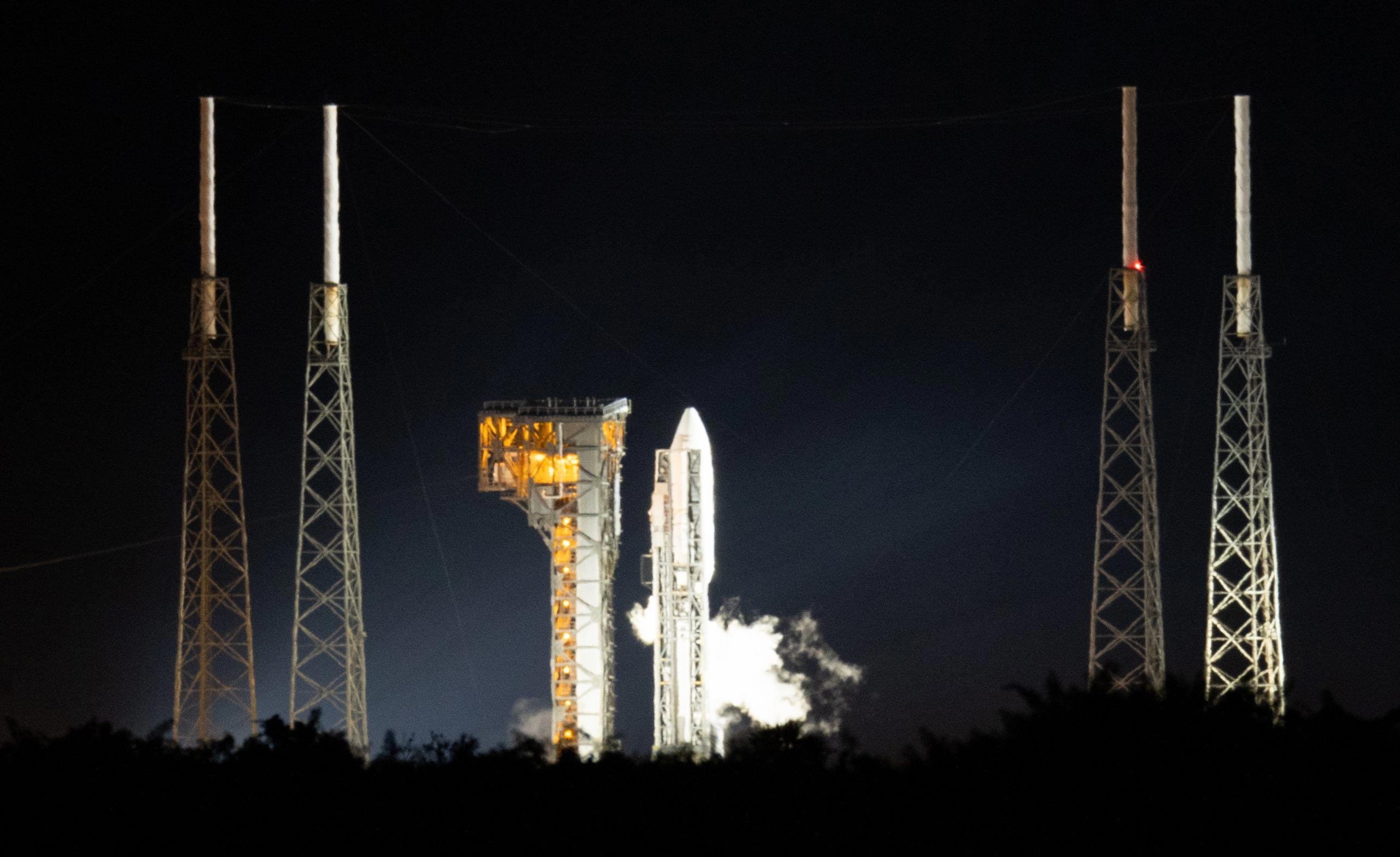
Launch preparations are underway, but because of high velocity upper level winds the new launch time is 5:19 a.m. EST for the Department of Defense’s (DOD) Space Test Program 3 (STP-3) mission, managed by the U.S. Space Force (USSF) Space Systems Command (SSC), from Launch Complex 41 on Cape Canaveral Space Force Station in Florida.
The United Launch Alliance (ULA) Atlas V 551 rocket will carry satellites and technology experiments, including NASA payload Laser Communications Relay Demonstration (LCRD) and the NASA-U.S. Naval Research Laboratory Ultraviolet Spectro-Coronagraph (UVSC) Pathfinder, to space.
Previous update:
New Launch Time
Launch preparations are underway, and because of high velocity upper level winds the new launch time is 5:03 a.m. EST for the Department of Defense’s (DOD) Space Test Program 3 (STP-3) mission, managed by the U.S. Space Force (USSF) Space Systems Command (SSC), from Launch Complex 41 on Cape Canaveral Space Force Station in Florida.
The United Launch Alliance (ULA) Atlas V 551 rocket will carry satellites and technology experiments, including NASA payload Laser Communications Relay Demonstration (LCRD) and the NASA-U.S. Naval Research Laboratory Ultraviolet Spectro-Coronagraph (UVSC).
Previous update:
A Look at What’s on Board

Today’s Space Test Program 3 (STP-3) mission contains technology experiments from government, military, and research institutions including two NASA payloads that will help advance the future of space exploration. NASA’s primary payload, hosted on the U.S. Department of Defense’s Space Test Program Satellite-6 (STPSat-6) spacecraft, is the Laser Communications Relay Demonstration (LCRD).
Like technology demonstrations that have come before it, LCRD is a giant step toward making operational laser, or optical, communications a reality. About the size of a king-size mattress, LCRD will send and receive data over infrared lasers at 1.2 gigabits per second from geosynchronous orbit to Earth.
Just how much data can we transmit at once with laser communications? Sending a high-resolution map of Mars to Earth would take around nine weeks with current radio systems onboard spacecraft, but as little as nine days with laser communications. That “speed” (or, more accurately, data rate) is appealing for future human exploration and science missions. The systems also offer a smaller package – laser communications systems can take up less space, weight, and power on a spacecraft.
LCRD will help make all of that a reality. The mission will operate for at least two years. It will start off “talking” with ground stations in California and Hawaii to test the invisible, near-infrared lasers. Engineers will beam data to and from the satellite (located more than 22,000 miles above Earth) to refine the transmission process, study different operational scenarios, and perfect tracking systems. The information and data are essential for readying a laser communications system for an operational mission, as we can’t replicate the same conditions with tests on the ground. LCRD will also study the effects of clouds (a factor that doesn’t impact current space-to-ground communications) and other potential disruptions to identify viable solutions.
LCRD will also help NASA update how astronauts communicate to and from space. Later in the mission, LCRD will conduct optical communications relays with a future terminal on the International Space Station. As NASA goes back to the Moon, laser communications can empower sustainable communications architectures and help set us up for a human presence at Mars.
Take an inside look into the development of LCRD with a laser communications show from NASA EDGE.
NASA’s The Invisible Network podcast will debut a special LCRD series today, with additional episodes released over the following four Wednesdays. The podcast will highlight the future of the laser communications technologies demonstrated by this mission and the people behind it.
Also hitching a ride on STPSat-6 is a joint NASA-U.S. Naval Research Laboratory experiment dedicated to studying the origins of solar energetic particles (SEPs) — the Sun’s most dangerous form of radiation.
UVSC Pathfinder — short for Ultraviolet Spectro-Coronagraph Pathfinder — will peer at the lowest regions of the Sun’s outer atmosphere, or corona, where SEPs are thought to originate. UVSC Pathfinder is the latest addition to NASA’s fleet of heliophysics observatories. NASA heliophysics missions study a vast, interconnected system from the Sun to the space surrounding Earth and other planets, and to the farthest limits of the Sun’s constantly flowing stream of solar wind. UVSC Pathfinder provides key information on SEPs, enabling future space exploration.
Previous update:
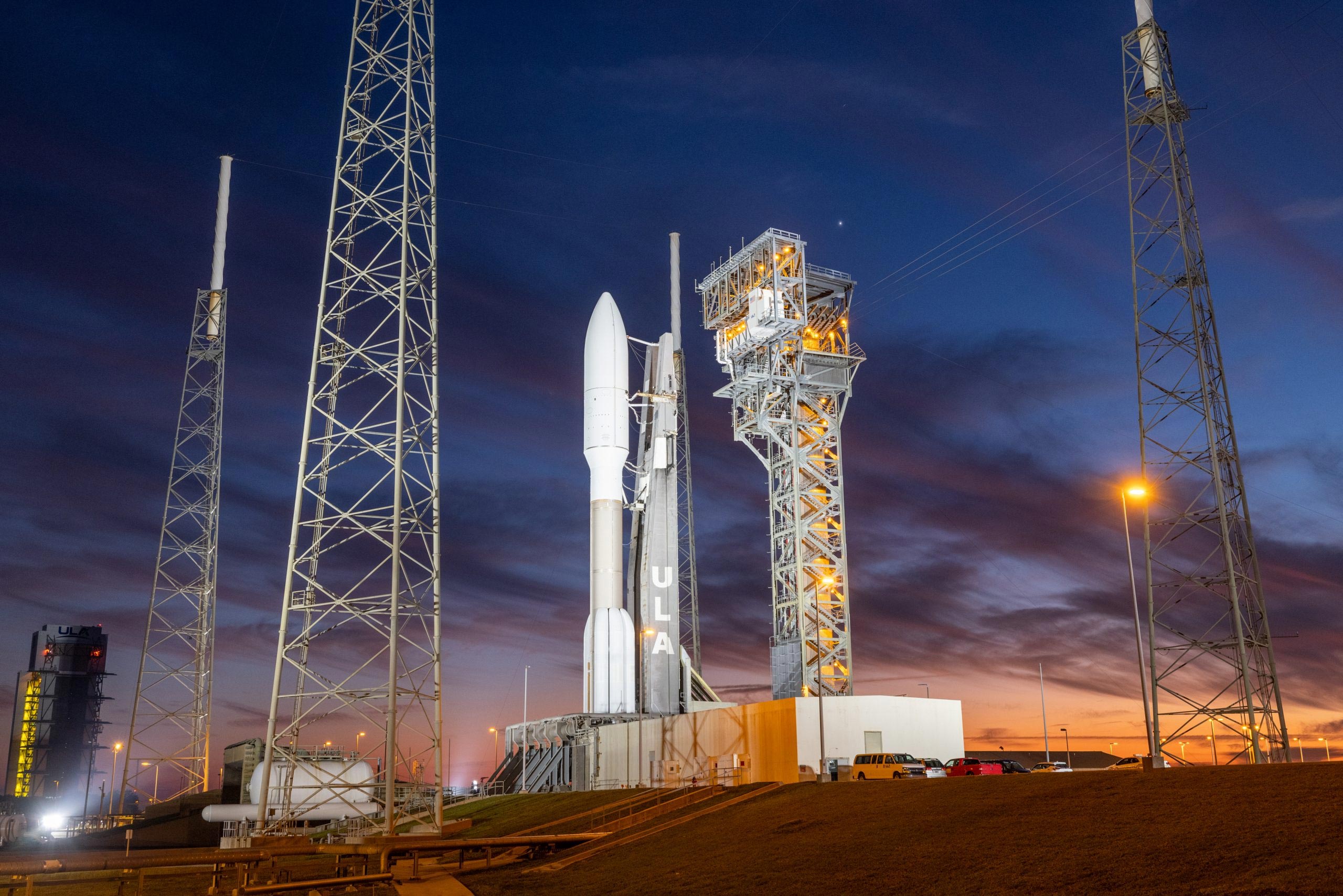
U.S. Space Force’s Space Systems Command STP-3 Mission
A United Launch Alliance (ULA) Atlas V 551 rocket stands ready for liftoff at Launch Complex 41 on Cape Canaveral Space Force Station (CCSFS) for the U.S. Space Force’s (USSF) Space Systems Command (SSC) Space Test Program 3 (STP-3) mission, which hosts NASA’s Laser Communications Relay Demonstration (LCRD) and the NASA-U.S. Naval Research Laboratory Ultraviolet Spectro-Coronagraph (UVSC) Pathfinder.
Launch is scheduled for 4:04 a.m. EST this morning, with a two-hour launch window. Follow along on NASA Television for the live broadcast.
Meteorologists with the U.S. Space Force 45th Weather Squadron predict a more than 90% chance of favorable weather for liftoff.
Here’s a look at some of today’s countdown and ascent milestones. All times are approximate:
COUNTDOWN
Hr/Min/Sec Event
– 00:55:00 Start flight control final preparations to raise hydraulic pressures
– 00:45:00 Pressurize Main Engine Pneumatic System to flight pressure
– 00:16:00 Initiate fuel fill sequence
– 00:10:00 Weather briefing with Atlas Launch Weather Officer
– 00:05:00 Fuel fill sequence is complete; water deluge system actuation pressure adjustment is performed; Atlas L02 at flight level; Centaur L02 at Flight level; Centaur LH2 at flight level
– 00:04:00 Hazardous gas monitoring is complete; automatic computer sequencer takes control for all critical events through liftoff; Atlas first stage LO2 replenishment is secured, allowing the tank to be pressurized for flight
– 00:03:00 Atlas tanks reach flight pressure
– 00:02:00 Atlas first stage and Centaur upper stage switch to internal power; L02 and LH2 topping for Centaur will stop in 10 seconds
– 00:01:30 Launch control system is enabled
LAUNCH AND SPACECRAFT DEPLOYMENT
All Times Approximate
Hr/Min/Sec Event
00:00:00.1 RD-180 Engine Ignition
00:00:01.1 Liftoff of the Atlas V
00:00:03.9 Begin Pitch/Yaw Maneuver
00:00:34.7 Mach 1
00:00:48.7 Max Q (moment of peak mechanical stress on the rocket)
00:01:46.7 Solid rocket booster jettison
00:03:30.2 Payload fairing jettison
00:04:27.4 Atlas booster engine cutoff (BECO)
00:04:33.4 Atlas Centaur separation
00:04:43.3 Centaur first main engine start (MES-1)
00:10:38.4 Centaur first main engine cutoff (MECO-1)
01:07:22.1 Centaur second main engine start (MES-2)
01:12:25.6 Centaur second main engine cutoff (MECO-2)
06:24:48.2 Centaur third main engine start (MES-3)
06:27:26.3 Centaur third main engine cutoff (MECO-3)
06:30:15.4 STPSat-6 Separation
07:10:02.4 LDPE-1 Separation
08:08:02.3 End of mission
Never miss a breakthrough: Join the SciTechDaily newsletter.
Follow us on Google and Google News.
5 Comments
Sirculates the exhaust from midian to support the lift to produce remember our reindeer. Mayalatsia? Non?
Malaysian temple index w techuwklelpa
… Mexico men of gold. Calderon number of indices for small transracial. Of sensors. Sound ocios. The triad.
Wtf. W cris.
crisis. But faraday
Christian. Religion.the notebook. Word of Jesuit on new Scotland across from Teresa? Or overit.