
Close Menu
    Facebook X (Twitter) Instagram
    SciTechDaily
    • Biology
    • Chemistry
    • Earth
    • Health
    • Physics
    • Science
    • Space
    • Technology
    Facebook X (Twitter) Pinterest YouTube RSS
    SciTechDaily
    Home»Space»Cosmic Houdini: Scientists Baffled by Mysterious Planet That Should Have Been Destroyed by Its Star
    Space

    Cosmic Houdini: Scientists Baffled by Mysterious Planet That Should Have Been Destroyed by Its Star

    By University of WarwickJuly 5, 20231 Comment5 Mins Read
    Facebook Twitter Pinterest Telegram LinkedIn WhatsApp Email Reddit
    Share
    Facebook Twitter LinkedIn Pinterest Telegram Email Reddit
    Death Defying Planet
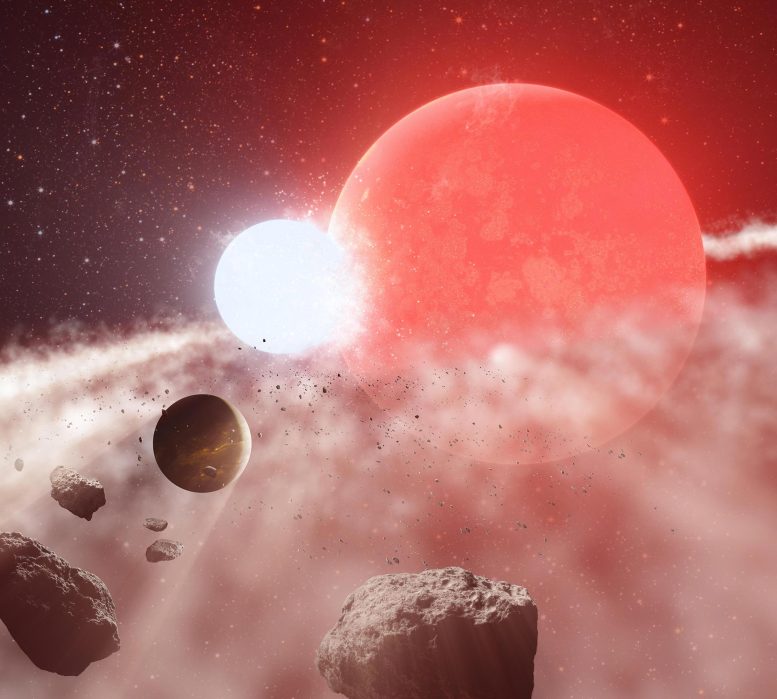
    Portrayed is the violent merger between two stars that may have formed the helium-burning giant star Baekdu. The merger debris forms a disk from which the planet Halla formed, enabling the planet’s unlikely survival around the star. Credit: W. M. Keck Observatory/Adam Makarenko

    8 Ursae Minoris b, a giant planet, surprisingly survives despite its host star’s expansion that should have engulfed it. Scientists suggest either a binary star system that checked the star’s growth or a second-generation planet formation from a stellar merger as possible explanations, shedding new light on stellar and planetary evolution.

    A giant planet has escaped engulfment by its host star, to the surprise of scientists around the world.

    The very unusual planet, 8 Ursae Minoris b, survives in its current location, 520 light years from Earth, in the Milky Way, for reasons very hard to explain. In normal circumstances, it should have been engulfed by its host star – which expands significantly as it decays. But 8 Ursae Minoris b remains in existence.

    The discovery was made by a collaboration of more than 40 academics around the world – including Marc Hon at the University of Hawai’i and Dr. Dimitri Veras at the University of Warwick, which hosts leading research into white dwarf stars.

    Dr. Veras said: “The distance between the Earth and its star, the sun, is 1 astronomical unit, or 1 au. 8 Ursae Minoris b is orbiting its star at 0.5 au. While the distance is not unusual in itself, what is strange is that the star is in the process of dying, having already spent some of its fuel.
    Planet Survives Star
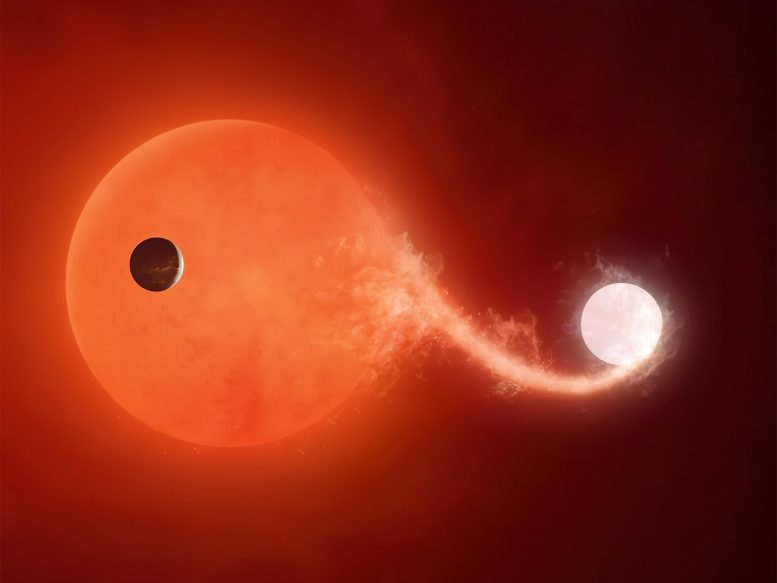
    The planet Halla may have once orbited two stars that interacted with one another by mass transfer as depicted. The eventual merger between the stars allowed Halla to escape engulfment and persist around a helium-burning giant star. Credit: W. M. Keck Observatory/Adam Makarenko

    “When a star spends fuel, it expands in size significantly. This star would have already expanded its size to 0.7 au, which should have engulfed and destroyed the planet. So it’s very unusual that the planet still exists.”

    The scientists then further investigated reasons as to why the planet remains unscathed.

    “We came up with two possible explanations,” added Dr. Veras. “The first, more plausible argument, is that the star once had a companion star (a “binary star”), that quenched its increase in size, allowing the planet to survive. This binary companion eventually merged with the main star, and now just appears as a single star.

    “The second theory, which is less widely explored, again invokes a binary companion. This time the merger of the two stars produced a disc from which this planet was generated – known as a second-generation planet.

    “The wider impact is a better understanding of the evolution of stars like our Sun and the evolution of planets like those we see in the solar system, and the need to look out for additional unusual cases like the observed system. Sometimes the rarest cases can reveal the most about stellar and planetary physics.

    “Understanding these rare planetary systems enables us to learn new ways in which planets and stars evolve, and motivates us to discover even more rare examples.”
    Death Defying Planet Illustration
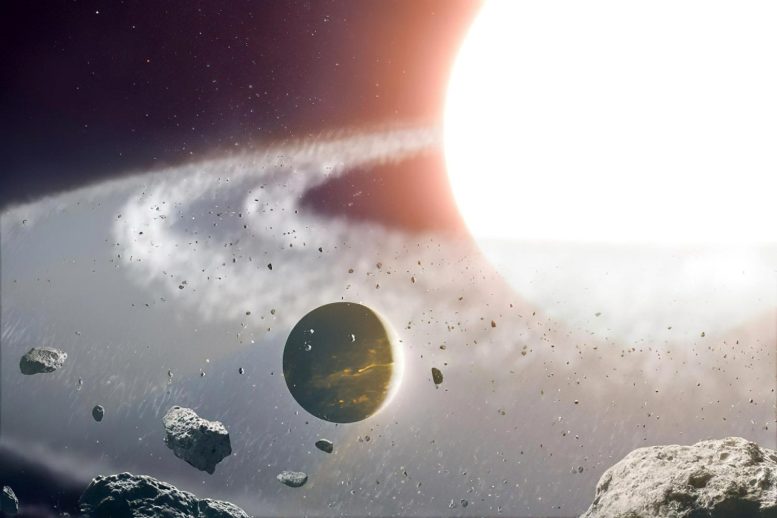
    The Jupiter-like planet, Halla, orbits a red giant star called Baekdu at a very close distance. The researchers found that Baekdu had already expanded to become a red giant once before, inflating up to 1.5 times the planet’s orbital distance—close enough to have engulfed Halla—and then contracted to its current size. The survival of Halla poses intriguing questions about planetary evolution, with theories ranging from an original binary star system preventing complete expansion and engulfment, to the planet being a “second generation” planet formed from the gas cloud produced by a violent stellar collision. Credit: W. M. Keck Observatory/Adam Makarenko

    Marc Hon, University of Hawai’i, said: “Most stars are in binary systems, but we don’t yet fully grasp how planets may form around them. It is plausible that many more peculiar planetary systems may exist due to the influence of binary companions.”

    Professor Bill Chaplin from the University of Birmingham added: “This is a great example of the detailed, forensic studies we can now perform thanks to the latest data, including using the natural oscillations of the host star (asteroseismology) observed by the TESS space telescope to confirm beyond any doubt that the star is a core-helium-burning red giant.”

    For more on this discovery, see Astronomers Discover a Mysterious Planet That Shouldn’t Exist.

    Reference: “A close-in giant planet escapes engulfment by its star” by Marc Hon, Daniel Huber, Nicholas Z. Rui, Jim Fuller, Dimitri Veras, James S. Kuszlewicz, Oleg Kochukhov, Amalie Stokholm, Jakob Lysgaard Rørsted, Mutlu Yıldız, Zeynep Çelik Orhan, Sibel Örtel, Chen Jiang, Daniel R. Hey, Howard Isaacson, Jingwen Zhang, Mathieu Vrard, Keivan G. Stassun, Benjamin J. Shappee, Jamie Tayar, Zachary R. Claytor, Corey Beard, Timothy R. Bedding, Casey Brinkman, Tiago L. Campante, William J. Chaplin, Ashley Chontos, Steven Giacalone, Rae Holcomb, Andrew W. Howard, Jack Lubin, Mason MacDougall, Benjamin T. Montet, Joseph M. A. Murphy, Joel Ong, Daria Pidhorodetska, Alex S. Polanski, Malena Rice, Dennis Stello, Dakotah Tyler, Judah Van Zandt and Lauren M. Weiss, 28 June 2023, Nature.
    DOI: 10.1038/s41586-023-06029-0

    Never miss a breakthrough: Join the SciTechDaily newsletter.
    Follow us on Google and Google News.

    Astronomy Exoplanet Planets University of Warwick
    Share. Facebook Twitter Pinterest LinkedIn Email Reddit

    Related Articles

    This Giant Planet Shouldn’t Exist – But Astronomers Just Found It Around a Tiny Star

    Astronomers Stunned by WASP-132’s Bizarre Planetary System

    Cosmic Sandwiches: A New Explanation for Planet Formation

    Massive COCONUTS Exoplanet Discovery: Giant Planet Just 35 Light Years From Earth

    Star’s Death Will Play a Mean Pinball With Unusual Planetary System Locked in a Perfect Rhythm

    Mysterious Population of Rogue Planets Spotted Near the Center of Our Galaxy

    Breakthrough: Shrinking Planets Could Explain Mystery of Universe’s Missing Worlds

    Investigating Baked Meteorites Yields Clues to Planetary Atmospheres

    “Chemical Fingerprint” of First Transiting Exoplanet Reveals Its Distant Birthplace

    1 Comment

    1. Stuart on July 6, 2023 7:11 am

      Ha ha ha, :Scientists can’t figure out why a planet exists. You can’t even tell us how lightning gets its seed power for the bolt and you think you can explain all of your Creators masterful design… ; )

      Reply
    Leave A Reply Cancel Reply

    • Facebook
    • Twitter
    • Pinterest
    • YouTube

    Don't Miss a Discovery

    Subscribe for the Latest in Science & Tech!

    Trending News

    Why Popular Diabetes Drugs Like Ozempic Don’t Work for Everyone: The “Genetic Glitch”

    Scientists Stunned After Finding Plant Thought Extinct for 60 Years

    Scientists Discover Tiny New Spider That Hunts Prey 6x Its Size

    Natural Component From Licorice Shows Promise for Treating Inflammatory Bowel Disease

    Scientists Warn: Popular Sweetener Linked to Dangerous Metabolic Effects

    Monster Storms on Jupiter Unleash Lightning Beyond Anything on Earth

    Scientists Create “Liquid Gears” That Spin Without Touching

    The Simple Habit That Could Help Prevent Cancer

    Follow SciTechDaily
    • Facebook
    • Twitter
    • YouTube
    • Pinterest
    • Newsletter
    • RSS
    SciTech News
    • Biology News
    • Chemistry News
    • Earth News
    • Health News
    • Physics News
    • Science News
    • Space News
    • Technology News
    Recent Posts
    • Ancient Bacteria Turned a DNA System Into a Cell Skeleton
    • Researchers Finally Solve 50-Year-Old Blood Group Mystery
    • Scientists Discover “Molecular Switch” That Fuels Alzheimer’s Brain Inflammation
    • Hidden Ocean Currents Revealed in Stunning Detail by AI
    • Trees Emit Tiny Lightning Flashes During Storms and Scientists Finally Prove It
    Copyright © 1998 - 2026 SciTechDaily. All Rights Reserved.
    • Science News
    • About
    • Contact
    • Editorial Board
    • Privacy Policy
    • Terms of Use

    Type above and press Enter to search. Press Esc to cancel.