
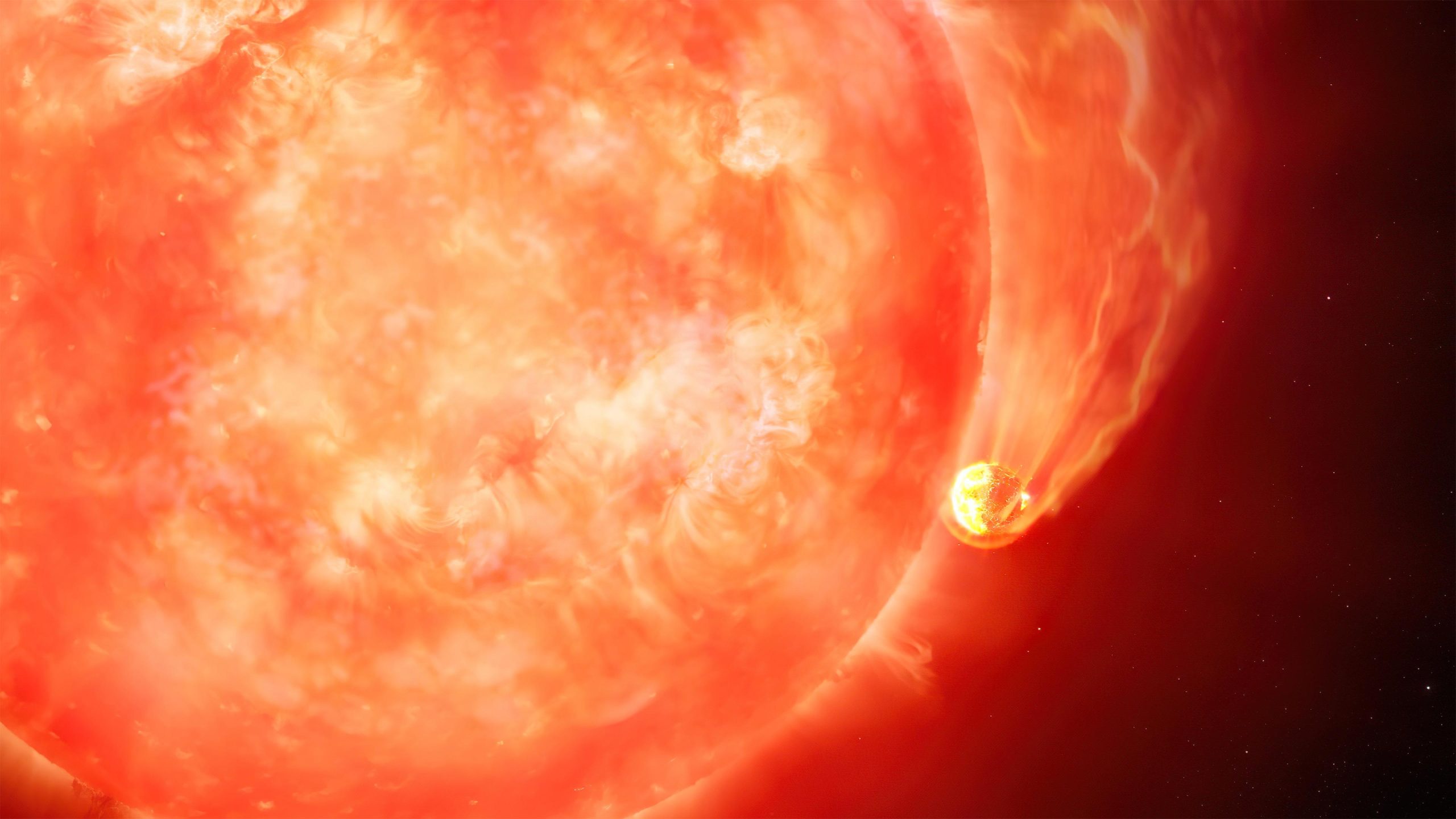
Gemini South captures first direct evidence of an exoplanet being swallowed by an ancient Sun-like star.
For the first time, scientists have directly observed a star engulfing a planet, an event that could hint at the eventual fate of our own solar system. The discovery offers important insights into the evolution and final destiny of planetary systems.
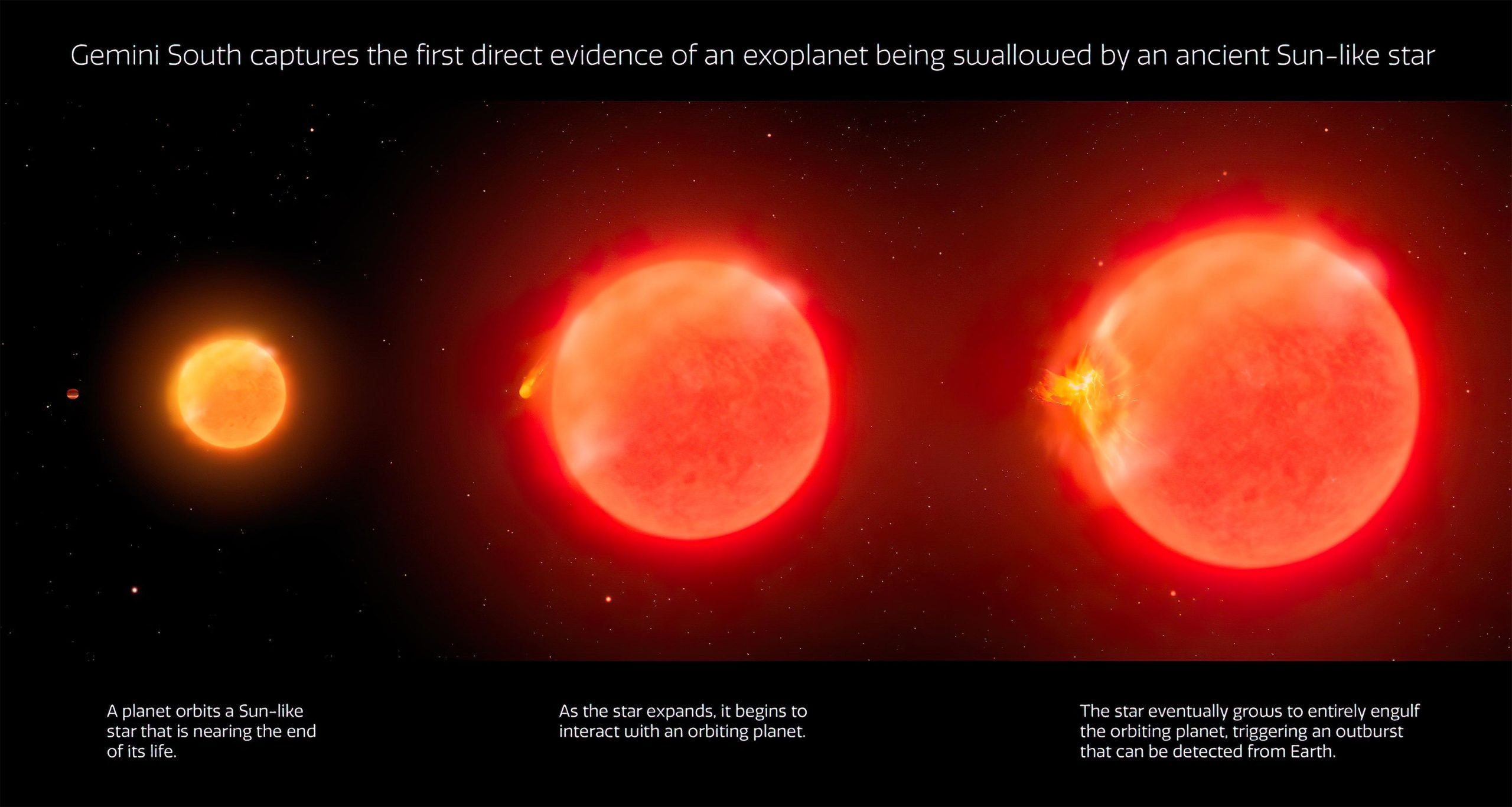
By studying countless stars at various stages of their evolution, astronomers have been able to piece together an understanding of the life cycle of stars and how they interact with their surrounding planetary systems as they age. This research confirms that when a Sun-like star nears the end of its life, it expands anywhere from 100 to 1000 times its original size, eventually engulfing the system’s inner planets. Such events are estimated to occur only a few times each year across the entire Milky Way. Though past observations have confirmed the aftermath of planetary engulfments,[1] astronomers have never caught one in the act, until now.
With the power of the Gemini South Adaptive Optics Imager (GSAOI) on Gemini South, one half of the International Gemini Observatory, operated by NSF’s NOIRLab,[2] astronomers have observed the first direct evidence of a dying star expanding to engulf one of its planets. Evidence for this event was found in a telltale “long and low-energy” outburst from a star in the Milky Way about 13,000 light-years from Earth. This event, the devouring of a planet by an engorged star, likely presages the ultimate fate of Mercury, Venus, and Earth when our Sun begins its death throes in about five billion years.
“These observations provide a new perspective on finding and studying the billions of stars in our Milky Way that have already consumed their planets,” says Ryan Lau, NOIRLab astronomer and co-author on this study, which is published today (May 3, 2023) in the journal Nature.
The Fate of Inner-System Planets
For most of its life, a Sun-like star fuses hydrogen into helium in its hot, dense core, which allows the star to push back against the crushing weight of its outer layers. When hydrogen in the core runs out, the star begins fusing helium into carbon, and hydrogen fusion migrates to the star’s outer layers, causing them to expand, and changing the Sun-like star into a red giant.
Such a transformation, however, is bad news for any inner-system planets. When the star’s surface eventually expands to engulf one of its planets, their interaction would trigger a spectacular outburst of energy and material. This process would also put the brakes on the planet’s orbital velocity, causing it to plunge into the star.
The first hints of this event were uncovered by optical images from the Zwicky Transient Facility. Archival infrared coverage from NASA’s Near-Earth Object Wide-field Infrared Survey Explorer (NEOWISE), which is able to peer into dusty environments in search of outbursts and other transient events, then confirmed the engulfment event, named ZTF SLRN-2020. “Our team’s custom reanalysis of all-sky infrared maps from NEOWISE exemplifies the vast discovery potential of archival survey data sets,” said NOIRLab astronomer Aaron Meisner, another co-author on the paper.
Distinguishing a planetary-engulfment outburst from other types of outbursts, such as solar-flare-type events and coronal-mass ejections, is difficult and requires high-resolution observations to pinpoint the location of an outburst and long-term measurements of its brightness without contamination from nearby stars.
Gemini South provided this essential data thanks to its adaptive-optics capabilities.
“Gemini South continues to expand our understanding of the Universe and these new observations support predictions for the future of our own planet,” said NSF Gemini Observatory program director Martin Still. “This discovery is a wonderful example of the feats we can accomplish when we combine world-class telescope operations and cutting-edge scientific collaboration.”
“With these revolutionary new optical and infrared surveys, we are now witnessing such events happen in real-time in our own Milky Way — a testament to our almost certain future as a planet,” said Kishalay De, an astronomer at the Massachusetts Institute of Technology and lead author on the paper.
Material Ejection and Cosmic Recycling
The outburst from the engulfment lasted approximately 100 days and the characteristics of its lightcurve, as well as the ejected material, gave astronomers insight into the mass of the star and that of its engulfed planet. The ejected material consisted of about 33 Earth masses of hydrogen and about 0.33 Earth masses of dust. “That’s more star- and planet-forming material being recycled, or burped out, into the interstellar medium thanks to the star eating the planet,” said Lau. From this analysis, the team estimated that the progenitor star is about 0.8−1.5 times the mass of our Sun and the engulfed planet was 1−10 times the mass of Jupiter.
Now that the signatures of a planetary engulfment have been identified for the first time, astronomers have improved metrics they can use to search for similar events happening elsewhere in the cosmos. This will be especially important when Vera C. Rubin Observatory comes online in 2025. For instance, the observed effects of chemical pollution on the remnant star when seen elsewhere can hint that an engulfment has taken place. The interpretation of this event also provides evidence for a missing link in our understanding of the evolution and final fates of planetary systems, including our own.
“I think there’s something pretty remarkable about these results that speaks to the transience of our existence,” says Lau. “After the billions of years that span the lifetime of our Solar System, our own end stages will likely conclude in a final flash that lasts only a few months.”
Notes
- While evidence of engulfment events has been found before — such as the resulting corpse of a star and the burnt out husk of a planet, suggesting the engulfment took place sometime in the distant past — the results presented here are the first direct evidence that it is happening as we are observing it.
- The Gemini South observations were made using Director’s Discretionary Time (Program ID: GS-2022A-DD-102, PI: K. De)
Reference: “An infrared transient from a star engulfing a planet” by Kishalay De, Morgan MacLeod, Viraj Karambelkar, Jacob E. Jencson, Deepto Chakrabarty, Charlie Conroy, Richard Dekany, Anna-Christina Eilers, Matthew J. Graham, Lynne A. Hillenbrand, Erin Kara, Mansi M. Kasliwal, S. R. Kulkarni, Ryan M. Lau, Abraham Loeb, Frank Masci, Michael S. Medford, Aaron M. Meisner, Nimesh Patel, Luis Henry Quiroga-Nuñez, Reed L. Riddle, Ben Rusholme, Robert Simcoe, Loránt O. Sjouwerman, Richard Teague and Andrew Vanderburg, 3 May 2023, Nature.
DOI: 10.1038/s41586-023-05842-x
Never miss a breakthrough: Join the SciTechDaily newsletter.
Follow us on Google and Google News.