
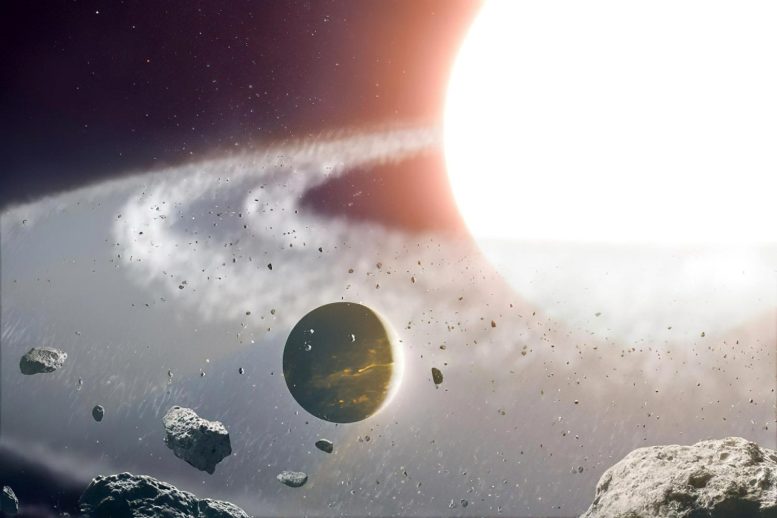
Astronomers from the University of Hawaii Institute for Astronomy have discovered a planet that survived what should have been a catastrophic event caused by its sun.
When our Sun reaches the end of its life, it will expand to 100 times its current size, enveloping the Earth. Many planets in other solar systems face a similar doom as their host stars grow old. But not all hope is lost, as astronomers from the University of Hawaiʻi Institute for Astronomy (IfA) have made the remarkable discovery of a planet’s survival after what should have been certain demise at the hands of its sun. The study was published on June 28 in the journal Nature.
The Jupiter-like planet 8 UMi b, officially named Halla, orbits the red giant star Baekdu (8 UMi) at only half the distance separating the Earth and the Sun. Using two Maunakea Observatories on Hawaiʻi Island—W. M. Keck Observatory and Canada-France-Hawaiʻi Telescope (CFHT)—a team of astronomers led by Marc Hon, a NASA Hubble Fellow at IfA, discovered that Halla persists despite the normally perilous evolution of Baekdu. Using observations of Baekdu’s stellar oscillations from NASA’s Transiting Exoplanet Survey Satellite, they found that the star is burning helium in its core, signaling that it had already expanded enormously into a red giant star once before.
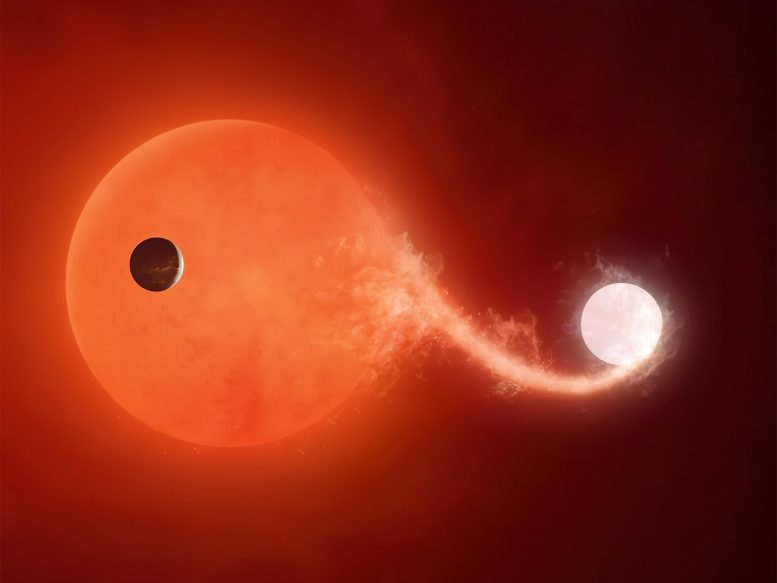
The star would have inflated up to 1.5 times the planet’s orbital distance—engulfing the planet in the process—before shrinking to its current size at only one-tenth of that distance.
“Planetary engulfment has catastrophic consequences for either the planet or the star itself—or both,” said Hon, the lead author of the study. “The fact that Halla has managed to persist in the immediate vicinity of a giant star that would have otherwise engulfed it highlights the planet as an extraordinary survivor.”
Maunakea Observatories Confirm Survivor
The planet Halla was discovered in 2015 by a team of astronomers from Korea using the radial velocity method, which measures the periodic movement of a star due to the gravitational tug of the orbiting planet. Following the discovery that the star must at one time have been larger than the planet’s orbit, the IfA team conducted additional observations from 2021 to 2022 using Keck Observatory’s High-Resolution Echelle Spectrometer and CFHT’s ESPaDOnS instrument. These new data confirmed the planet’s 93-day, nearly circular orbit had remained stable for more than a decade and that the back-and-forth motion must be due to a planet.
“Together, these observations confirmed the existence of the planet, leaving us with the compelling question of how the planet actually survived,” said IfA astronomer Daniel Huber, second author of the study. “The observations from multiple telescopes on Maunakea were critical in this process.”
Escaping Engulfment
At a distance of 0.46 astronomical units (AU, or the Earth-Sun distance) to its star, the planet Halla resembles “warm” or “hot” Jupiter-like planets that are thought to have started on larger orbits before migrating inward close to their stars. However, in the face of a rapidly evolving host star, such an origin becomes an extremely unlikely survival pathway for planet Halla.
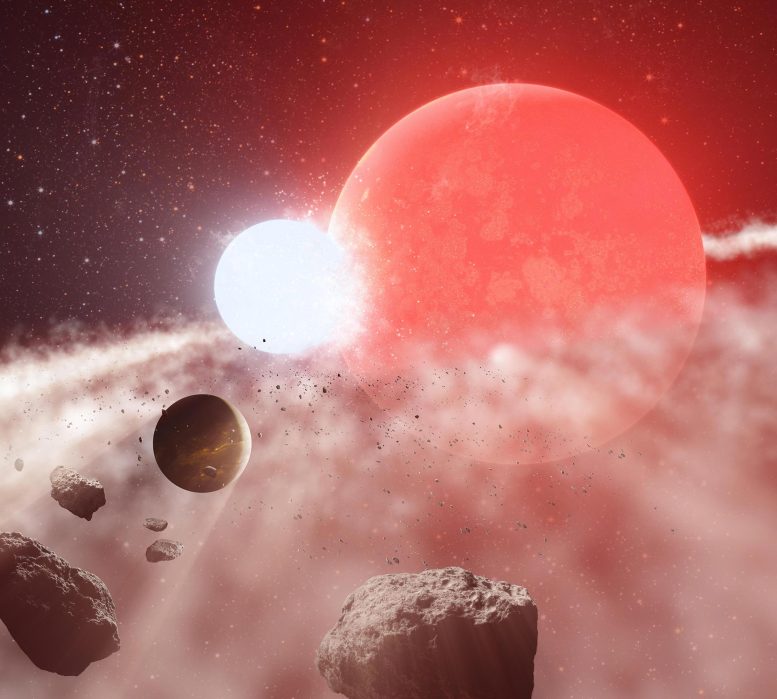
Another theory for the planet’s survival is that it never faced the danger of engulfment. Similar to the famous planet Tatooine from Star Wars, which orbits two suns, the host star Baekdu may have originally been two stars, according to the team. A merger of these two stars may have prevented any one of them from expanding sufficiently large enough to engulf the planet.
A third possibility is that Halla is a relative newborn—that the violent collision between the two stars produced a gas cloud from which the planet formed. In other words, the planet Halla may be a recently born “second generation” planet.
“Most stars are in binary systems, but we don’t yet fully grasp how planets may form around them,” said Hon. “Therefore, it’s plausible that more planets may actually exist around highly evolved stars thanks to binary interactions.”
Reference: “A close-in giant planet escapes engulfment by its star” by Marc Hon, Daniel Huber, Nicholas Z. Rui, Jim Fuller, Dimitri Veras, James S. Kuszlewicz, Oleg Kochukhov, Amalie Stokholm, Jakob Lysgaard Rørsted, Mutlu Yıldız, Zeynep Çelik Orhan, Sibel Örtel, Chen Jiang, Daniel R. Hey, Howard Isaacson, Jingwen Zhang, Mathieu Vrard, Keivan G. Stassun, Benjamin J. Shappee, Jamie Tayar, Zachary R. Claytor, Corey Beard, Timothy R. Bedding, Casey Brinkman, Tiago L. Campante, William J. Chaplin, Ashley Chontos, Steven Giacalone, Rae Holcomb, Andrew W. Howard, Jack Lubin, Mason MacDougall, Benjamin T. Montet, Joseph M. A. Murphy, Joel Ong, Daria Pidhorodetska, Alex S. Polanski, Malena Rice, Dennis Stello, Dakotah Tyler, Judah Van Zandt and Lauren M. Weiss, 28 June 2023, Nature.
DOI: 10.1038/s41586-023-06029-0
Never miss a breakthrough: Join the SciTechDaily newsletter.
Follow us on Google and Google News.
2 Comments
“When our Sun reaches the end of its life, it will expand to 100 times its current size, enveloping the Earth.”
Unless, of course, the Earth has been moved, which seems likely enough without insisting on the limits we may currently operate under.
Unless, of course, they were referring to the secular evolution, which seems likely enough without insisting on the limits a non-secular evolution may operate under.