

While it’s well-established that environmental factors shape the evolution of species, a recent study illustrates a reciprocal relationship where the evolutionary adaptations of species, in turn, impact their environment.
The narrative of the peppered moths is a well-known example of evolution in action. During the Industrial Revolution in England, the pollution from coal smoke darkened the tree bark around the urban areas, rendering the white-bodied peppered moths highly visible to predators, which led to a rapid decline in their population. Simultaneously, the previously uncommon black-bodied moths flourished, becoming the dominant variety due to their ability to blend into the newly darkened environment.
This phenomenon is often cited as a classic illustration of how environmental alterations can drive the evolution of species. However, in recent times, researchers have started to explore the inverse scenario. Could it be possible that there is a reciprocal relationship where the evolution of a species influences and instigates changes in its ecosystem?
Now, a new study by researchers at the University of Rhode Island shows some of the best evidence yet for that very phenomenon.
In research published in the Proceedings of the National Academy of Sciences, the researchers show that an evolutionary change in the length of lizards’ legs can have a significant impact on vegetation growth and spider populations on small islands in the Bahamas. This is one of the first times, the researchers say, that such dramatic evolution-to-environment effects have been documented in a natural setting.
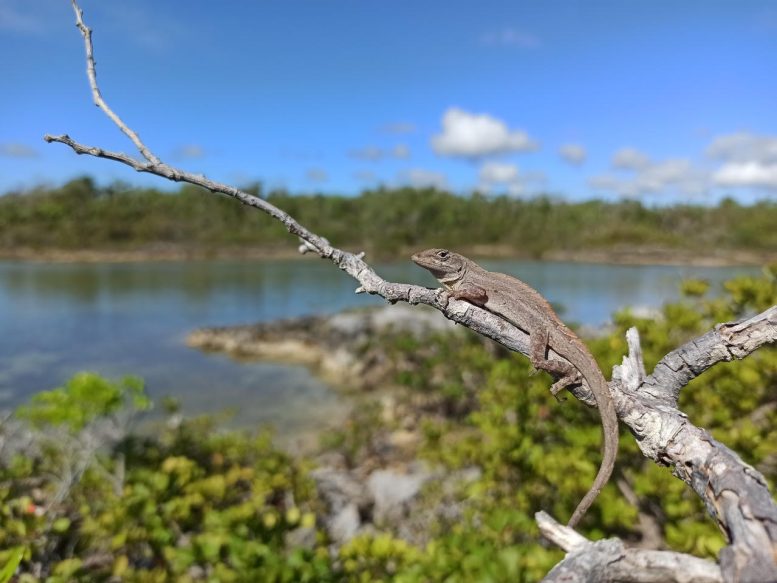
Investigating the Evolution-Environment Feedback Loop
“The idea here is that, in addition to the environment shaping the traits of organisms through evolution, those trait changes should feed back and drive changes in predator-prey relationships and other ecological interactions between species,” said Jason Kolbe, a professor of biological sciences at the University of Rhode Island and one of the study’s senior authors. “And we really need to understand how those dynamics work so we can make predictions about how populations are going to persist, and what sort of ecological changes might result.”
For the last 20 years, Kolbe and his colleagues have been observing the evolutionary dynamics of anole lizard populations on a chain of tiny islands in the Bahamas. The chain is made up of around 40 islands ranging from a few dozen to a few hundred meters in the area—small enough that the researchers can keep close tabs on the lizards living there. And the islands are far enough apart that lizards can’t easily hop from one island to another, so distinct populations can be isolated from each other.
Previous research had shown that brown anoles adapt quickly to the characteristics of the surrounding vegetation. In habitats where the diameter of the brush and tree limbs is smaller, natural selection favors lizards with shorter legs, which enable individuals to move more quickly when escaping predators or chasing a snack. In contrast, lankier lizards tend to fare better where the tree and plant limbs are thicker. Researchers have shown that this limb-length trait can evolve quickly in brown anoles—in just a few generations.
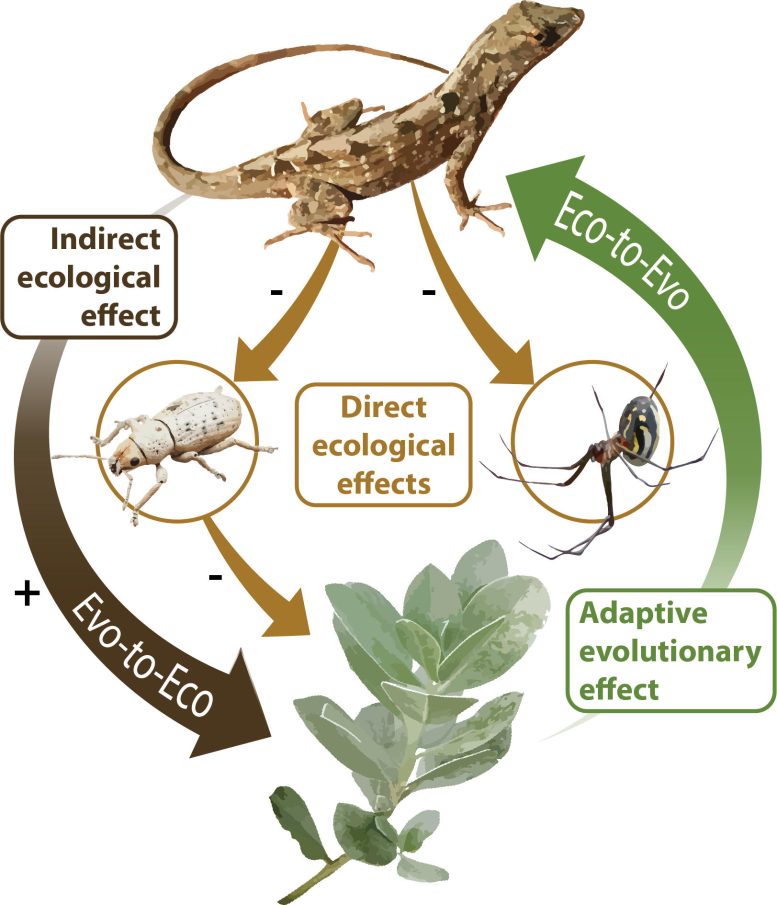
For this new study, Kolbe and his team wanted to see how this evolved limb-length trait might affect the ecosystems on the tiny Bahamian islands. The idea was to separate short- and long-legged lizards on islands of their own, then look for differences in how the lizard populations affect the ecology of their island homes.
Armed with specialized lizard wrangling gear—poles with tiny lassos made of dental floss at the end—the team captured hundreds of brown anoles. They then measured the leg length of each lizard, keeping the ones whose limbs were either especially long or especially short and returning the rest to the wild. Once they had distinct populations of short- and long-limbed lizards, they set each population free on islands that previously had no lizards living on them.
Since the experimental islands were mostly covered by smaller diameter vegetation, the researchers expected that the short-legged lizards would be better adapted to that environment, that is, more maneuverable and better able to catch prey in the trees and brush. The question the researchers wanted to answer was whether the ecological effects of those highly effective hunters could be detected.
After eight months, the researchers checked back on the islands to look for ecological differences between islands stocked with the short- and long-legged groups. The differences, it turned out, were substantial. On islands with shorter-legged lizards, populations of web spiders—a key prey item for brown anoles—were reduced by 41% compared to islands with lanky lizards. There were significant differences in plant growth as well. Because the short-legged lizards were better at preying on insect herbivores, plants flourished. On islands with short-legged lizards, buttonwood trees had twice as much shoot growth compared to trees on islands with long-legged lizards, the researchers found.
The results, Kolbe says, help to bring the interaction between ecology and evolution full circle.
Closing the Loop Between Evolution and Ecology
“These findings help us to close that feedback loop,” Kolbe said. “We knew from previous research that ecological factors shape limb length, and now we show the reciprocal relationship of that evolutionary change on the environment.”
Understanding the full scope of interactions between evolution and ecology will be helpful in predicting environments’ outcomes, the researchers say—particularly as human activities accelerate the pace of both evolutionary and ecological change worldwide.
Reference: “Experimentally simulating the evolution-to-ecology connection: Divergent predator morphologies alter natural food webs” by Jason J. Kolbe, Sean T. Giery, Oriol Lapiedra, Kelsey P. Lyberger, Jessica N. Pita-Aquino, Haley A. Moniz, Manuel Leal, David A. Spiller, Jonathan B. Losos, Thomas W. Schoener and Jonah Piovia-Scott, 5 June 2023, Proceedings of the National Academy of Sciences.
DOI: 10.1073/pnas.2221691120
The study was funded by the National Science Foundation.
Never miss a breakthrough: Join the SciTechDaily newsletter.
Follow us on Google and Google News.