
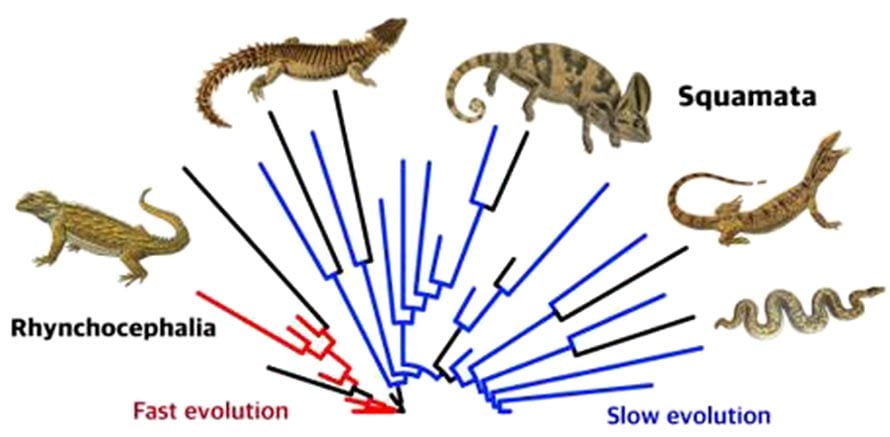
A new study reveals that rapid evolution does not guarantee long-term success.
Researchers at the University of Bristol have found that fast evolution can lead to nowhere.
In a new study of lizards and their relatives, Dr. Jorge Herrera-Flores of Bristol’s School of Earth Sciences and colleagues have discovered that ‘slow and steady wins the race.’
The team studied lizards, snakes, and their relatives, a group called the Lepidosauria. Today there are more than 10,000 species of lepidosaurs, and much of their recent success is a result of fast evolution in favorable circumstances. But this was not always the case.
Mr. Herrera-Flores explained: “Lepidosaurs originated 250 million years ago in the early Mesozoic Era, and they split into two major groups, the squamates on the one hand, leading to modern lizards and snakes, and the rhynchocephalians on the other, represented today by a single species, the tuatara of New Zealand. We expected to find slow evolution in rhynchocephalians, and fast evolution in squamates. But we found the opposite.”
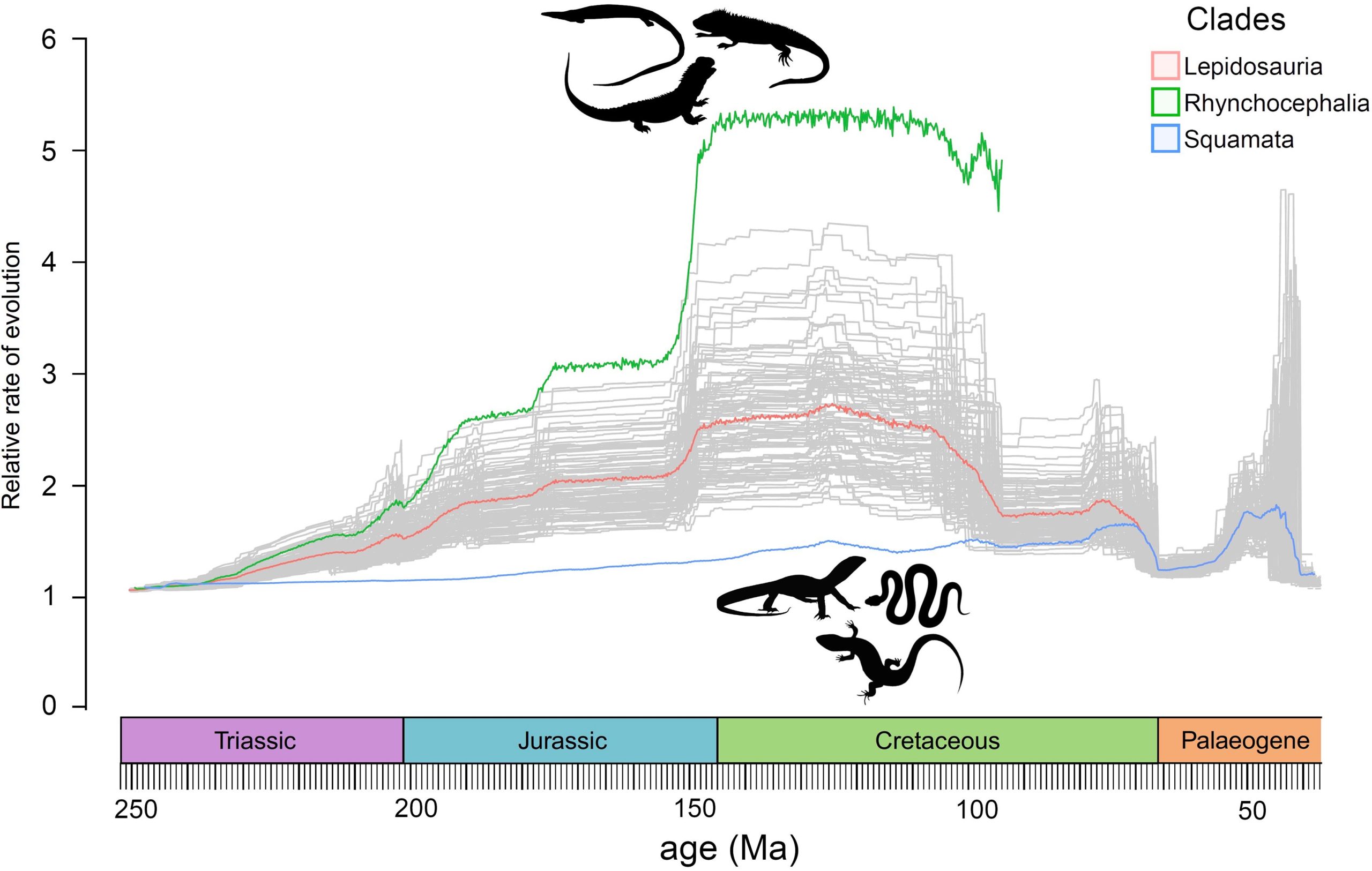
“We looked at the rate of change in body size among these early reptiles,” said Dr. Tom Stubbs, a collaborator. “We found that some groups of squamates evolved fast in the Mesozoic, especially those with specialized lifestyles like the marine mosasaurs. But rhynchocephalians were much more consistently fast-evolving.”
Fast, But Fragile: The Rise and Fall of Ancient Lizards
“In fact, their average rates of evolution were significantly faster than those for squamates, about twice the background rate of evolution, and we really did not expect this,” said Dr. Armin Elsler, another collaborator. “In the later part of the Mesozoic all the modern groups of lizards and snakes originated and began to diversify, living side-by-side with the dinosaurs, but probably not engaging with them ecologically. These early lizards were feeding on bugs, worms, and plants, but they were mainly quite small.”

Prof Mike Benton added: “‘After the extinction of the dinosaurs, 66 million years ago, at the end of the Mesozoic, the rhynchocephalians and squamates suffered a lot, but the squamates bounced back. But for most of the Mesozoic, the rhynchocephalians were the innovators and the fast evolvers. They tailed off quite severely well before the end of the Mesozoic, and the whole dynamic changed after that.”
This work confirms a challenging proposal made by the famous paleontologist George Gaylord Simpson in his 1944 book Tempo and Mode in Evolution. He looked at the fundamental patterns of evolution in a framework of Darwinian evolution and observed that many fast-evolving species belonged to unstable groups, which were potentially adapting to rapidly changing environments.
Tortoise vs. Hare: A Darwinian Perspective on Success
Prof Benton continued: “Slow and steady wins the race. In the classic Aesop’s fable, the speedy hare loses the race, whereas the slow-moving tortoise crosses the finishing line first. Since the days of Darwin, biologists have debated whether evolution is more like the hare or the tortoise. Is it the case that big groups of many species are the result of fast evolution over a short time or slow evolution over a long time?
“In some cases, they can stabilize and survive well, but in many cases, the species go extinct as fast as new ones emerge, and they can go extinct, just like the napping hare. On the other hand, Simpson predicted that slowly evolving species might also be slow to go extinct, and could, in the end, be successful in the longer term, just like the slow-moving but persistent tortoise in the fable.”
Reference: “Slow and fast evolutionary rates in the history of lepidosaurs” by Jorge A. Herrera-Flores, Armin Elsler, Thomas L. Stubbs and Michael J. Benton, 10 November 2021, Palaeontology.
DOI: 10.1111/pala.12579
Never miss a breakthrough: Join the SciTechDaily newsletter.
Follow us on Google and Google News.
4 Comments
250,000,000 triassic rhynchocephalia orignate
230,000,000 triassic lepidosauria originate
230,000,000 triassic squamata originate
202,000,000 jurassic rhynchocephalia higher evolution rates
lepidosauria middle evolution rates
squamata low evolution rates
145,000,000 cretaceous rhynchocephalia higher evolution rates peak
lepidosauria middle evolution rates peak
squamata low evolution rates
90,000,000 cretaceous lepidosauria top evolution slumping
squamata middle evolution rates
rhynchocephalia no evolution rates rates drop off the scale
13,616,000,000 anno universo = 84,000,000 annual years ago 86,000,000 84,000,000 79,000,000 late cretaceous earth tipped over on its side 12 degrees and back which would move new york to where tampa florida is right now and back
italy ancient limestone magnetic alignment earths crust moving 3 degrees every million years during its tilt and tilt back from paleomagnetic data
13,616,000,000 anno universo = 84,000,000 annual years ago
84,000,000 italy northern apennine mountains furlo exposure scaglia rossa limestone aligned one oclock to seven oclock latitude shift a 12 degree tilt of the planet 84 million years ago
84,000,000 late cretaceous
solid iron core of earth
liquid iron core of earth earth magnetic field generated by electric currents in the convecting liquid ni fe metal of the outer core
outer solid shell of earth can wobble
outer solid shell can it tip over relative to the spin axis true polar wander would look like the earth tipping on its side
the whole rocky shell of the earth planet mantle and crust 3,000 kilometres deep is rotating around the inner liquid outer core 1000 kilometres deep the roller conveyor belt effect
north and south geographic poles a vertical field means you are at the pole
the tilt angle gives the distance from the poles tiny crystals of the mineral magnetite produced by some bacteria actually line up like tint compass needles and get trapped in the sediment when the rock solidifies
a horizontal field tells us you are at the equator
this fossil magnetism can be used to track where the spin axis is wandering relative to the crust
italy central apennine mountains road cut west of the apiro dam lake
these italian sedimentary rocks turn out to be special and very reliable because the magnetic minerals are actually fossils of bacteria that formed chains of the mineral magnetite
not superior over another in competition but the ability to survive dramatic changes in environmental conditions
live underground
live overground
live marine
live aerial
live earth magnetic wise
survivors survive reproduce and therefore propagate any heritable characters which have affected their survival and reproductive success
gigantism lost out dinosaurs fast evolution can lead to nowhere rapidly evolving species more likely to go extinct fast evolving species belonged to unstable groups which were probably adapting to rapidly changing environments the fast napping hare loses the race
lizards and their relatives mainly quite small slow and steady wins the race feeding on bugs worms and plants the slow moving perisitent tortoise crosses the finishing line first slow to go extinct
rhynchocephalia 1 species tuatara of new zeland
squamata 10,000 lepidosauria species slow and steady wins the race
65,000,000 cretaceous extinction of the dinosaurs
lepidosauria middle evolution slumping bottom of trough
squamata low evolution rates bottom of trough
rhynchocephalia higher evolution rates rates drop off the scale
50,000,000 cretaceous lepidosauria middle evolution slumping bottom of trough
squamata low evolution rates 10,000 species
rhynchocephalia higher evolution rates 1 species
ooooppppphhhhhsss i forgot this detail
13,615,000,000 anno universo = 85,000,000 annual years ago western australia north of gingin yallale breccia rocks christmas fruit cake rock impact in quartz shocked minerals buried crater 12 to 16 kilometres in diameter
… but would humans ever evolve in those conditions, perhaps no. Would there be a same old, same old if our rock didn’t get hit by another rock, well…
Dinosaur is extinct it’s only one scientist view the educated scientist say spinosauridae is alive the very hollow bone beyond the skull eusuchian mesoeucrocodylia the gator it is a advance spinosauridae now 23 -27 species .mesoeucrocodylia and mammal rapid evolution when they developed full palate they can breathe when eating that was a great technology .mammal won the war they are more species of mammal than gator but the war is not over.modern crocodilian are only predator all plant eating mesoeucrocodylia are dead .the only 3 toe claw gator are alive all eusuchian ancestor are dead early eusuchian are dead.advance eusuchian are alive reason why advance eusuchian did not reach mammal level because early mesoeucrocodylia was alive in human time they were tough .mammal did not rapid evolve because mesoeucrocodylia was around. Mammal were small rat type animal today they are million of modern crocodilian a very successful dinosaur they would be more but skin trade is around .mammal rapid evolve 60 million years ago but dinosaur was still there they are still here with big numbers .mammals did not take dinosaur place because dinosaur still alive today .as for hollow bone macelognathus is only early mesoeucrocodylia with hollow bone beyond the skull they first thought it was a dinosaur no data if it was bird like hollow bone may be I find that in the future because high suspicion .all hollow bone is in eusuchian .gator a advance eusuchian have more hollow bone.spinosauridae has hollow bone because it is fuse ankle dinosaur.macelognathus has unique gator ankle not kind find in protosuchus it only superfacial look like it. mesoeucrocodylia ankle is unique to mesoeucrocodylia .i wonder how my story match this story.