
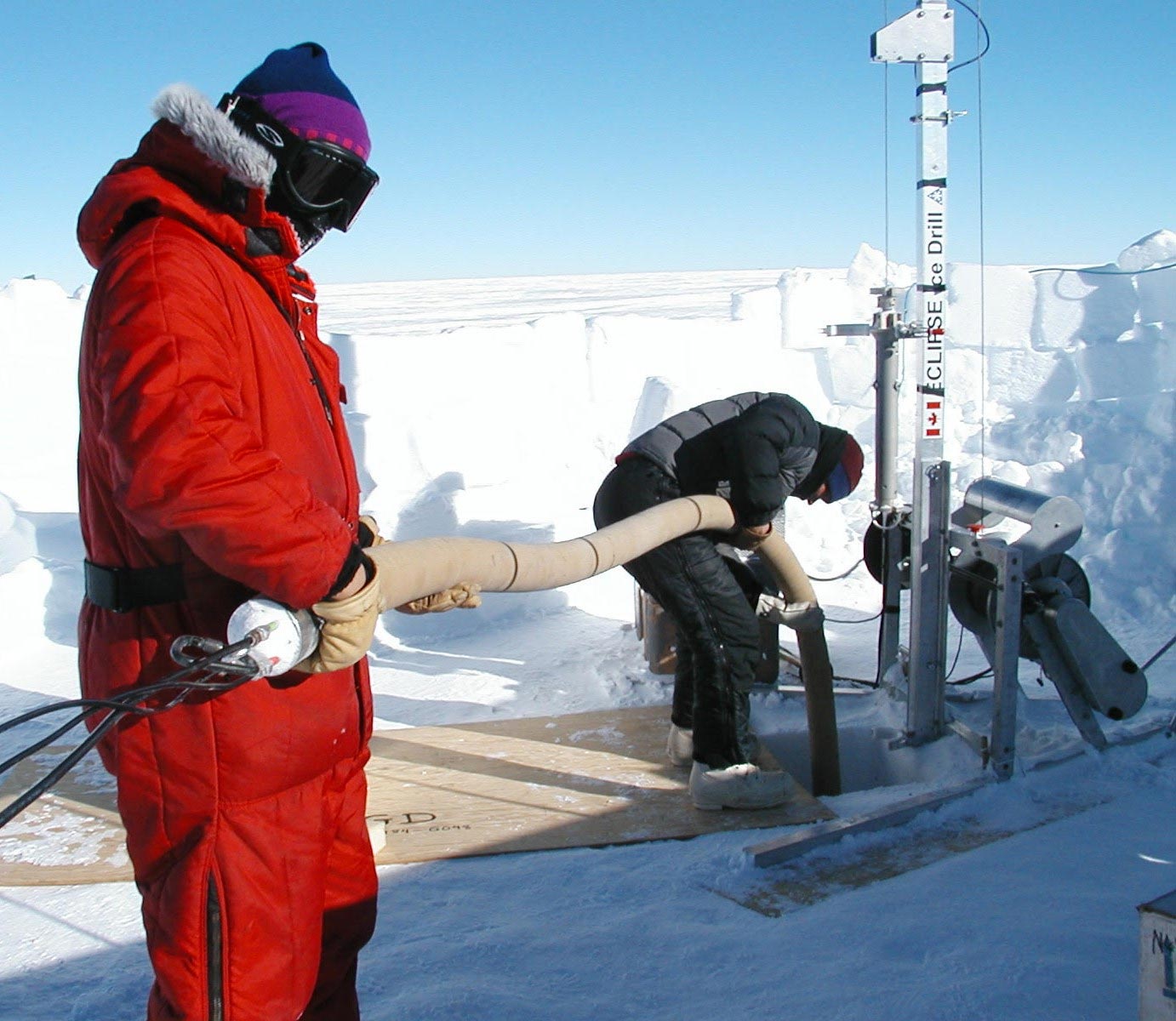
By analyzing air in Antarctic firn layers, scientists found that molecular hydrogen in the atmosphere has risen dramatically since the industrial era, mostly from human activity.
Earth system scientists at UCI studied air trapped in compacted layers of Antarctic ice and snow to come up with some answers and a few new questions about the amount of molecular hydrogen in our planet’s atmosphere. H2 is a byproduct of fossil fuel combustion, biomass burning, and the oxidation of methane, among other sources, and has an impact on global warming and the ozone layer. The UCI researchers, who were joined by scientists from the National Oceanic and Atmospheric Administration, the University of Colorado Boulder and UC San Diego, learned that molecular hydrogen increased from 330 to 550 parts per billion in Earth’s atmosphere from 1852 to 2003, the time span measured in the firn air collected near the South Pole at Megadunes, Antarctica. The team reported its findings in a paper published recently in the Proceedings of the National Academy of Sciences.
“Aging air is trapped in the perennial snowpack above an ice sheet, and sampling it gives us a highly accurate account of atmospheric composition over time,” said lead author John Patterson, a graduate student in the laboratory of Eric Saltzman, UCI professor of Earth system science. “Our paleoatmospheric reconstruction of H2 levels has greatly enhanced our understanding of anthropogenic emissions since the beginning of the industrial revolution.”
Human Activities Behind the H₂ Surge
Patterson said the bulk of the growth in H2 is attributable to human activities, especially those resulting in transportation-sourced emissions, but a portion of the increase is still unaccounted for. “Government policies on tailpipe emissions have led to a decrease in carbon monoxide in the atmosphere, so we should have expected to see the same impact on molecular hydrogen, but that appears not to be the case,” he said. “There’s no evidence that atmospheric molecular hydrogen emissions decreased in the 20th century, so we are likely underestimating nonautomotive sources of the gas.”
The researchers said there may be a new source of H2 emissions looming on the horizon as more people adopt zero-carbon hydrogen power for autos and other needs, leading to the possibility of leakage into the atmosphere.
Reference: “H2 in Antarctic firn air: Atmospheric reconstructions and implications for anthropogenic emissions” by John D. Patterson, Murat Aydin, Andrew M. Crotwell, Gabrielle Pétron, Jeffrey P. Severinghaus, Paul B. Krummel, Ray L. Langenfelds and Eric S. Saltzman, 7 September 2021, Proceedings of the National Academy of Sciences.
DOI: 10.1073/pnas.2103335118
Joining Patterson and Saltzman in the study were Murat Aydin, UCI associate researcher in Earth system science; Andrew Crotwell and Gabrielle Petron of CIRES at CU Boulder/NOAA Global Monitoring Laboratory; Jeffrey Severinghaus of the Scripps Institution of Oceanography at UC San Diego; and Paul Krummel and Ray Langenfelds of Australia’s Commonwealth Scientific and Industrial Research Organisation.
Never miss a breakthrough: Join the SciTechDaily newsletter.
Follow us on Google and Google News.
1 Comment
“…, but a portion of the increase is still unaccounted for.”
A major use of hydrogen is transforming liquid hydrocarbons into solids. Everything from the food industry to cosmetics employ hydrogenation. Thus, there are opportunities for leakage (hydrogen is hard to contain) during production, transportation, and use. Oxy-hydrogen welding is an important use, as is liquid hydrogen for rockets. There are numerous opportunities for anthropogenic hydrogen to be released! I suspect that the claimed sources of hydrogen from burning fossil fuels and biomass are seriously overestimated. Hydrogen is so combustible that it is difficult for me to believe that, with a lean air-to-fuel ratio, hydrogen is left unburned instead of carbon. Their point about catalytic converters is valid, and should have been a clue that they were inappropriately blaming fossil fuels when, in fact, any free hydrogen was being catalytically turned into water as intended.
http://conference.ing.unipi.it/ichs2005/Papers/120001.pdf