
A single anatomical innovation can drive ecological dominance and reshape evolutionary trajectories
Many lizards are phenomenal climbers. Their sharp, curved claws are ideal for clinging to tree trunks, rocks, and other rough surfaces. However, in the precarious world of tree tops — filled with slippery leaves and unstable branches — three peculiar groups of lizards possess a remarkable evolutionary accessory: sticky pads on their fingers and toes.
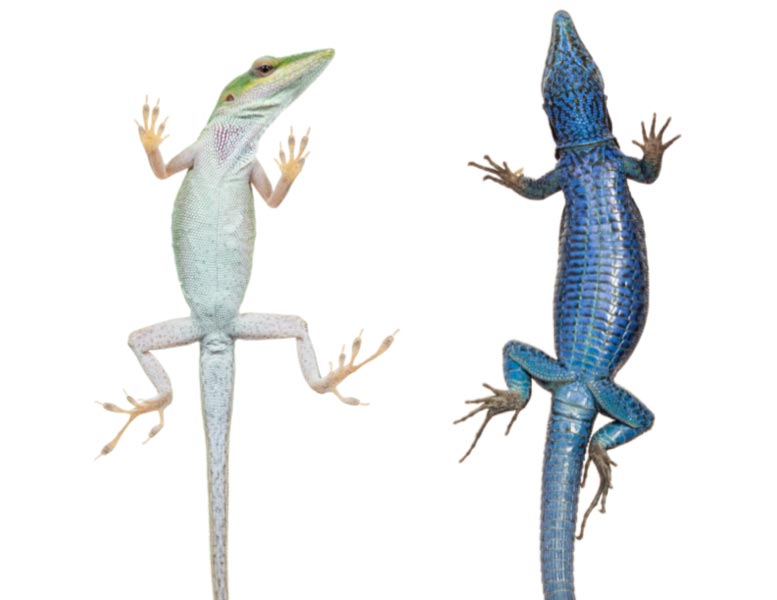
Sticky toepads have independently evolved in geckos, skinks, and Anolis lizards — producing tree acrobats specially adapted to life in the forest canopy. Scientists have long considered sticky toepads an ‘evolutionary key innovation’ that allows arboreal lizards to interact with the environment in ways that many padless lizards cannot.
Yet, some lizards without toepads have adopted the canopy lifestyle, an observation that has puzzled scientists for decades. Biologists Aryeh Miller and James Stroud at Washington University in St. Louis set out to find if lizards with toepads had an evolutionary advantage for life in the trees relative to their padless counterparts.
They analyzed data from 2,600 lizard species worldwide and discovered that, while hundreds of different types of lizards have independently evolved arboreal lifestyles, species that possessed sticky toepads prevailed.
Sticky Feet: A Biological Superpower
“Lizards with toepads have a greater ecological advantage in the arboreal environment,” said Miller, a graduate student in the Evolution, Ecology, and Population Biology program at Washington University and lead author on the study. “Toepads are essentially a biological superpower for lizards to access new resources that lizards without toepads cannot.”
“We found that lizards with sticky feet dominate the arboreal environment. Once adapted to life in the trees, they rarely leave,” said Stroud, a postdoctoral research associate in Arts & Sciences, who is the senior author on the paper. “Conversely, lizards without sticky toepads frequently transition away from living in trees to living on the ground.”
The study is published in Systematic Biology.
Toepad Evolution Shapes Lizard Diversity
“Scientists have long wondered about the role that the origin of key innovation plays in subsequent evolutionary diversification. Lizards are an excellent type of organism for such studies due to their exceptional species richness and the incredible extent of anatomical variation and habitat use,” said Jonathan Losos, the William H. Danforth Distinguished University Professor and professor of biology in Arts & Sciences and director of the Living Earth Collaborative at Washington University.
Using a recently published database of habitat use for nearly every lizard species across the globe, the researchers were able to perform a comprehensive analysis of toepad evolution in the context of lizard habitat use — for the first time, the evolutionary relationships between which lizards live in trees and which do not become clear.
“Miller and Stroud have developed an elegant new approach to understand this diversity and the role that anatomical evolution plays in shaping the great diversity of lizard kind. This work will be a model for researchers working on many types of plants, animals, and microbes,” Losos added.
Becoming a Tree Lizard is Easy—Staying One is Hard
Miller, who led the analysis, is the first to find that species have evolved for specialized life in trees at least 100 times in thousands of lizards. In other words, it is evolutionarily easy for a lizard to become a tree lizard.
What’s difficult is sticking around (pun intended!). Toepads don’t evolve until after lizards get into the trees, not before. And padless lizards will leave trees at a high frequency — much higher than padbearing lizards.
“There are hundreds of lizards living in the trees, but over evolutionary time many of those species end up leaving for life on the ground because, presumably, they interact with these padded lizards that have a greater advantage,” Stroud said.
The next step in this research is to find out exactly what padbearing lizards can do that their padless relatives can’t. Scientists can learn about this by watching the animals in their natural habitat.
“Analyzing evolutionary relationships can tell us a lot, but next we need to go out into nature — to see what parts of the environment the lizards use and why these evolutionary relationships exist,” Miller said.
Reference: “Novel Tests of the Key Innovation Hypothesis: Adhesive Toepads in Arboreal Lizards” by Aryeh H Miller and James T Stroud, 9 June 2021, Systematic Biology.
DOI: 10.1093/sysbio/syab041
Never miss a breakthrough: Join the SciTechDaily newsletter.
Follow us on Google and Google News.