
Close Menu
    Facebook X (Twitter) Instagram
    SciTechDaily
    • Biology
    • Chemistry
    • Earth
    • Health
    • Physics
    • Science
    • Space
    • Technology
    Facebook X (Twitter) Pinterest YouTube RSS
    SciTechDaily
    Home»Space»New Cassini Image of Small Moon Daphnis
    Space

    New Cassini Image of Small Moon Daphnis

    By SciTechDailyJanuary 19, 2017No Comments3 Mins Read
    Facebook Twitter Pinterest Telegram LinkedIn WhatsApp Email Reddit
    Share
    Facebook Twitter LinkedIn Pinterest Telegram Email Reddit
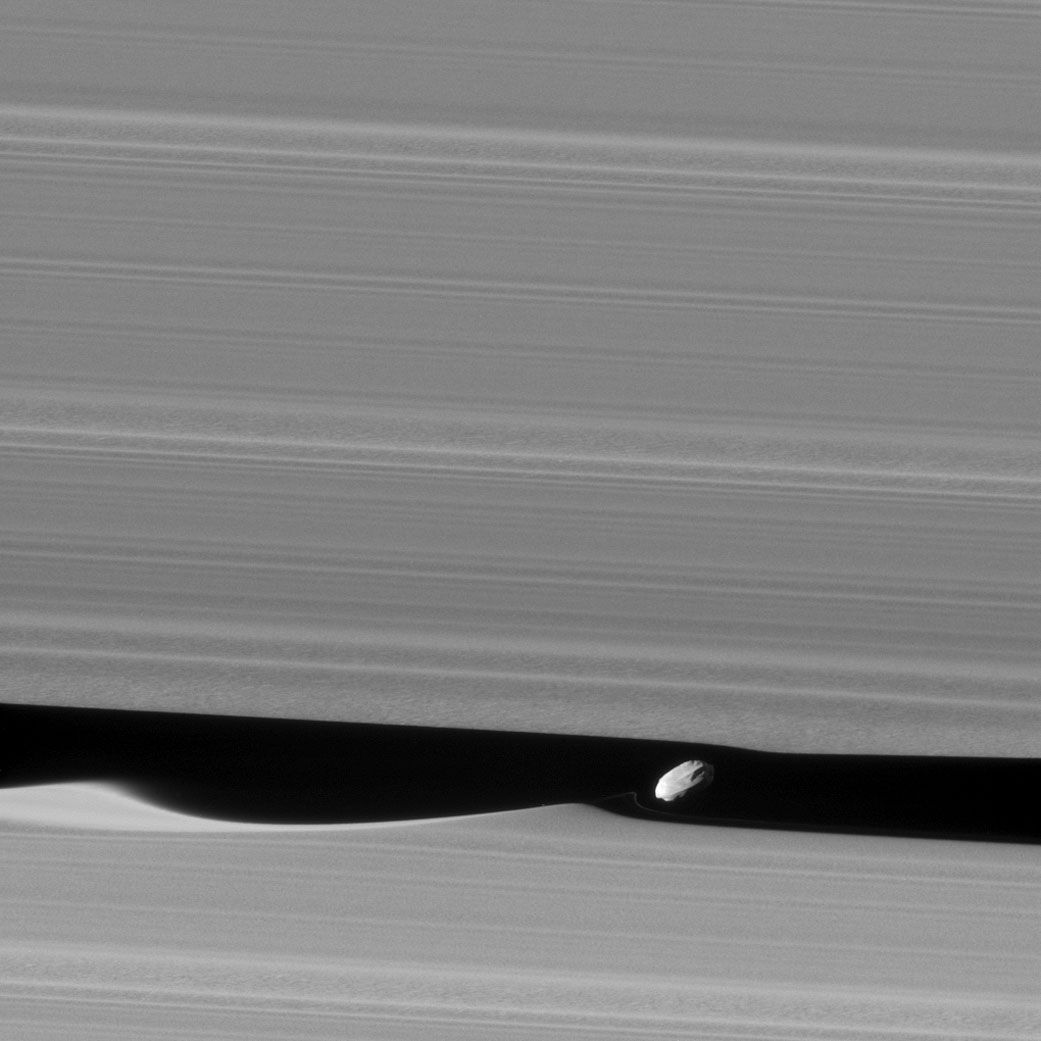
    Cassini Views Daphnis
    Saturn’s ring moon Daphnis exhibits a narrow equatorial ridge and a smooth surface likely composed of fine ring particles. A few craters are visible, and a parallel ridge to the equatorial band can be seen further north. Credit: NASA/JPL-Caltech/Space Science Institute

    This new Cassini image features one of Saturn’s small moons.

    The wavemaker moon, Daphnis, is featured in this view, taken as NASA’s Cassini spacecraft made one of its ring-grazing passes over the outer edges of Saturn’s rings on January 16, 2017. This is the closest view of the small moon obtained yet.

    Daphnis (5 miles or 8 kilometers across) orbits within the 42-kilometer (26-mile) wide Keeler Gap. Cassini’s viewing angle causes the gap to appear narrower than it actually is, due to foreshortening.

    The little moon’s gravity raises waves in the edges of the gap in both the horizontal and vertical directions. Cassini was able to observe the vertical structures in 2009, around the time of Saturn’s equinox.

    Like a couple of Saturn’s other small ring moons, Atlas and Pan, Daphnis appears to have a narrow ridge around its equator and a fairly smooth mantle of material on its surface — likely an accumulation of fine particles from the rings. A few craters are obvious at this resolution. An additional ridge can be seen further north that runs parallel to the equatorial band.

    Fine details in the rings are also on display in this image. In particular, a grainy texture is seen in several wide lanes which hints at structures where particles are clumping together. In comparison to the otherwise sharp edges of the Keeler Gap, the wave peak in the gap edge at the left has a softened appearance. This is possibly due to the movement of fine ring particles being spread out into the gap following Daphnis’ last close approach to that edge on a previous orbit.

    A faint, narrow tendril of ring material follows just behind Daphnis (to its left). This may have resulted from a moment when Daphnis drew a packet of material out of the ring, and now that packet is spreading itself out.

    The image was taken in visible (green) light with the Cassini spacecraft narrow-angle camera. The view was acquired at a distance of approximately 17,000 miles (28,000 kilometers) from Daphnis and at a Sun-Daphnis-spacecraft, or phase, angle of 71 degrees. Image scale is 551 feet (168 meters) per pixel.

    Never miss a breakthrough: Join the SciTechDaily newsletter.
    Follow us on Google and Google News.

    Astronomy Cassini-Huygens Mission Daphnis Planetary Science Saturn
    Share. Facebook Twitter Pinterest LinkedIn Email Reddit

    Related Articles

    New Findings Emerge About Tiny Moons Nestled In Saturn’s Rings

    Cassini Views Outer Edge of Saturn’s Main Rings

    New Cassini Image of Saturn’s Ring-Embedded Moon Daphnis

    Cassini Reveals Clues about Saturn’s Moon Titan

    Massive Saturn Storm Churns Up Water Ice from Great Depths

    Cassini Views a Spinning Vortex at Saturn’s North Pole

    Cassini Observes Meteors Colliding With Saturn’s Rings

    NASA’s Cassini Catches a Glimpse of Venus From Saturn Orbit

    Storm Spawns the Largest Tropospheric Vortex Ever Seen on Saturn

    Leave A Reply Cancel Reply

    • Facebook
    • Twitter
    • Pinterest
    • YouTube

    Don't Miss a Discovery

    Subscribe for the Latest in Science & Tech!

    Trending News

    Breakthrough Parkinson’s Drug Targets Disease at Its Genetic Roots

    Just 4 Weeks of Simple Diet Changes Reversed Signs of Aging in Older Adults

    Scientists May Have Finally Solved Why Humans Are Right-Handed

    NASA’s Hubble Accidentally Witnesses a Comet Shattering in Space

    Researchers Discover the Body’s Hidden “Off Switch” for Inflammation

    Scientists Discover Metformin Doesn’t Work the Way We Thought

    Tea or Coffee? Your Daily Choice Could Affect Osteoporosis Risk

    Vitamin C May Fight Cancer in a Surprising Way

    Follow SciTechDaily
    • Facebook
    • Twitter
    • YouTube
    • Pinterest
    • Newsletter
    • RSS
    SciTech News
    • Biology News
    • Chemistry News
    • Earth News
    • Health News
    • Physics News
    • Science News
    • Space News
    • Technology News
    Recent Posts
    • Scientists Develop Experimental Eye Drop That Could Transform Dry Eye Treatment
    • Extra Weight Could Age Your Brain Faster, Study Warns
    • Scientists Warn: America’s Most Popular Cooking Oil May Be Harming Your Intestines
    • Scientists Unravel the Mystery of Angola’s Giant “Ghost Elephants”
    • Ancient DNA Shatters the Simple Story of Europe’s Origins
    Copyright © 1998 - 2026 SciTechDaily. All Rights Reserved.
    • Science News
    • About
    • Contact
    • Editorial Board
    • Privacy Policy
    • Terms of Use

    Type above and press Enter to search. Press Esc to cancel.