
Close Menu
    Facebook X (Twitter) Instagram
    SciTechDaily
    • Biology
    • Chemistry
    • Earth
    • Health
    • Physics
    • Science
    • Space
    • Technology
    Facebook X (Twitter) Pinterest YouTube RSS
    SciTechDaily
    Home»Space»NASA’s Cassini Catches a Glimpse of Venus From Saturn Orbit
    Space

    NASA’s Cassini Catches a Glimpse of Venus From Saturn Orbit

    By Jia-Rui Cook, Jet Propulsion LaboratoryMarch 5, 2013No Comments4 Mins Read
    Facebook Twitter Pinterest Telegram LinkedIn WhatsApp Email Reddit
    Share
    Facebook Twitter LinkedIn Pinterest Telegram Email Reddit
    NASA Cassini Spacecraft Views Venus
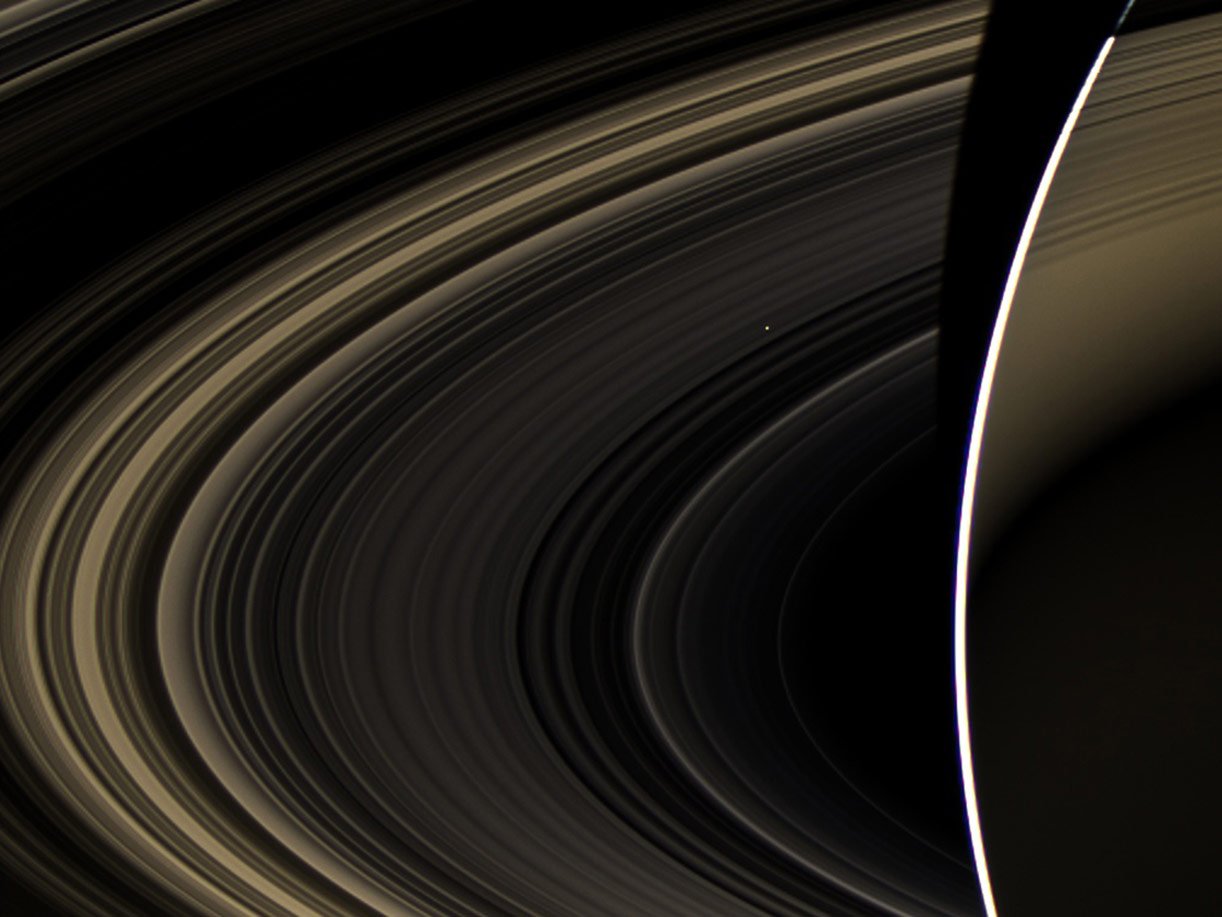
    Peering over the shoulder of giant Saturn, through its rings, and across interplanetary space, NASA’s Cassini spacecraft spies the bright, cloudy terrestrial planet, Venus. The vast distance from Saturn means that Venus only shows up as a white dot, just above and to the right of the image center. This view looks toward the unilluminated side of the rings from about 17 degrees below the ring plane. The image was taken in visible light with the Cassini spacecraft wide-angle camera on November 10, 2012. This is a true-color picture of Saturn and Venus. The bright arc is the limb of Saturn. A portion of the rings is seen in silhouette against the face of Saturn, which itself is faintly illuminated by sunlight scattered off the rings. The view was obtained at a distance of approximately 498,000 miles (802,000 kilometers) from Saturn and at a sun-Saturn-spacecraft, or phase, angle of 178 degrees. Credit: NASA/JPL-Caltech/Space Science Institute

    NASA’s Cassini spacecraft has taken several new images of Saturn and its rings, capturing a glimpse of Venus in the process.

    Pasadena, California – A distant world gleaming in sunlight, Earth’s twin planet, Venus, shines like a bright beacon in images taken by NASA’s Cassini spacecraft in orbit around Saturn.

    One special image of Venus and Saturn was taken last November when Cassini was placed in the shadow of Saturn. This allowed Cassini to look in the direction of the sun and Venus, and take a backlit image of Saturn and its rings in a particular viewing geometry called “high solar phase.” This observing position reveals details about the rings and Saturn’s atmosphere that cannot be seen in lower solar phase.

    One of the Venus and Saturn images being released today is a combination of separate red, green and blue images covering the planet and main rings and processed to produce true color. Last December, a false-color version of the mosaic was released.

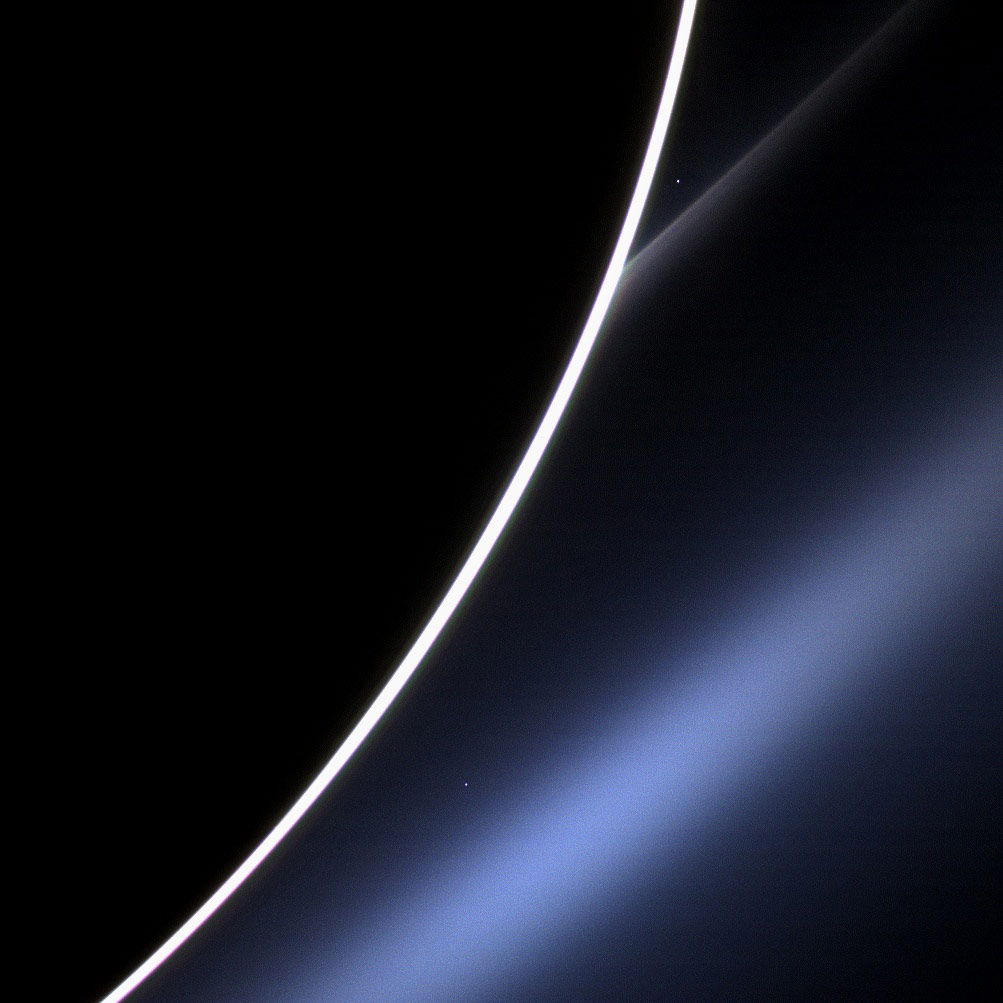
    Another image, taken in January, captures Venus just beyond the limb of Saturn and in close proximity to Saturn’s G ring, a thin ring just beyond the main Saturnian rings. The diffuse E ring, which is outside the G ring and created by the spray of the moon Enceladus, also is visible.
    Venus as Seen by the Cassini Spacecraft
    Dawn on Saturn is greeted across the vastness of interplanetary space by the morning star, Venus, in this image from NASA’s Cassini spacecraft. Venus appears just off the edge of the planet, in the upper part of the image, directly above the white streak of Saturn’s G ring. Lower down, Saturn’s E ring makes an appearance, looking blue thanks to the scattering properties of the dust that comprises the ring. A bright spot near the E ring is a distant star. This view looks toward the unilluminated side of the rings from about 21 degrees below the ring plane. Images taken using red, green and blue spectral filters were combined to create this natural color view. The images were obtained with the Cassini spacecraft wide-angle camera on January 4, 2013, at a distance of approximately 371,000 miles (597,000 kilometers) from Saturn. Credit: NASA/JPL-Caltech/Space Science Institute

    Venus is, along with Mercury, Earth, and Mars, one of the rocky “terrestrial” planets in the solar system that orbit relatively close to the sun. Though Venus has an atmosphere of carbon dioxide that reaches nearly 900 degrees Fahrenheit (500 degrees Celsius) and a surface pressure 100 times that of Earth’s, it is considered a twin to our planet because of their similar sizes, masses, rocky compositions and close orbits. It is covered in thick sulfuric acid clouds, making it very bright.

    The Cassini-Huygens mission is a cooperative project of NASA, the European Space Agency, and the Italian Space Agency. NASA’s Jet Propulsion Laboratory, a division of the California Institute of Technology in Pasadena, manages the Cassini-Huygens mission for NASA’s Science Mission Directorate, Washington. The Cassini orbiter and its two onboard cameras were designed, developed, and assembled at JPL. The imaging team consists of scientists from the U.S., England, France, and Germany. The imaging operations center is based at the Space Science Institute in Boulder, Colo.

    Never miss a breakthrough: Join the SciTechDaily newsletter.
    Follow us on Google and Google News.

    Astronomy Cassini-Huygens Mission Planetary Science Saturn
    Share. Facebook Twitter Pinterest LinkedIn Email Reddit

    Related Articles

    Cassini Views Saturn’s Uppermost Cloud Layers

    New Study Details the Changes in Saturn’s F Ring

    Cassini Reveals Possible New Moon Forming Around Saturn

    NASA Detects Ocean Inside Saturn’s Moon Enceladus

    Cassini Reveals Clues about Saturn’s Moon Titan

    Massive Saturn Storm Churns Up Water Ice from Great Depths

    Cassini Views a Spinning Vortex at Saturn’s North Pole

    Cassini Observes Meteors Colliding With Saturn’s Rings

    Storm Spawns the Largest Tropospheric Vortex Ever Seen on Saturn

    Leave A Reply Cancel Reply

    • Facebook
    • Twitter
    • Pinterest
    • YouTube

    Don't Miss a Discovery

    Subscribe for the Latest in Science & Tech!

    Trending News

    The Universe Is Expanding Too Fast and Scientists Can’t Explain Why

    “Like Liquid Metal”: Scientists Create Strange Shape-Shifting Material

    Early Warning Signals of Esophageal Cancer May Be Hiding in Plain Sight

    Common Blood Pressure Drug Shows Surprising Power Against Deadly Antibiotic-Resistant Superbug

    Scientists Uncover Dangerous Connection Between Serotonin and Heart Valve Disease

    Scientists Discover a “Protector” Protein That Could Help Reverse Hair Loss

    Bone-Strengthening Discovery Could Reverse Osteoporosis

    Scientists Uncover Hidden Trigger Behind Stem Cell Aging

    Follow SciTechDaily
    • Facebook
    • Twitter
    • YouTube
    • Pinterest
    • Newsletter
    • RSS
    SciTech News
    • Biology News
    • Chemistry News
    • Earth News
    • Health News
    • Physics News
    • Science News
    • Space News
    • Technology News
    Recent Posts
    • Scientists Create Improved Insulin Cells That Reverse Diabetes in Mice
    • Scientists Stunned After Finding Plant Thought Extinct for 60 Years
    • A Common Diabetes Drug May Hold the Key to Stopping HIV From Coming Back
    • Ancient “Syphilis-Like” Disease in Vietnam Challenges Key Scientific Assumptions
    • Drinking Alcohol To Cope in Your 20s Could Damage Your Brain for Life
    Copyright © 1998 - 2026 SciTechDaily. All Rights Reserved.
    • Science News
    • About
    • Contact
    • Editorial Board
    • Privacy Policy
    • Terms of Use

    Type above and press Enter to search. Press Esc to cancel.