
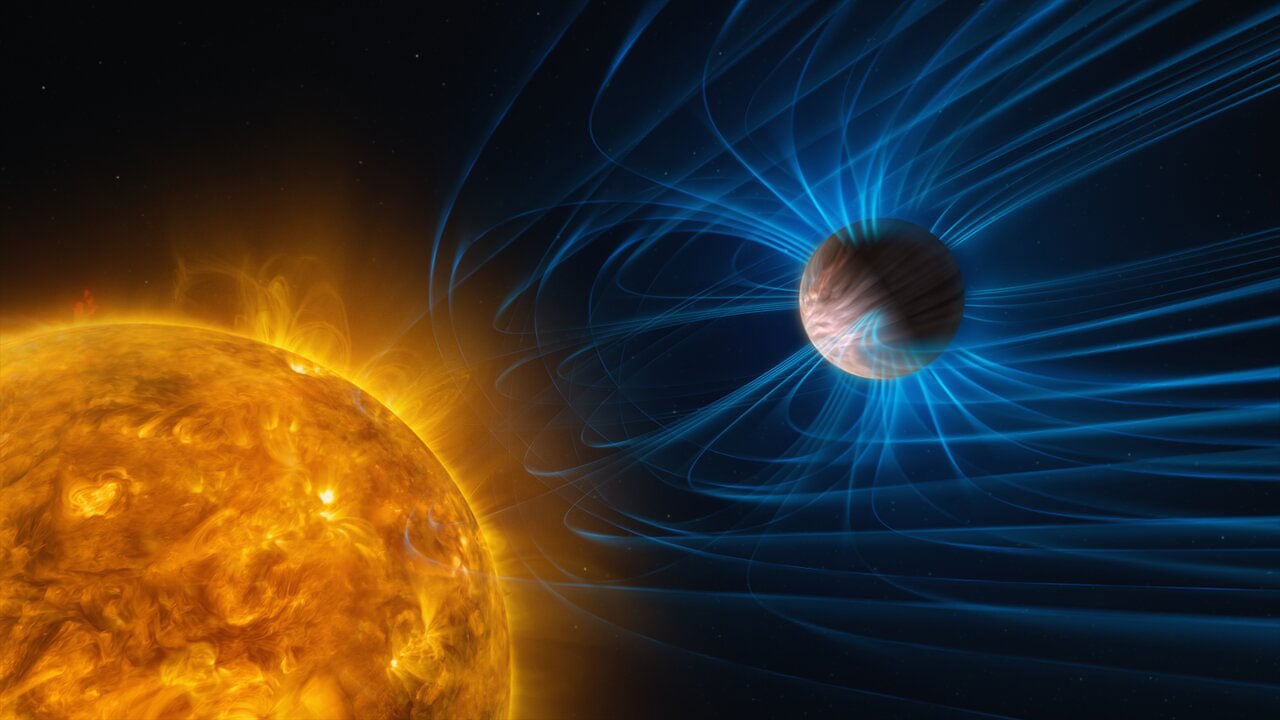
Astronomers studying the atmospheres of several intensely heated exoplanets uncovered an unexpected pattern that may reveal a hidden property of these distant worlds.
Astronomers have uncovered the clearest evidence so far that some planets beyond our Solar System possess magnetic fields. By measuring atmospheric winds on seven extremely hot gas giants, researchers found signs that magnetism is shaping conditions on these distant worlds.
The study used observations from the European Southern Observatory’s Very Large Telescope (ESO’s VLT) and the Gemini North telescope. The results suggest that magnetic fields are controlling the planets’ powerful winds, providing the first reliable measurements of magnetic field strength on exoplanets.
“This breakthrough opens a completely new window on exoplanet research. It’s the first time we can compare the magnetic environments of other worlds — a key step toward ultimately understanding which planets can stay alive, keep their water, and perhaps even, one day, host life as we know it,” says Julia Seidel, an astronomer at the Laboratoire Lagrange, Observatoire de la Côte d’Azur, France and lead author of the study published today in Nature Astronomy.
A Long-Sought Exoplanet Measurement
Magnetic fields play an important role in shaping planetary environments. On Earth, the magnetic field interacts with the atmosphere and helps protect the planet from harmful charged particles. Other planets in our Solar System, including Jupiter and Saturn, also have magnetic fields.
Despite years of research, scientists had not been able to directly determine the strength of magnetic fields on exoplanets. That challenge has remained unsolved for about 15 years.
Interestingly, the researchers were not originally searching for magnetic fields. Their goal was to study winds in the atmospheres of seven giant planets orbiting different stars. These worlds resemble Jupiter but orbit much closer to their stars and are tidally locked, meaning one side constantly faces the star.
Like the Moon always showing the same face to Earth, these planets have permanent day and night sides. One hemisphere is intensely heated while the other remains much colder. The extreme temperature contrast creates unusual weather patterns and exceptionally powerful winds.
Extreme Winds Reveal an Unexpected Pattern
The team measured winds ranging from about 7,200 km/h (4,475 mph) to more than 25,000 km/h (15,535 mph). By comparison, Jupiter’s fastest known winds reach roughly 1,500 km/h (930 mph).
“In the beginning we set out to check if the atmospheric winds behaved the same way for all hot planets,” explains Seidel, who was previously an astronomer at ESO in Chile.
The researchers analyzed data from the ESPRESSO instrument on ESO’s VLT in Chile’s Atacama Desert and a similar instrument on the Gemini North telescope in Hawaiʻi, USA. (The VLT is an ESO telescope while Gemini North is one half of the International Gemini Observatory, partly funded by the U.S. National Science Foundation (NSF) and operated by NSF NOIRLab.)
As they compared wind speeds with planetary temperatures, an unexpected trend appeared. Instead of moving faster, winds slowed down as temperatures increased.
“This is totally counterintuitive because, all things being equal, hot planets have more energy to accelerate the winds! Something must happen that slows down the wind speeds for hotter objects,” says study co-author Vivien Parmentier, a professor at the Laboratoire Lagrange.
Magnetic Fields as a Planetary Brake
The researchers concluded that the most likely explanation is the presence of global magnetic fields. These fields can interact with charged particles in a planet’s atmosphere, reducing their motion and effectively slowing atmospheric circulation.
Using this effect, the team estimated the magnetic field strength of each planet. The results indicate magnetic fields comparable to those found on giant planets in our own Solar System, with strengths roughly four times greater than Saturn’s or about half that of Jupiter’s.
The findings also suggest that magnetic fields could influence much more than atmospheric winds.
“Here on Earth, we know the beauty of the northern and southern lights, where particles from the Sun hit our magnetic field and are guided toward the poles, colliding with gases in the atmosphere to produce colorful displays of green, pink, and purple,” explains study co-author Bibiana Prinoth, a former PhD student at Lund University, Sweden, now an astronomer at ESO in Garching, Germany.
On these exoplanets, auroras powered by magnetic activity could be even more spectacular.
Looking ahead, scientists are eager to use ESO’s Extremely Large Telescope to study both giant and Earth-sized exoplanets in greater detail. The observatory may even be able to identify atmospheric gases linked to auroral activity on distant worlds.
Prinoth says: “I like to imagine that some of these worlds have a sky filled not only with stars, but with vast curtains of colorful light dancing across a planet that’s half in perpetual day and half in endless night.”
Reference: “Magnetic field strengths of hot giant exoplanets consistent with Solar System values” by Julia V. Seidel, Vivien Parmentier, Bibiana Prinoth, Thea Hood, Nishil Mehta, Valentin De Lia, Konstantin Batygin, Tristan Guillot, Ragnar Van den Broeck, Hayley Beltz, Brian Thorsbro, Florian Debras, Daniel D. B. Koll, Thaddeus D. Komacek, Emily Rauscher, Lorenzo Pino, Matteo Brogi, Joost P. Wardenier, Jacob L. Bean, Björn Benneke, Jean-Michel L. B. Désert, Pablo Drake, Siddharth Gandhi, Mark Hammond, David Kasper, Michael R. Line, Elspeth K. H. Lee, Stefan Pelletier, Andreas Seifahrt, Adrien Simonnin, Peter C. B. Smith and Kevin B. Stevenson, 2 June 2026, Nature Astronomy.
DOI: 10.1038/s41550-026-02870-1
Never miss a breakthrough: Join the SciTechDaily newsletter.
Follow us on Google and Google News.