
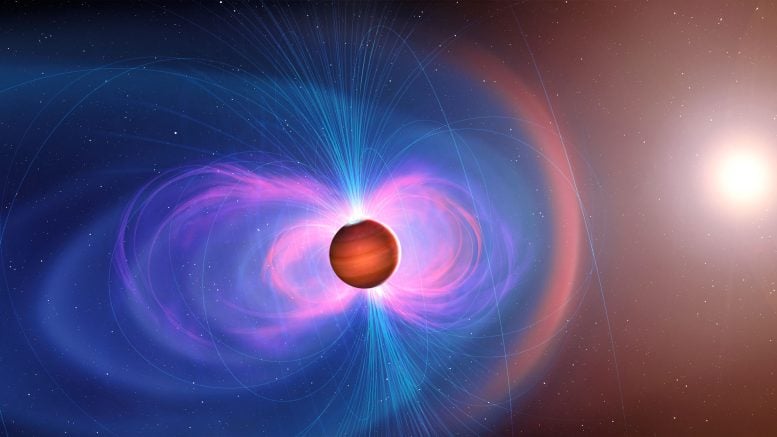
The first direct measurements of exoplanet magnetic fields reveal that ultra-hot Jupiters possess strong magnetism that shapes their atmospheres and may provide new insights into planetary habitability.
Astronomers have achieved a major advance in the study of worlds beyond our Solar System by estimating the strength of the magnetic fields surrounding seven ultra-hot Jupiters. The findings, published in Nature Astronomy, suggest that some of the hottest known exoplanets possess magnetic fields comparable in strength to those found on planets in our own Solar System.
“This breakthrough opens a completely new window on exoplanet research. It’s the first time we can compare the magnetic environments of other worlds — a key step toward ultimately understanding which planets can stay alive, keep their water, and perhaps even, one day, host life as we know it,” says Julia Seidel, an astronomer at the Laboratoire Lagrange, Observatoire de la Côte d’Azur, France, and lead author of the study.
Earth’s magnetic field serves as a protective barrier, helping prevent cosmic radiation from stripping away the atmosphere and supporting conditions suitable for life. Other planets in our Solar System, including Jupiter and Saturn, also have magnetic fields. Until now, however, astronomers had not been able to directly estimate the strength of magnetic fields on planets orbiting other stars.
Tracking Extreme Winds on Ultra-Hot Jupiters
The researchers were originally studying atmospheric winds rather than magnetic fields. They measured wind speeds on seven giant exoplanets similar to Jupiter that orbit very close to their stars and are tidally locked. Like the Moon, which always shows the same face to Earth, these planets permanently keep one side pointed toward their star. As a result, they have an intensely hot day side and an extremely cold night side.
The dramatic temperature contrast creates unusual weather conditions with exceptionally powerful winds. Wind speeds on the studied planets ranged from about 7,200 kilometers (4,400 miles) per hour to more than 25,000 kilometers (15,500 miles) per hour. For comparison, Jupiter’s fastest known winds reach roughly 1,500 kilometers (900 miles) per hour.
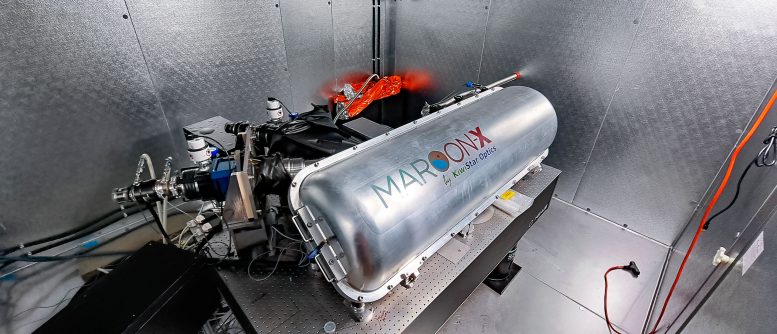
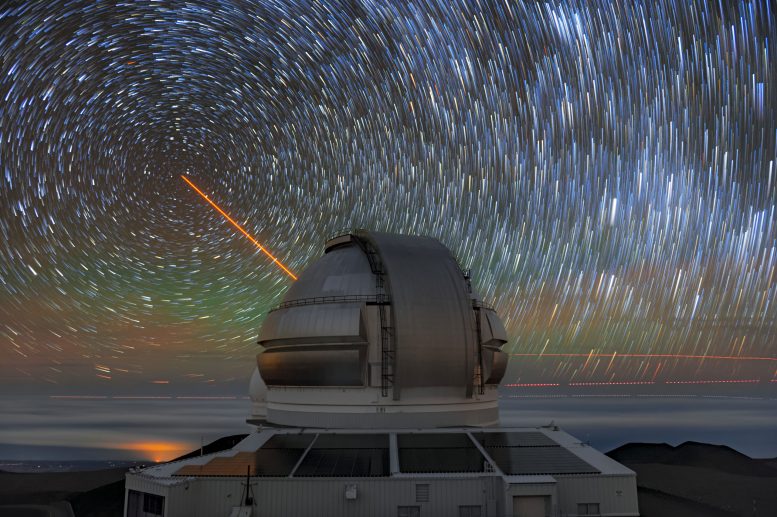
To make these measurements, the team analyzed observations from the MAROON-X instrument on the Gemini North telescope in Hawaiʻi, one of the two telescopes that make up the International Gemini Observatory, which is partly funded by the U.S. National Science Foundation (NSF) and operated by NSF NOIRLab. They also used data from the ESPRESSO instrument on ESO’s Very Large Telescope (VLT) in Chile’s Atacama Desert. These high-resolution instruments allowed researchers to track atmospheric motion by identifying the light signatures of specific chemicals and following their movement through the planets’ atmospheres.
“The stability of MAROON-X makes it a powerful tool for detecting the subtle motion of Earth-sized planets around other stars, as well as tracing changes in the atmospheres of exoplanets depending on orbital phase,” says Andreas Seifahrt, Associate Director of Development for Gemini Observatory and study co-author. “The unexpected discovery that resulted from studying the winds of these seven ultra-hot Jupiters shows that there is even more that we can learn from the data. MAROON-X provides a world-class capability for these studies.”
Magnetic Fields Explain the Wind Mystery
When the team compared wind speeds with planetary temperatures, they uncovered an unexpected trend. Instead of producing faster winds, higher temperatures were associated with slower winds.
“This is totally counterintuitive because, all things being equal, hot planets have more energy to accelerate the winds! Something must happen that slows down the wind speeds for hotter objects,” says study co-author Vivien Parmentier, a professor at the Laboratoire Lagrange.
According to the researchers, the most likely explanation is the presence of strong magnetic fields spanning the entire planet. These fields can act like a braking mechanism, slowing the movement of charged particles in the atmosphere. Using this relationship, the team was able to estimate the magnetic field strength of each planet. The results indicate fields roughly four times stronger than Saturn’s magnetic field and about half as strong as Jupiter’s.
Strong magnetic fields may influence much more than atmospheric winds. “Here on Earth, we know the beauty of the northern and southern lights, where particles from the Sun hit our magnetic field and are guided toward the poles, colliding with gases in the atmosphere to produce colourful displays of green, pink, and purple,” explains study co-author Bibiana Prinoth, a former PhD student at Lund University, Sweden, now an astronomer at ESO in Garching, Germany. Similar magnetic interactions on these distant planets could generate even more spectacular auroras.
Reference: “Magnetic field strengths of hot giant exoplanets consistent with Solar System values” by Julia V. Seidel, Vivien Parmentier, Bibiana Prinoth, Thea Hood, Nishil Mehta, Valentin De Lia, Konstantin Batygin, Tristan Guillot, Ragnar Van den Broeck, Hayley Beltz, Brian Thorsbro, Florian Debras, Daniel D. B. Koll, Thaddeus D. Komacek, Emily Rauscher, Lorenzo Pino, Matteo Brogi, Joost P. Wardenier, Jacob L. Bean, Björn Benneke, Jean-Michel L. B. Désert, Pablo Drake, Siddharth Gandhi, Mark Hammond, David Kasper, Michael R. Line, Elspeth K. H. Lee, Stefan Pelletier, Andreas Seifahrt, Adrien Simonnin, Peter C. B. Smith and Kevin B. Stevenson, 2 June 2026, Nature Astronomy.
DOI: 10.1038/s41550-026-02870-1
Never miss a breakthrough: Join the SciTechDaily newsletter.
Follow us on Google and Google News.
1 Comment
Memo 2606271433_Source 1. Reinterpretation【()】
Source 1.
https://scitechdaily.com/the-hottest-known-exoplanets-may-hold-clues-to-planetary-habitability/
1.
_The hottest known exoplanets may provide clues to planetary habitability.
_According to the results of the first study to directly measure the magnetic fields of exoplanets, superhot Jovian planets possess strong magnetic fields that form their atmospheres, which could provide new insights into planetary habitability.
========
【&&&&&&&b1.() 21st-century Earthlings have realized the era of electromagnetic scientific civilization and, using advanced equipment such as quantum mechanics-based experimental data cpls(*), 1507.
1.)
^^^^^They have reached the level of peering into deep space by installing the James Webb Advanced Space Telescope at Lagrange Point L2, which was created by the gravity of the Sun, Earth, and Moon. This is the level at which humanity, an intelligent life form, has come to understand the universe scientifically.
_I personally speculate1. that the probability of similar superintelligent extraterrestrials existing biologically throughout the universe is very high. 1508.
^^^It is reasonable that the universe appears differently from the perspective of an observer (Earthling cosmic principles).
2.)
>>>>>>However, I believe that intelligent extraterrestrials throughout the universe, even if their scientific expressions differ, ‘the principles pointed out by natural phenomena or religion are the same.’
^^^^^^^ The debate between general basic physical phenomena and the Absolute Creator [Name]… seems like it would always be a hot topic there, too… Haha. 1410.
>>>> This views the Christian concepts of God, worship, and creationism as ‘self-generating as a higher religion even among highly intelligent extraterrestrial beings.’ Then, the ‘Gods’ of their spiritual world become infinitely numerous. 1405.11.
3.)
>>>> The question is, how many habitable natural zones exist across the universe for highly intelligent life forms to exist?
^^^^^^& My personal opinion on this is that it is ‘infinitely numerous’.1417. The reason is the highlight.1435.
^^^^^^^ Our universe is msbase.universe.galaxy and is composed of element-based electromagnetic fields. This means it is a system protected from harmful radiation. Hmm. 1437.
4.)
>>>> The more important fact is that deep space observations across the entire universe, driven by the Lagrange point L2 effect, naturally generated a network applying the principle of local scarcity, which allowed for the synchronization(*) of space science.
^^&& This implies that even countless biological extraterrestrial beings of the same age as 21st-century Earthlings—not just Earthlings—are at a basic level of discussing the Big Bang theory in depth and searching for other galaxies and other extraterrestrial realms. Heh. 1448.
5.)
^^^^ Then the idea of ”going to another star country after death” no longer sounds completely nonsensical. Heh.
^^&& Of course, it may be hard to believe… but given the circumstances, various possibilities are valid even with my explanation based on scientific reasoning. Hmm. 1453. 1514.
】
1-1.
_Astronomers have made significant progress in the study of worlds beyond the solar system by estimating the magnetic field strengths of seven superheated Jovian planets. The results of this study, published in Nature Astronomy, suggest that some of the hottest known exoplanets possess magnetic fields of similar strength to those found on planets in our solar system.
1-2.
“This groundbreaking discovery has opened a completely new horizon in exoplanet research. This is the first time we have been able to compare the magnetic environments of different planets, and this is an important step in understanding which planets can ultimately sustain life, preserve water, and eventually allow life as we know it to exist,” said Julia Seidel, an astronomer at the Lagrange Institute of the Côte d’Azur in France and the lead author of the study.
1-3.
Earth’s magnetic field acts as a protective shield, preventing cosmic radiation from stripping away its atmosphere and maintaining an environment suitable for life. Other planets in the solar system, including Jupiter and Saturn, also possess magnetic fields. However, until now, astronomers have been unable to directly measure the strength of magnetic fields on planets orbiting other stars.
2. Tracking Extreme Winds on a Superheated Jupiter
_The research team was originally studying atmospheric winds rather than magnetic fields. They measured wind speeds on seven tidal-locked exoplanets that are similar to Jupiter, orbit very close to their stars, and are tide-locked. Just like the Moon, which always shows the same side to Earth, these planets always keep one side facing their star. As a result, these planets have environments that are very hot during the day and extremely cold at night.
2-1.
_Extreme temperature differences create unusual weather conditions accompanied by very powerful winds. Wind speeds on the planets under study ranged from approximately 7,200 km/h to over 25,000 km/h. For comparison, the fastest wind speed on Jupiter is roughly 1,500 km/h.
2-2.
_To make these measurements, the research team analyzed observational data obtained from the MAROON-X instrument on the Gemini North Telescope in Hawaii (one of the two telescopes that make up the International Gemini Observatory). The International Gemini Observatory is operated by NSF NOIRLab with partial funding from the National Science Foundation (NSF).
_In addition, data from the ESPRESSO instrument mounted on the Very Large Telescope (VLT) at the European Southern Observatory (ESO) in the Atacama Desert, Chile, was utilized. Through this high-resolution instrument, researchers were able to observe atmospheric motion by identifying light signals from specific chemicals and tracking their movement as they passed through the planet’s atmosphere.
2-3. Polar Laser Tests Conducted at Gemini North
_”The stability of MAROON-X allows it to serve as a powerful tool for detecting the minute movements that occur when Earth-sized planets orbit other stars and for tracking changes in exoplanet atmospheres based on orbital phase,” says Andreas Seifard, Associate Director of Development at the Gemini Observatory and co-author of this study. “The unexpected findings obtained while studying the stellar winds of these seven superheated Jovian planets demonstrate that we can learn much more from the data. MAROON-X provides world-class capabilities for such research.”
3. Magnetic Fields Explain the Mysteries of Wind
The research team compared wind speeds with Earth’s temperature and discovered an unexpected trend. It was found that high temperatures actually slow down wind speeds.
=============
【&&&&&&1.() The center of the msbase is hot and narrow, so wind speeds may be slow along short circumferences due to the speed being inversely proportional to the lower temperature. Hmm. 2606270744.
^^^Then where is the center of our universe? According to Big Bang theorists, it seems to be the hot Big Bang event 13.7 billion years ago. Huh? 1459. 1516.
^^^Therefore, I believe the current universe consists of a rapidly expanding cosmos racing at high speed around a giant circle and cold sidems. Hmm. 1519.
>>>Now, that universe could be a masterless parpi.circle(*) world of only space xy.vixxa(*), where time t(zz’) is ignored, within a world sample1.oms.vix.ain led by vixer(xyz). Heh. 1501. 1520.
】
_”Assuming all other conditions are equal, this is a completely counterintuitive result because hot planets have more energy to accelerate winds! Some phenomenon must occur on hotter celestial bodies to slow down the speed of the winds,” says Professor Vivien Parmentier of the Lagrange Institute, a co-author of the study.
_According to the research team, the most likely explanation is the existence of a strong magnetic field across the entire planet. These magnetic fields can act like braking mechanisms, slowing down the movement of charged particles in the atmosphere. Using this relationship, the research team was able to estimate the magnetic field strength of each planet. As a result, they found that there are magnetic fields approximately four times stronger than Saturn’s and about half the strength of Jupiter’s.
3-1.
_Strong magnetic fields can affect much more than just atmospheric winds. “On Earth, particles from the sun collide with magnetic fields and head toward the polar regions, where they collide with atmospheric gases to create the beautiful Northern and Southern Lights, which produce auroras in colorful shades of green, pink, and purple,” explains Viviana Prinos, a co-author of the study who completed her doctoral studies at Lund University in Sweden and is currently an astronomer at the European Southern Observatory (ESO) in Garching, Germany.
_If similar magnetic interactions occur on distant planets, much more spectacular auroras could be generated.