
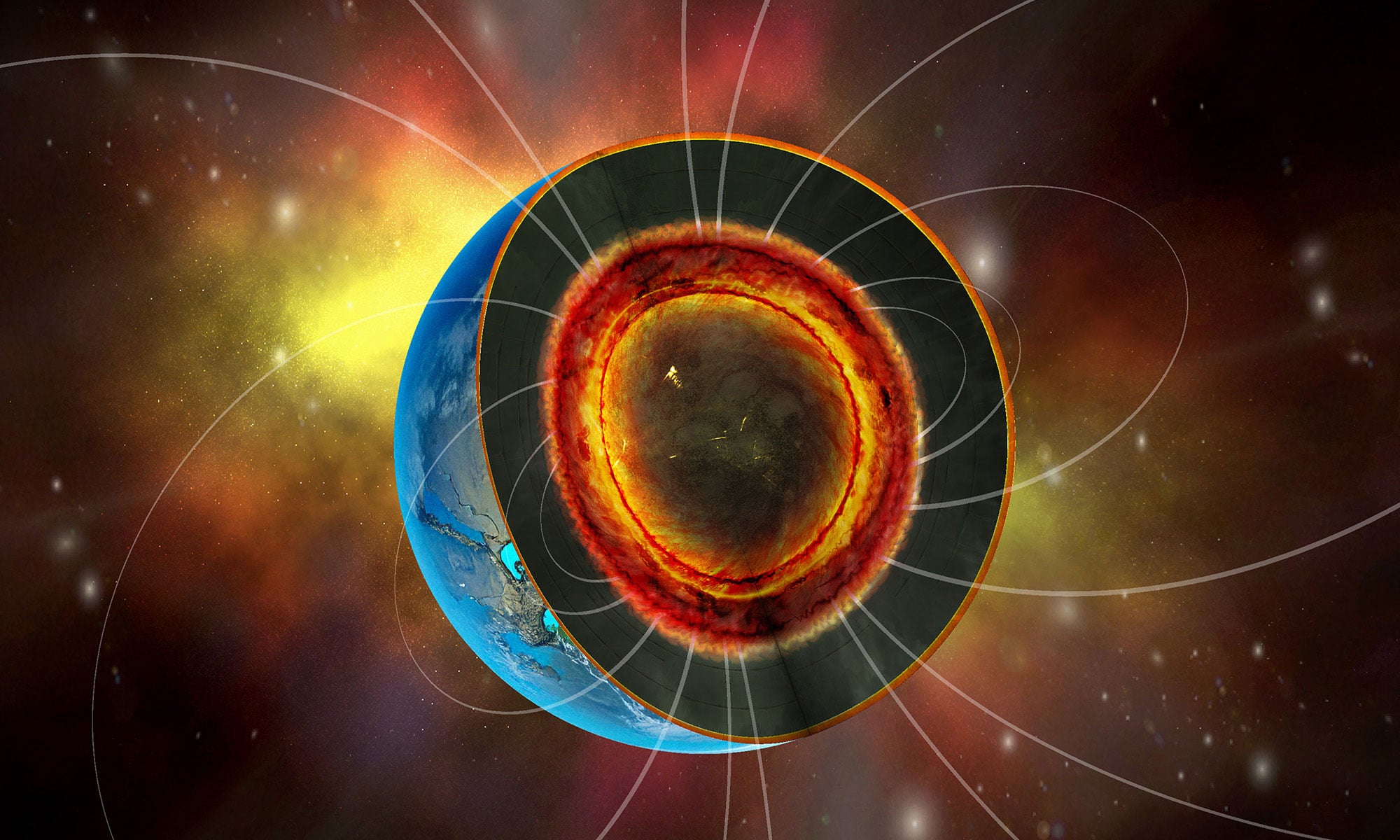
Deep within massive rocky exoplanets, hidden oceans of molten rock may be generating powerful magnetic fields in an unexpected way.
Far below the surfaces of distant rocky exoplanets known as super-earths, vast layers of molten rock may be performing a remarkable role. These hidden reservoirs could generate magnetic fields strong enough to protect entire planets from cosmic radiation and other high-energy particles.
On Earth, the magnetic field comes from motion in the planet’s liquid iron outer core, a process called a dynamo, but larger rocky planets may not operate the same way. Some super-earths could have cores that are either solid or entirely liquid, limiting their ability to produce magnetic fields through this familiar mechanism.
In a paper published in Nature Astronomy, researchers at the University of Rochester, including Miki Nakajima, an associate professor in the Department of Earth and Environmental Sciences, describe a different source. They point to a deep layer of molten rock known as a basal magma ocean (BMO). This idea could change how scientists understand planetary interiors and may influence how they assess whether distant worlds can support life.
“A strong magnetic field is very important for life on a planet,” Nakajima says, “but most of the terrestrial planets in the solar system, such as Venus and Mars, do not have them because their cores don’t have the right physical conditions to generate a magnetic field. However, super-earths can produce dynamos in their core and/or magma, which can increase their planetary habitability.”
What is a super-earth?
Super-earths are planets larger than Earth but smaller than ice giants like Neptune. They are thought to be mostly rocky, with solid surfaces instead of thick gas envelopes like those surrounding Jupiter or Saturn. Although they are the most commonly detected type of exoplanet in our galaxy, none exist in our own solar system. The term “super-earth” refers only to their size and mass, not to how Earth-like they are in other respects.
Because they are so common, super-earths provide valuable insight into how planets form and change over time. Many orbit within habitable zones around their stars, where liquid water could exist. By examining their structure, atmospheres, and magnetic fields, scientists are piecing together clues about how planetary systems develop and where life-friendly conditions might arise.
Simulating super-earths on Earth
Researchers think that early in its history, Earth may also have had a basal magma ocean. This layer of molten or partially molten rock at the base of the mantle can influence a planet’s magnetic field, internal heat flow, and chemical development. Since super-earths are larger and experience much greater internal pressure, they are more likely to maintain these molten layers over long periods, making BMOs central to understanding their internal dynamics and potential habitability.
To study these extreme conditions, Nakajima and her team carried out laser shock experiments at the University of Rochester’s Laboratory for Laser Energetics. They combined these experiments with quantum mechanical simulations and models of planetary evolution, focusing on how molten rock behaves under pressures similar to those inside a BMO.
Their results show that at such high pressures, molten rock deep within a planet’s mantle can become electrically conductive enough to sustain a magnetic field for billions of years. This finding suggests that super-earths more than three to six times the size of Earth could generate powerful and long-lasting magnetic fields through magma-driven dynamos. These fields may be even stronger and more persistent than Earth’s, increasing the chances that such planets could support life.
“This work was exciting and challenging, given that my background is primarily computational and this was my first experimental work,” Nakajima says. “I’m very grateful for the support from my collaborators from various research fields to conduct this interdisciplinary work. I cannot wait for future magnetic field observations of exoplanets to test our hypothesis.”
Reference: “Electrical conductivities of (Mg,Fe)O at extreme pressures and implications for planetary magma oceans” by Miki Nakajima, Sarah K. Harter, Alex V. Jasko, Danae N. Polsin, Ian Szumila, Kim A. Cone, Victor Lherm, Eric G. Blackman, Francis Dragulet, Lars Stixrude, Dustin Trail, Margaret F. Huff, J. Ryan Rygg, Angel Paz, Gilbert W. Collins, Alexa LaPierre and Zaire Sprowal, 15 January 2026, Nature Astronomy.
DOI: 10.1038/s41550-025-02729-x
Never miss a breakthrough: Join the SciTechDaily newsletter.
Follow us on Google and Google News.
1 Comment
maybe that’s where frogs came from – their spores were belched out from super volcanoes into space and they found their way here.
yes?