
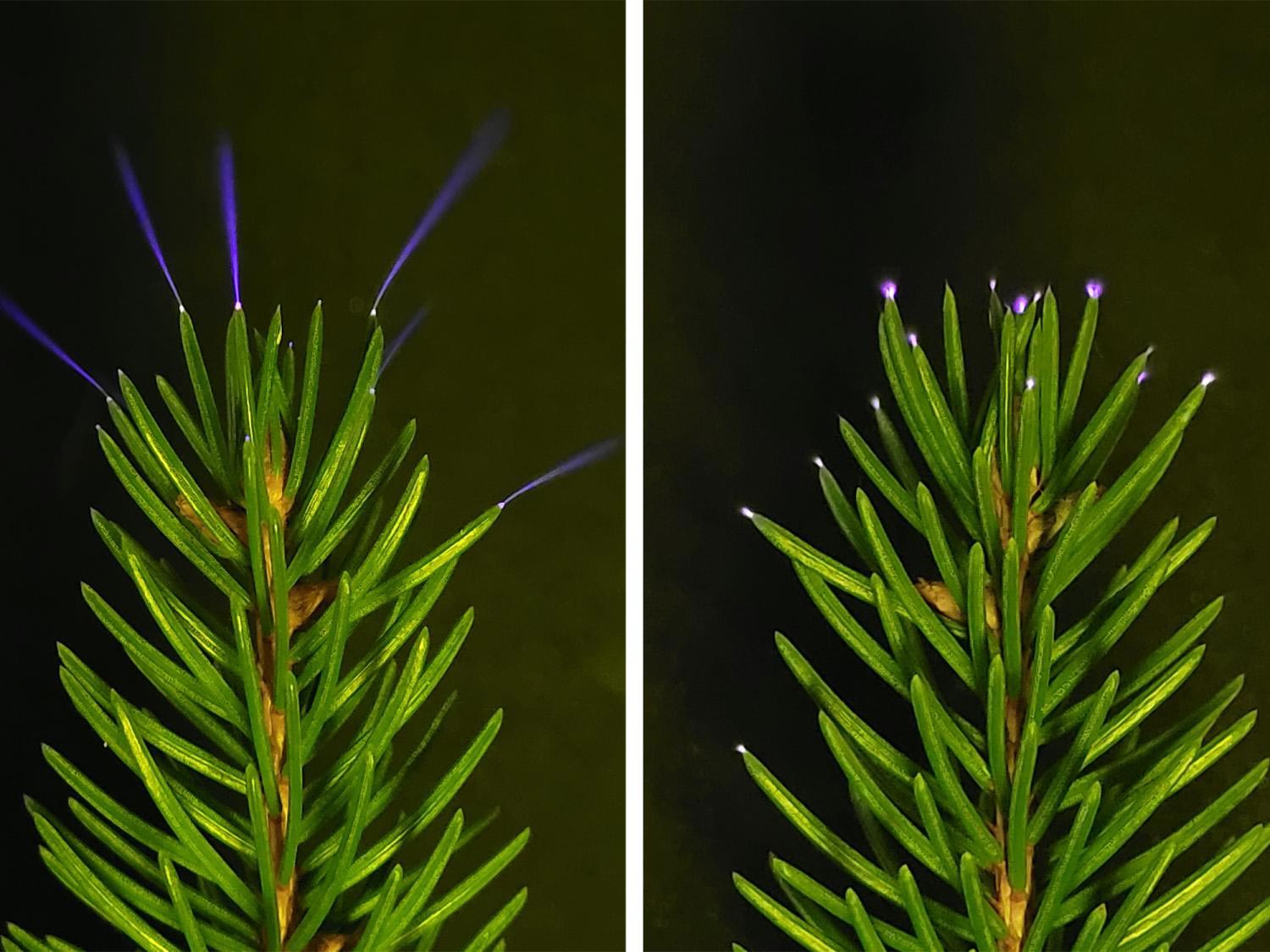
Researchers have captured the first real-world evidence of tiny electrical flashes glowing from treetops during thunderstorms. These nearly invisible bursts may help clean the air while revealing a hidden side of forests.
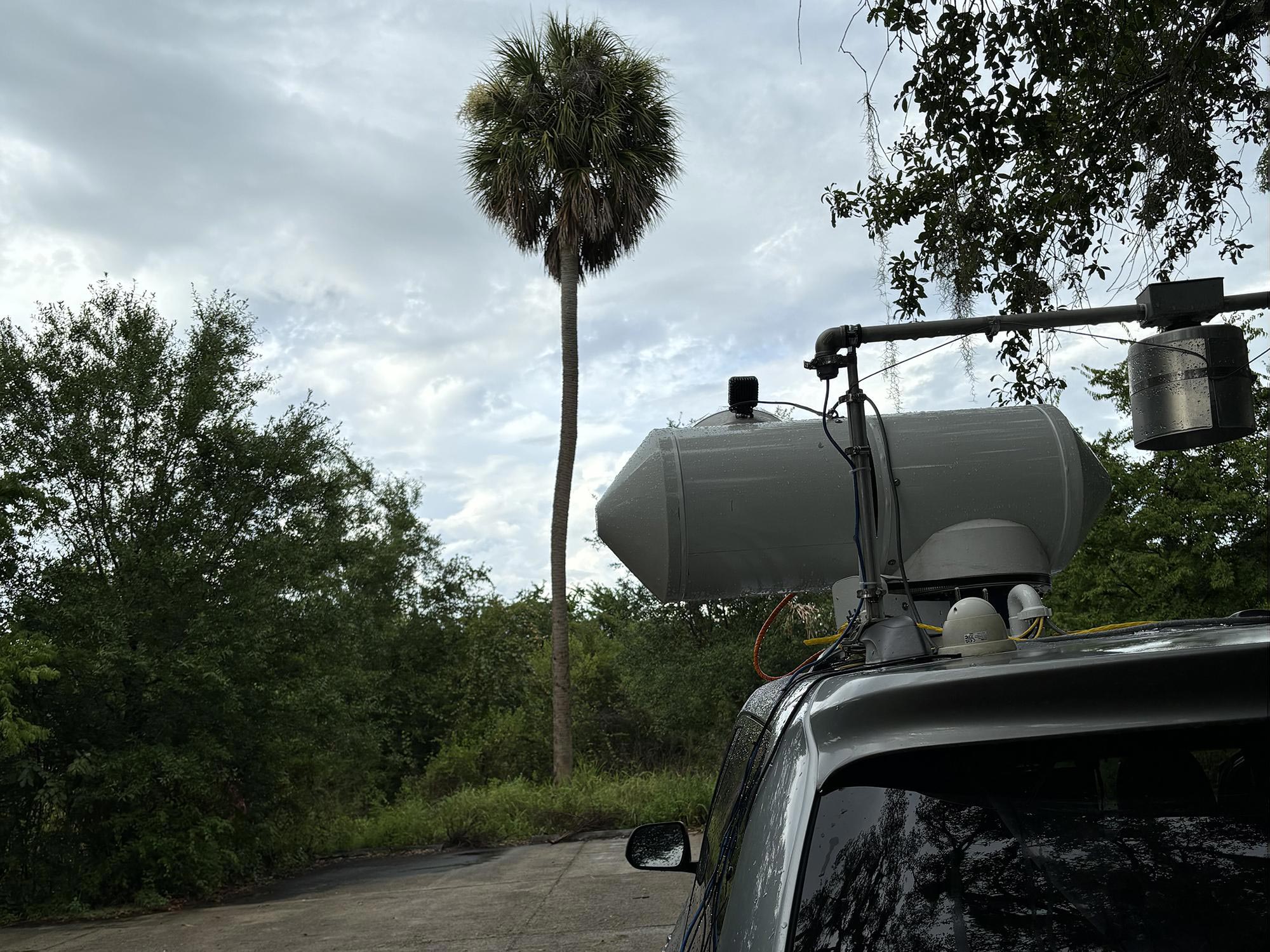
In June 2024, a team of Penn State researchers set out along the East Coast in a modified 2013 Toyota Sienna equipped with a custom telescopic weather instrument mounted on its roof. Their mission was to track Florida’s frequent summer thunderstorms and capture evidence of a phenomenon that had never been observed outside laboratory conditions.
They were searching for corona discharges, a long-suspected atmospheric effect in which tiny electrical pulses form at the tips of leaves, causing treetops to emit a faint glow in the ultraviolet (UV). For more than 70 years, scientists have linked unusual electric field activity in forests during storms to this effect, but direct observations in nature had remained out of reach.
A Team Determined to Make the First Observation
The group included William Brune, a distinguished professor of meteorology and atmospheric science; Patrick McFarland, a doctoral student in the same field; Jena Jenkins, an assistant research professor; and David Miller, a former associate research professor now working at the Penn State Applied Research Lab. Their goal was to become the first to document corona discharges occurring in the natural environment.
Florida was selected because of its regular thunderstorm activity. However, conditions did not unfold as expected. For three weeks, McFarland and Brune pursued brief, scattered storms that faded quickly, leaving the team without meaningful results.
Breakthrough During the Return Trip
The turning point came as the researchers began their journey back to Pennsylvania. Large, long-lasting storms developed just west of Interstate 95. The team pulled off the highway and set up in a parking lot at the University of North Carolina at Pembroke. From there, they directed their instruments toward the upper branches of a sweetgum tree located about 100 feet from their vehicle.
A storm lasted nearly two hours, producing steady rain and repeated lightning. During this time, the team detected corona discharges on the sweetgum tree and later observed similar activity on a nearby long needle loblolly pine as the storm weakened. These observations marked the first confirmed detection of corona discharges in nature. The findings were published in Geophysical Research Letters.
“This just goes to show that there’s still discovery science being done,” said McFarland, lead author on the paper. “For more than half a century, scientists have theorized that corona exists, but this proves it.”
How Corona Discharges Form in Storm Conditions
The researchers explained that corona discharges arise from strong electrical imbalances during thunderstorms. Storm clouds build up negative charges, which attract positive charges from the ground below. This positive charge travels upward through trees, concentrating at the highest points, such as the tips of leaves.
At these fine, hair-like structures, the electric field becomes intense enough to produce a faint glow in both visible and UV wavelengths. The UV light generated during this process breaks apart water vapor, leading to the formation of hydroxyl.
Why Hydroxyl Matters for Air Quality
Hydroxyl plays a crucial role in atmospheric chemistry as the primary oxidizer. Oxidizers help cleanse the air by reacting with various chemicals and converting them into forms that can be more easily removed. These reactions involve substances released by trees as well as human-produced pollutants, including methane, a greenhouse gas.
Previous studies by the team showed that corona discharges could be an important source of these cleansing compounds within forest canopies, suggesting a potential link between storms, trees, and air quality.
From Laboratory Experiments to Field Detection
Earlier experiments conducted by the researchers involved applying high-voltage, low-current electrical pulses to tree branches. These tests revealed a strong connection between UV emissions from corona discharges and the production of hydroxyl. Both in those experiments and in the recent field observations, the team also noted minor damage to leaves at the points where corona formed.
To observe the phenomenon in real-world conditions, the researchers developed the Corona Observing Telescope System. This system uses a Newtonian telescope connected to a UV-sensitive camera. It includes geolocation capabilities, instruments to measure atmospheric electricity, and calibration using a mercury lamp. By blocking solar UV wavelengths, the system ensures that only corona, lightning, and fire can produce detectable UV signals.
Hundreds of Electrical Events Recorded in Trees
Using this system in North Carolina, the team recorded 859 corona events on the sweetgum tree and 93 on the loblolly pine. Individual events lasted from brief flashes to several seconds, according to McFarland. The researchers also observed corona activity during four additional thunderstorms and across four other tree species.
“It’s nearly invisible to the naked eye, but our instruments give rise to a vision of swaths of scintillating corona glowing as thunderstorms pass overhead,” McFarland said. “Such widespread coronae have implications for the removal of hydrocarbons emitted by trees, subtle tree leaf damage, and could have broader implications for the health of trees, forests, and the atmosphere.”
New Questions About Trees and Atmospheric Effects
Although the study confirms that corona discharges occur in nature, many uncertainties remain. Researchers are now investigating whether these electrical events harm trees or provide some benefit. They are also exploring whether trees have adapted to withstand this process and whether the resulting chemical reactions improve forest health.
To answer these questions, the team is beginning collaborations with tree ecologists and biologists. Their work could deepen understanding of how forests interact with the atmosphere and influence environmental processes.
Reference: “Corona Discharges Glow on Trees Under Thunderstorms” by P. J. McFarland, W. H. Brune, D. O. Miller and J. M. Jenkins, 12 February 2026, Geophysical Research Letters.
DOI: 10.1029/2025GL119591
The research was supported by the U.S. National Science Foundation. Brune, Jenkins and Miller were co-authors on the study.
Never miss a breakthrough: Join the SciTechDaily newsletter.
Follow us on Google and Google News.
1 Comment
As a ham radio op, this is a well known phenomena amongst even the early (1930’s) navy radiomen. My antenna system will trigger arcing across the spark arrestor when a T-storm is 20Km away. The beverage antenna in the trees will draw an arc when it gets a little closer.