
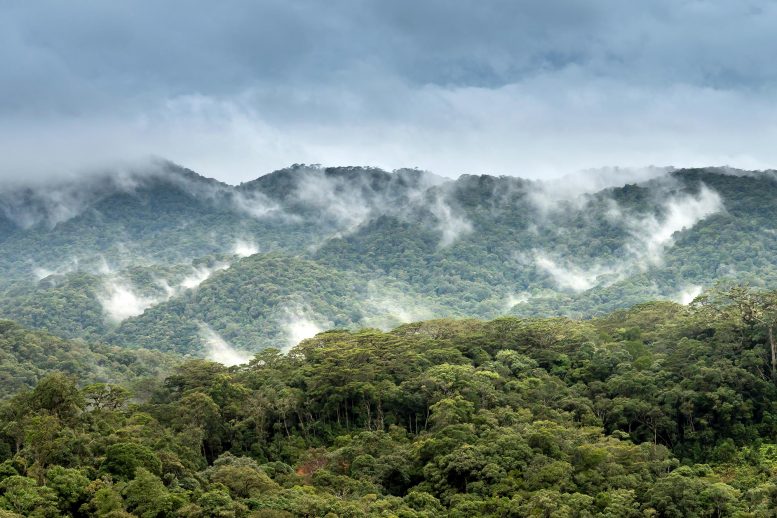
Princeton University researchers found that greater formation of clouds over forested areas suggests that reforestation would likely be more effective at cooling Earth’s atmosphere than previously thought. The findings address a concern among scientists that because forests absorb solar radiation, reforesting temperate latitudes could in fact make the planet warmer.
Planting trees and replenishing forests are among the simplest and most appealing natural climate solutions, but the impact of trees on atmospheric temperature is more complex than meets the eye.
One question among scientists is whether reforesting midlatitude locations such as North America or Europe could in fact make the planet hotter. Forests absorb large amounts of solar radiation as a result of having a low albedo, which is the measure of a surface’s ability to reflect sunlight. In the tropics, low albedo is offset by the higher uptake of carbon dioxide by the dense, year-round vegetation. But in temperate climates, the concern is that the sun’s trapped heat could counteract any cooling effect forests would provide by removing carbon dioxide from the atmosphere.
But a new study from Princeton University researchers found that these concerns may be overlooking a crucial component — clouds. They report in the Proceedings of the National Academy of Sciences that the denser cloud formations associated with forested areas means that reforestation would likely be more effective at cooling Earth’s atmosphere than previously thought.
“The main thing is that nobody has known whether planting trees at midlatitudes is good or bad because of the albedo problem,” said corresponding author Amilcare Porporato, Princeton’s Thomas J. Wu ’94 Professor of Civil and Environmental Engineering and the High Meadows Environmental Institute. “We show that if one considers that clouds tend to form more frequently over forested areas, then planting trees over large areas is advantageous and should be done for climate purposes.”
Cooling Power of Midlatitude Clouds
As anyone who has felt a cloud pass over the sun on a hot day knows, daytime clouds have a cooling — albeit transient — effect on the Earth. In addition to directly blocking the sun, clouds have a high albedo, similar to ice and snow. Clouds, however, are notoriously difficult to study and have been largely discounted from many studies examining the effectiveness of natural climate change mitigation, including reforestation, Porporato said.
To consider reforestation in the context of cloud coverage, Porporato worked with lead author Sara Cerasoli, a Princeton graduate student in civil and environmental engineering, and Jun Ying, an assistant professor at Nanjing University of Information Science and Technology who previously was a postdoctoral fellow in Porporato’s research group. Their work was supported by the Carbon Mitigation Initiative based in HMEI.
Porporato and Yin previously reported that climate models underestimate the cooling effect of the daily cloud cycle. They also reported last year that climate change could result in increased daily cloud coverage in arid regions such as the American Southwest that are currently ideal for solar power production.
For the latest study, Cerasoli, Porporato and Yin investigated the influence of vegetation on cloud formation in midlatitude regions by combining satellite data of cloud coverage from 2001-10 with models related to the interaction between plants and the atmosphere.
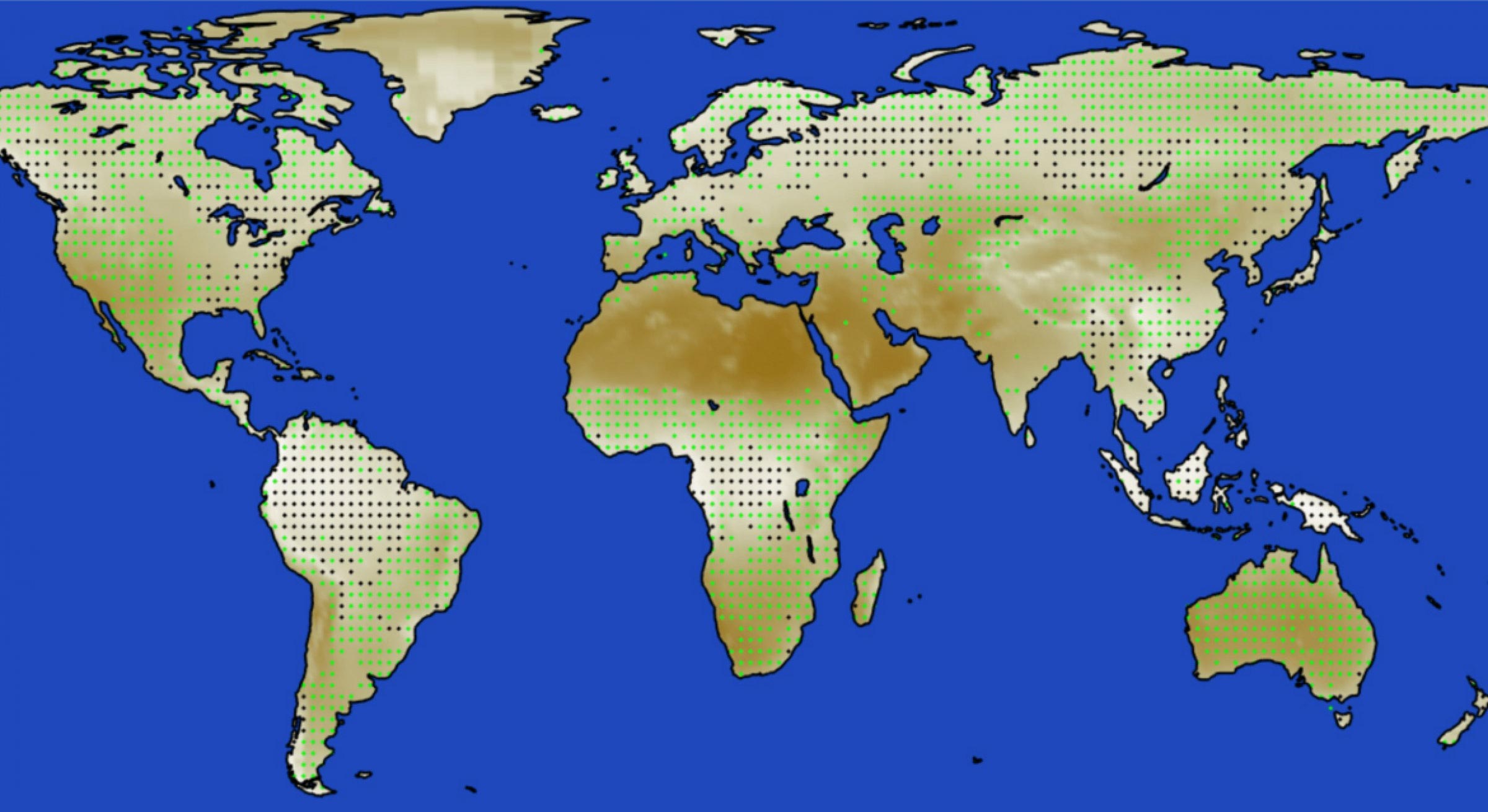
The researchers modeled interactions between different types of vegetation and the atmospheric boundary layer — which is the lowest layer of the atmosphere and interacts directly with the Earth’s surface — to determine whether cloud formation is differentially affected by vegetation type. They focused on regions in the 30-45 degree latitudinal range, roughly from the subtropics to the hemiboreal zones such as the northern Midwestern United States. They considered the effects of both reforestation — restoring lost tree cover — and afforestation, which entails planting forests in areas that were previously treeless, though this may come with other environmental costs.
The team found that for midlatitude regions, the cooling effect of clouds — in combination with that of carbon sequestration — outweighed the solar radiation that forested areas absorbed.
The models showed that clouds form more frequently over forested areas than over grasslands and other areas with short vegetation, and that this enhanced cloud formation had a cooling effect on Earth’s atmosphere. The researchers observed from the satellite data that clouds also tend to form earlier in the afternoon over forested areas, which results in a longer duration of cloud cover and more time for clouds to reflect solar radiation away from the Earth.
Striking a Balance: Climate, Land Use & Food
The findings could help develop policies for allocating land for reforestation and agriculture — wetter midlatitudinal areas such as the eastern United States or southeastern China are well-suited to reforestation and afforestation, but also are appealing for agriculture. One approach would be to pair midlatitudinal reforestation with the distribution of drought-tolerant crops for regions less suited to reforestation, the study authors reported.
However, the authors urged that we must be cautious when making the leap from science to policy. “We can’t just consider climate change, but must also consider other factors, such as biodiversity and the fact that land is also needed for food production,” Cerasoli said. “Future studies should continue to consider the role of clouds, but should focus on more specific regions and take their economies into account.”
“The first thing is to not make things worse,” Porporato added. “So many things are connected in the earth system. The nature of interactions between, for example, the water cycle and climate mean that if you change one thing, it’s very difficult to predict how other parts of the system will be affected.”
Reference: “Cloud cooling effects of afforestation and reforestation at midlatitudes” by Sara Cerasoli, Jun Yin and Amilcare Porporato, 9 August 2021, Proceedings of the National Academy of Sciences.
DOI: 10.1073/pnas.2026241118
The paper was published August 9 in the Proceedings of the National Academy of Sciences. The work was supported by the USDA Agricultural Research Service; the National Science Foundation; the HMEI Carbon Mitigation Initiative; and the National Natural Science Foundation of China.
Never miss a breakthrough: Join the SciTechDaily newsletter.
Follow us on Google and Google News.
5 Comments
Whether one believes in anthropogenic climate change or not, planting trees seems a good idea!
“… a concern among scientists that because forests absorb solar radiation, reforesting temperate latitudes could in fact make the planet warmer.”
They are overlooking more than just clouds! The reason that trees have a lower albedo than most bare soils is that the red and blue wavelengths are absorbed for the purpose of driving photosynthesis. That is, unlike inorganic materials that have low albedo and turn absorbed light into heat, vegetation uses the absorbed light to further its growth. That is, it sequesters CO2 by using light to transform the CO2 into cellulose and sugars. It seems that our institutions of higher learning are graduating scientists that have all the necessary qualifications to be journalists — professional, know-nothing wordsmiths.
We are in a 2.488 million year ice age called the Quaternary Glaciation(the fifth ice age) in a temporary warm spell between cold glacial periods. Some are complaining about how warm it is from the comfort of their nice warm homes and wearing bunches of nice warm clothes. If it is so warm why won’t they live outdoors in Chicago for a winter in their swimming trunks? That would surely prove their point.
It would be cheaper to just compensate people for their actual damages then to change society.
It sounds good on paper. Planting trees will require carbon fuels. It cannot be done with alternative energy. More importantly, trees catch fire, or die. When that happens their sequestered CO2 is recycled back to the atmosphere-ocean system. It is not a viable permanent solution.