
Close Menu
    Facebook X (Twitter) Instagram
    SciTechDaily
    • Biology
    • Chemistry
    • Earth
    • Health
    • Physics
    • Science
    • Space
    • Technology
    Facebook X (Twitter) Pinterest YouTube RSS
    SciTechDaily
    Home»Science»Divine Discovery: Ultraviolet Rays Illuminate 1,750-Year-Old New Testament Translation
    Science

    Divine Discovery: Ultraviolet Rays Illuminate 1,750-Year-Old New Testament Translation

    By Austrian Academy of SciencesApril 9, 2023No Comments4 Mins Read
    Facebook Twitter Pinterest Telegram LinkedIn WhatsApp Email Reddit
    Share
    Facebook Twitter LinkedIn Pinterest Telegram Email Reddit
    New Testament Translation Fragment
    The fragment of the translation of the New Testament is visible under UV light. Credit: © Vatican Library

    It is an important piece of the jigsaw puzzle in New Testament history and one of the oldest textual witnesses of the Gospels: a small manuscript fragment of the Syriac translation, written in the 3rd century and copied in the 6th century. A researcher from the Austrian Academy of Sciences discovered the fragment with the help of ultraviolet photography.

    About 1,300 years ago a scribe in Palestine took a book of the Gospels inscribed with a Syriac text and erased it. Parchment was scarce in the desert in the Middle Ages, so manuscripts were often erased and reused. A medievalist from the Austrian Academy of Sciences (OeAW) has now been able to make the lost words on this layered manuscript, a so-called palimpsest, legible again: Grigory Kessel discovered one of the earliest translations of the Gospels, made in the 3rd century and copied in the 6th century, on individual surviving pages of this manuscript.

    One of the Oldest Fragments That Testifies Ancient Syrian Version

    “The tradition of Syriac Christianity knows several translations of the Old and New Testaments,” says medievalist Grigory Kessel. “Until recently, only two manuscripts were known to contain the Old Syriac translation of the gospels.” While one of these is now kept in the British Library in London, another was discovered as a palimpsest in St. Catherine’s Monastery at Mount Sinai. The fragments from the third manuscript were recently identified in the course of the “Sinai Palimpsests Project.”
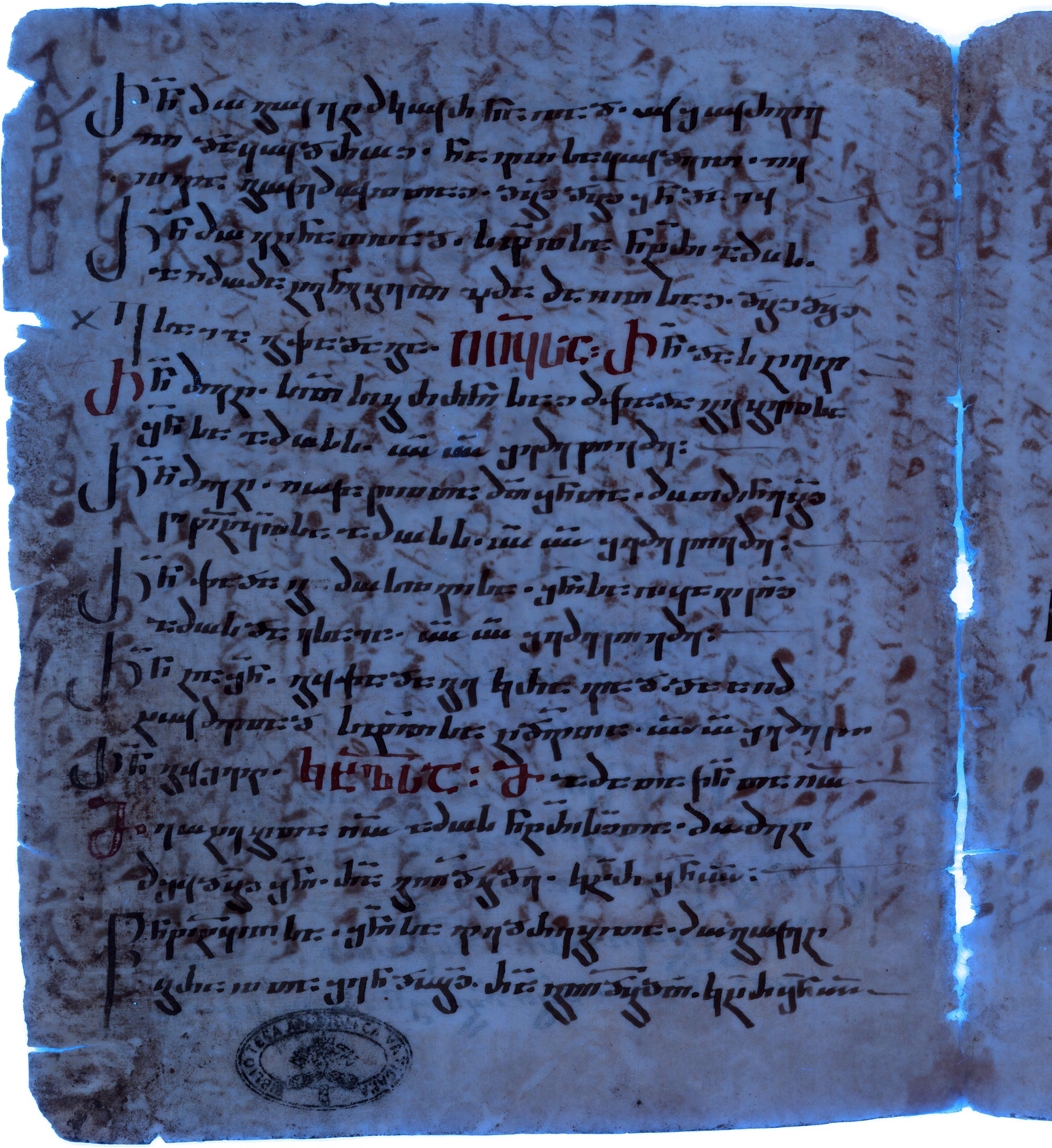
    New Testament Syriac Translation Fragment
    The fragment of the translation of the New Testament is visible under UV light. Credit: © Vatican Library

    The small manuscript fragment, which can now be considered as the fourth textual witness, was identified by Grigory Kessel using ultraviolet photography as the third layer of text, i.e., double palimpsest, in the Vatican Library manuscript. The fragment is so far the only known remnant of the fourth manuscript that attests to the Old Syriac version – and offers a unique gateway to the very early phase in the history of the textual transmission of the Gospels. For example, while the original Greek of Matthew chapter 12, verse 1 says: “At that time Jesus went through the grainfields on the Sabbath; and his disciples became hungry and began to pick the heads of grain and eat,” the Syriac translation says: “[…] began to pick the heads of grain, rub them in their hands, and eat them.”

    Syrian Translation Before Codex Sinaiticus

    Claudia Rapp, Director of the Institute for Medieval Research at the OeAW, is also pleased: “Grigory Kessel has made a great discovery thanks to his profound knowledge of old Syriac texts and script characteristics,” she says. The Syriac translation was written at least a century before the oldest Greek manuscripts that have survived, including the Codex Sinaiticus. The earliest surviving manuscripts with this Syriac translation date from the 6th century and are preserved in the erased layers, so-called palimpsests, of newly written parchment leaves.

    “This discovery proves how productive and important the interplay between modern digital technologies and basic research can be when dealing with medieval manuscripts,” Claudia Rapp says.

    Reference: “A New (Double Palimpsest) Witness to the Old Syriac Gospels (Vat. iber. 4, ff. 1 & 5)” by Grigory Kessel, 8 March 2023, New Testament Studies.
    DOI: 10.1017/S0028688522000182

    The Sinai Palimpsests Project aims to make the centuries-old valuable palimpsest manuscripts of St. Catherine’s Monastery in Egypt readable again and available in digital form. So far, 74 manuscripts have already been deciphered. Claudia Rapp from the University of Vienna and the Austrian Academy of Sciences (OeAW) is the scientific director of the project.

    Never miss a breakthrough: Join the SciTechDaily newsletter.
    Follow us on Google and Google News.

    History Popular Religion
    Share. Facebook Twitter Pinterest LinkedIn Email Reddit

    Related Articles

    Revolutionary Archaeology: Entire Roman City Revealed Without Any Digging

    Year 777: Radiocarbon Dating Pinpoints Date for Construction of Mysterious Por-Bajin Complex

    Dead in Unmarked Graves Identified by Combining Genetics With Genealogy

    Mystery Surrounding Dinosaur Footprints on a Cave Ceiling Finally Solved

    How Ancient Poop Debunked Myth of Native American Lost Civilization

    Mystifying Puzzle of Early Neolithic House Orientations Finally Solved

    Previously Dismissed As Myths, New Study Boosts Credibility of Columbus’ Cannibal Claims

    Famous Battle of Britain ‘What If’ Scenarios Put to the Test by Mathematicians

    What Really Caused Neanderthals to Go Extinct? New Study Has Shocking Answer

    Leave A Reply Cancel Reply

    • Facebook
    • Twitter
    • Pinterest
    • YouTube

    Don't Miss a Discovery

    Subscribe for the Latest in Science & Tech!

    Trending News

    Popular Sugar-Free Sweetener Linked to Liver Disease, Study Warns

    What Is Hantavirus? The Deadly Disease Raising Alarm Worldwide

    Scientists Just Discovered How the Universe Builds Monster Black Holes

    Scientists Unveil New Treatment Strategy That Could Outsmart Cancer

    A Simple Vitamin May Hold the Key to Treating Rare Genetic Diseases

    Scientists Think the Real Fountain of Youth May Be Hiding in Your Gut

    Ravens Don’t Follow Wolves, They Predict Them

    This Common Knee Surgery May Be Doing More Harm Than Good

    Follow SciTechDaily
    • Facebook
    • Twitter
    • YouTube
    • Pinterest
    • Newsletter
    • RSS
    SciTech News
    • Biology News
    • Chemistry News
    • Earth News
    • Health News
    • Physics News
    • Science News
    • Space News
    • Technology News
    Recent Posts
    • Scientists Discover That a Single Dose of Psilocybin Changes the Human Brain
    • “Totally Unexpected” – Scientists Discover Pancreatic Cancer’s Fatal Addiction
    • A Strange Quantum Effect May Explain One of Biology’s Greatest Mysteries
    • NASA’s Psyche Spacecraft Is About To Fly Shockingly Close to Mars
    • This Mars Rock Refused To Let Go of NASA’s Curiosity Rover
    Copyright © 1998 - 2026 SciTechDaily. All Rights Reserved.
    • Science News
    • About
    • Contact
    • Editorial Board
    • Privacy Policy
    • Terms of Use

    Type above and press Enter to search. Press Esc to cancel.