
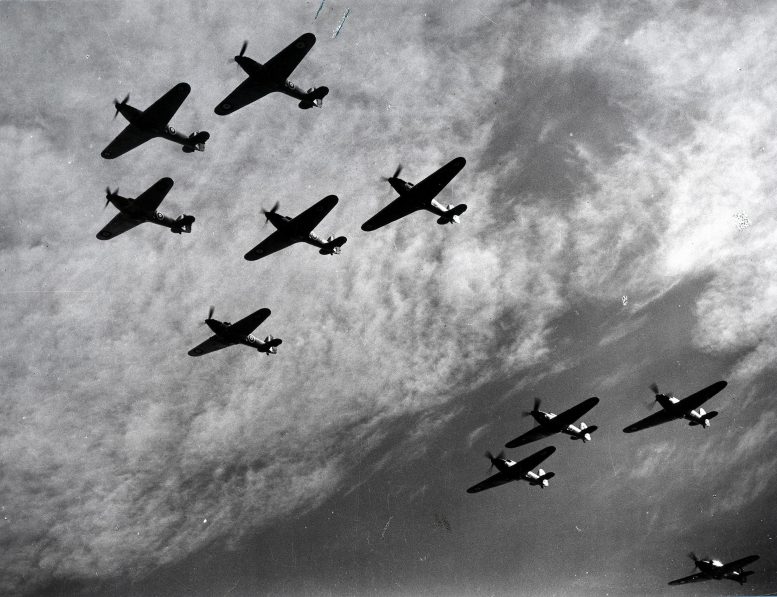
Mathematicians have used a statistical technique to interrogate some of the big “what if” questions in the Second World War battle for Britain’s skies.
What if the switch to bombing London had not occurred? What if a more eager Hitler had pushed for an earlier beginning to the campaign? What if Goring had focused on targeting British airfields throughout the entire period of the Battle?
These are just some of the alternative scenarios that have formed a long-running debate among Second World War historians and enthusiasts over what might have affected the outcome of the battle, which took place between May and October 1940.
Mathematicians from the University of York have developed a new model to explore what the impact of changes to Luftwaffe tactics would actually have been. Their approach uses statistical modeling to calculate how the Battle might have played out if history had followed one of several alternative courses.
The researchers say that the method could now be used as a tool to investigate other historical controversies and unrealized possibilities, giving us a deeper understanding of events such as the Battle of the Atlantic (the longest continuous military campaign of the Second World War).
The statistical technique is called “weighted bootstrapping” and the computer simulation is a bit like taking a ball for the events of each day of the Battle of Britain and placing them in a lotto machine. Balls are then drawn, read, and replaced to create thousands of alternative sets of days’ fighting, but in a different order, and perhaps with some days appearing more than once or not at all.
The researchers then repeated the process to test out the Battle “what ifs”, making some days more or less likely to be chosen, depending on how a protagonist (such as Hitler) would have changed their decisions had they been using different tactics.
Co-author of the paper, Dr. Jamie Wood from the Department of Mathematics at the University of York, said: “The weighted bootstrap technique allowed us to model alternative campaigns in which the Luftwaffe prolongs or contracts the different phases of the battle and varies its targets.
“The Luftwaffe would only have been able to make the necessary bases in France available to launch an air attack on Britain in June at the earliest, so our alternative campaign brings forward the air campaign by three weeks. We tested the impact of this and the other counterfactuals by varying the probabilities with which we choose individual days.”
The results provide statistical backing to a change in tactics that several historians have argued could have brought the Luftwaffe victory in the summer of 1940: The simulations suggested that if they had started the campaign earlier and focused on bombing airfields, the RAF might have been defeated, paving the way for a German land invasion.
According to the mathematical model, the impact of these two changes would have been dramatic. Although it is impossible to estimate what the real statistical chances of an RAF victory were in July 1940, the study suggests that whatever Britain’s prospects, an earlier start and focused targeting of airfields would have shifted the battle significantly in the Germans’ favor.
For example, had the likelihood of a British victory in the actual battle been 50%, these two tactical changes would have reduced it to less than 10%. If the real probability of British victory was 98%, the same changes would have reduced this to just 34%.
Co-author of the paper, Professor Niall Mackay from the Department of Mathematics at the University of York, said: “Weighted bootstrapping can provide a natural and intuitive tool for historians to investigate unrealized possibilities, informing historical controversies and debates.
“It demonstrates just how finely-balanced the outcomes of some of the biggest moments of history were. Even when we use the actual days’ events of the battle, make a small change of timing or emphasis to the arrangement of those days and things might have turned out very differently.
“This technique can be used to give us a more complete understanding of just how differently events might have played out.”
Never miss a breakthrough: Join the SciTechDaily newsletter.
Follow us on Google and Google News.
2 Comments
Watches time passes as money is lost as karma always gets its deadly costly revenge on the ignorant and greedy. Rubs forehead always getting what I want then don’t get it.
if the British hadn’t kicked the French out of India, a Vichy French India might have been a serious problem……..If the British hadn’t kicked the French out of north America a Vichy French America might not have near-bankrupted the UK by 1945…….. If the Norman French hadn’t invaded Britain, we could have been speaking German……and I wouldn’t have been forced to learn bad French at school. Ho hum, IF……?