
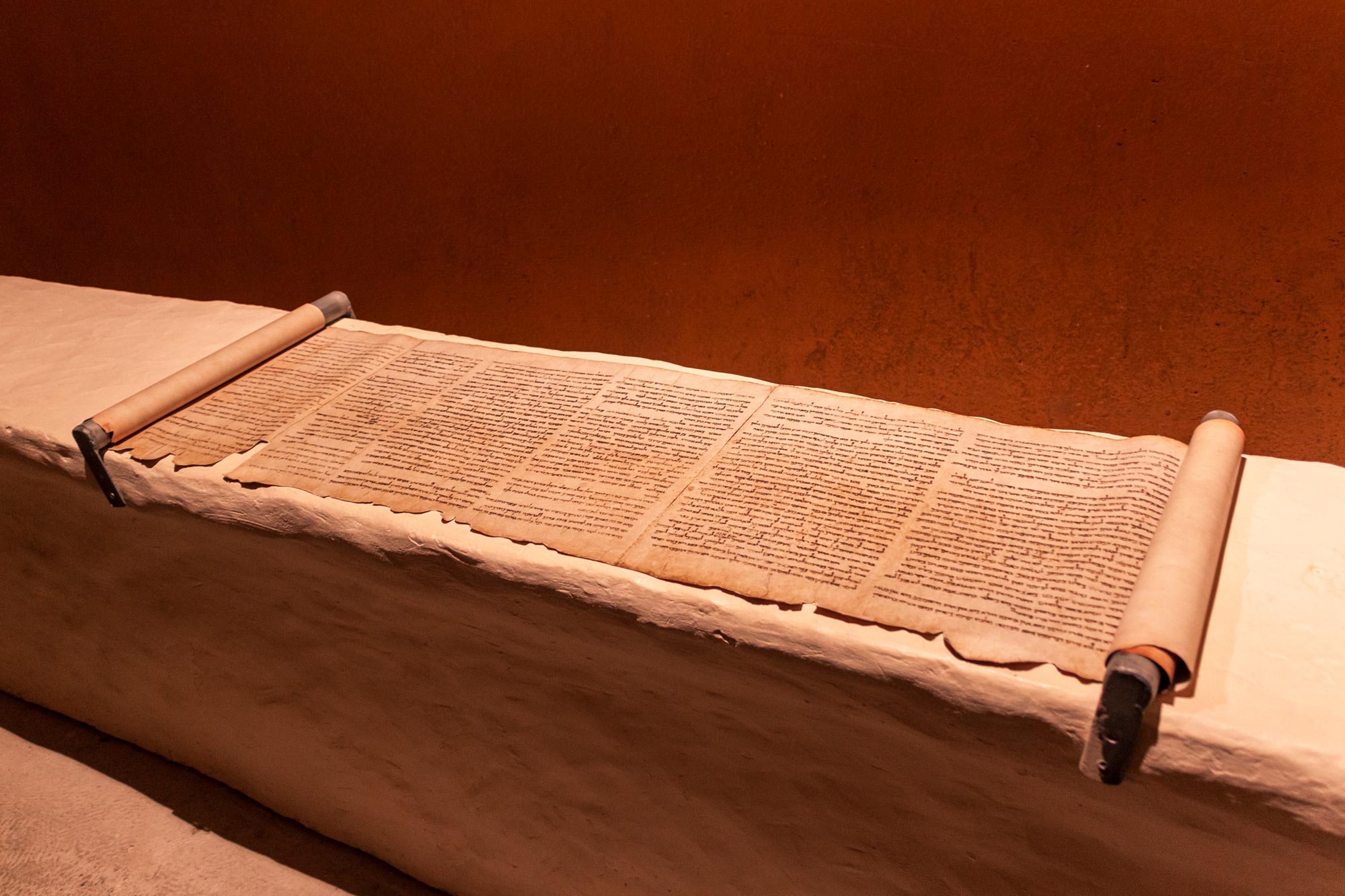
A new study uses Hasmonean history and evidence from the Dead Sea Scrolls to address a decades-old mystery.
For decades, researchers have debated whether the Qumran sect’s unusual 364-day calendar ever governed daily religious life or existed only as an idealized system. A Tel Aviv University study now proposes that both possibilities may be true at different points in the community’s history.
The study argues that the sect probably used the calendar during its early years, when disputes over religious dates may have contributed to its separation from the Jerusalem establishment and retreat into the desert. Over time, however, an unavoidable mismatch with the astronomical year made the system increasingly difficult to maintain. Improving relations with Hasmonean rulers during the reign of Alexander Jannaeus may also have helped prompt its abandonment.
The research was conducted by Prof. Eshbal Ratzon of the Department of Jewish Philosophy and the Cohn Institute for the History and Philosophy of Science and Ideas at the Entin Faculty of Humanities. The paper was published in the Tarbiz Quarterly for Jewish Studies.
A perfect calendar carried a hidden flaw
The Qumran system differed sharply from the lunisolar calendar that structured Jewish life during the Second Temple period. Its year contained exactly 364 days, a number divisible by seven, producing 52 complete weeks and ensuring that every festival always occurred on the same day of the week.

For the Qumran sect, that regularity represented perfect divine order. The calendar also carried political and religious significance because authorities at the Temple in Jerusalem determined important dates under the prevailing system. Members of the sect instead believed those dates had already been established by God at the Creation of the world and should not be altered by humans.
But the mathematical simplicity created a practical problem. A 364-day calendar is one day and a quarter shorter than the roughly 365-day astronomical year, so the discrepancy accumulates steadily.
After 20 years, festivals would have shifted by almost four weeks relative to the seasons. Given enough decades, a celebration intended for spring could eventually fall in winter or even autumn. That posed a serious difficulty for a community whose festivals were closely connected with agriculture, harvests, first fruits, and seasonal cycles.
The problem resembles a clock that loses one minute each day. The error seems trivial at first, but eventually the clock stops matching reality. Ratzon’s study proposes that the Qumran calendar faced the same fate: a system that was conceptually and mathematically elegant gradually moved farther away from the natural cycles it was meant to organize.
The scrolls point to real use
Researchers have offered several explanations for this long-standing puzzle. Some have suggested that the Qumran community periodically inserted extra days or weeks to keep its calendar aligned with the seasons. Others have argued that the 364-day system was never used practically and instead functioned only as a theoretical religious framework.
Prof. Ratzon contends that the Dead Sea Scrolls do not support either explanation. In her reconstruction, the calendar appears to have been a central part of the sect’s religious identity and an important source of conflict with the Jerusalem establishment.
Nearly 20 scrolls discovered at Qumran discuss calendars and astronomy, an unusually large number that underscores how important the subject was to the community. The Book of Jubilees, one of the central works preserved in the Qumran library, strongly condemns the prevailing lunar calendar and presents the 364-day calendar as the original system given to Moses on Mount Sinai.
Seasonal drift and politics may explain abandonment
Drawing on this evidence, Prof. Ratzon proposes that the Qumran sect actively followed the 364-day calendar during its formative period in the second century BCE. Its use may have intensified the group’s dispute with the religious authorities in Jerusalem.
As time passed, however, the growing mismatch between the calendar and the seasons would have become increasingly difficult to ignore. Political circumstances were also changing.
Relations between the sect and the Hasmonean dynasty improved during the reign of Alexander Jannaeus, who supported a halacha similar to theirs and opposed the Pharisaic leadership. Ratzon argues that this warmer political climate may have made it easier for the Qumran community to abandon its uncompromising position and adopt the more practical calendar used at the Temple.
The 364-day calendar could then have survived as a religious ideal rather than a working system, representing the calendar believed to have existed at the Creation of the world and perhaps one that would return in the End of Days.
Prof. Ratzon concludes: “The Qumran calendar has long been regarded as one of the Qumran sect’s defining features, but also as one of the most baffling mysteries of the Dead Sea Scrolls. This study proposes an alternative for the seeming contradiction between a functional calendar and a theoretical one. It is quite possible that the calendar was in fact used for a certain period of time, but then, losing its practical role due to both inherent problems and political changes, became a religious ideal and a symbol of identity. This would explain both its centrality in the Qumran scrolls and its gradual disappearance from historical reality.”
Never miss a breakthrough: Join the SciTechDaily newsletter.
Follow us on Google and Google News.