

Close Menu
    Facebook X (Twitter) Instagram
    SciTechDaily
    • Biology
    • Chemistry
    • Earth
    • Health
    • Physics
    • Science
    • Space
    • Technology
    Facebook X (Twitter) Pinterest YouTube RSS
    SciTechDaily
    Home»Health»Cloth COVID Masks Filter Less Than 10% of Particles – Inferior for Protection Against Airborne Viral Spread
    Health

    Cloth COVID Masks Filter Less Than 10% of Particles – Inferior for Protection Against Airborne Viral Spread

    By American Institute of PhysicsMarch 1, 2022No Comments3 Mins Read
    Facebook Twitter Pinterest Telegram LinkedIn WhatsApp Email Reddit
    Share
    Facebook Twitter LinkedIn Pinterest Telegram Email Reddit
    COVID Virus Physics Fluid Mechanics
    Study shows cloth masks let in most particles because air flows around the yarn gaps.

    Simulations reveal low filtration efficiency in woven fabric.

    Like many other viruses, COVID-19 is transmitted primarily via particles carried in the air. An infected person breathes out particles containing the virus into the air, which can then be inhaled by another person, who then becomes infected.

    Flow simulations suggest that when a person breathes through cloth, most of the air flows through the gaps between the yarns in the woven fabric, bringing with it more than 90% of the particles.

    Masks are widely considered an important first-line defense against airborne transmission of the disease, as is supported by a preponderance of evidence. Fueled by the omicron variant, the latest wave of the pandemic prompted public health officials to recommend more protective face coverings because not all masks are created equal.

    In Physics of Fluids, by AIP Publishing, researchers from England, Germany, and France focus their expertise — and their microscopes — on examining the efficacy of particle filtration by woven fabric, which, unlike material used in standard air filters and masks, consists of fibers twisted together into yarns. There are, therefore, two lengthscales: the diameters of the fiber and the yarn.

    Using 3D imagery produced by confocal microscopy to see the air flow channels, the scientists simulate the airflow through these channels and calculate filtration efficiency for particles a micrometer and larger in diameter. The study concludes for particles in this size range, the filtration efficiency is low.
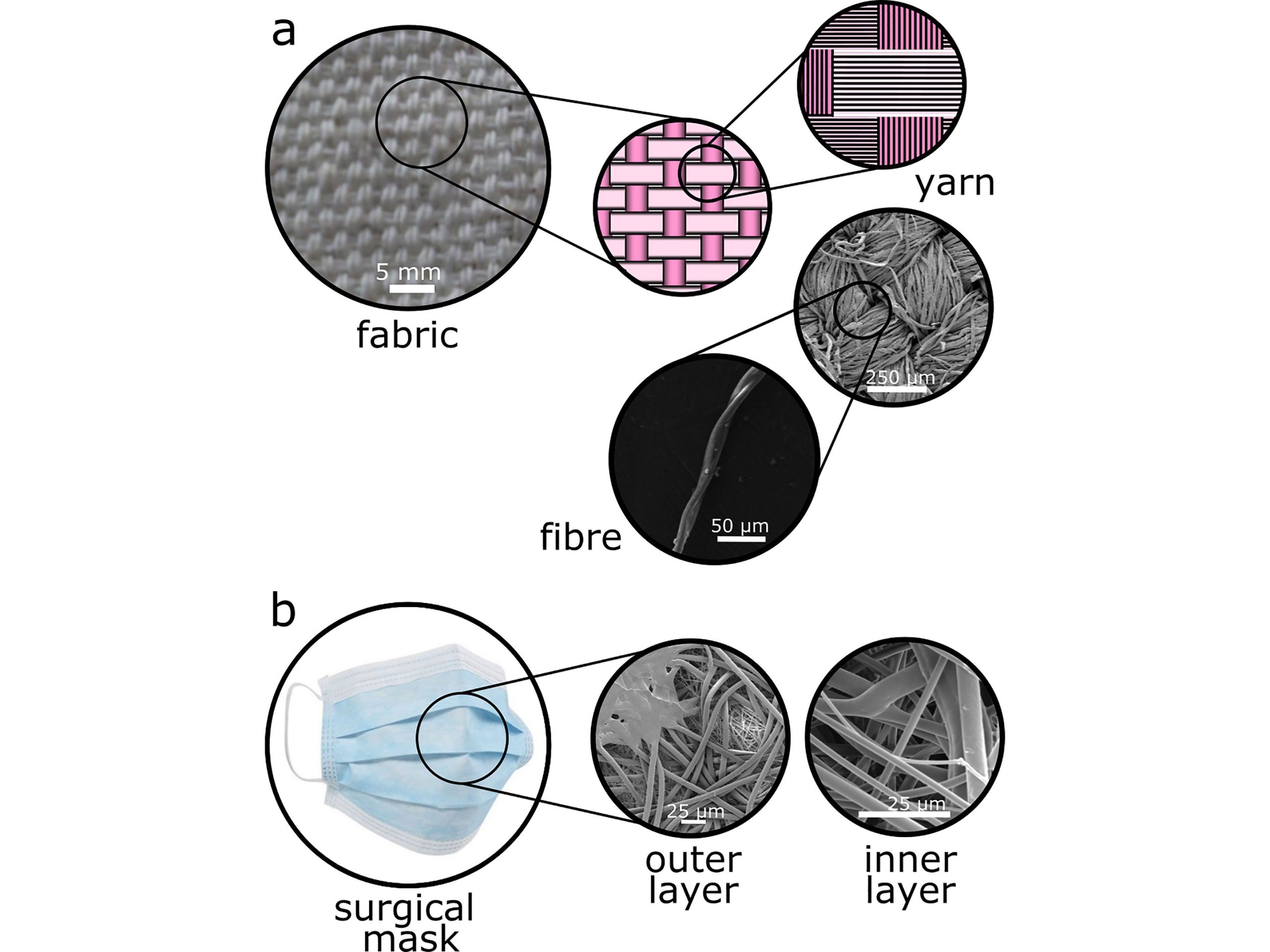
    Fabric Is Porous
    Fabric is a porous material with structure on multiple lengthscales. The top three images, from left to right, depict successively smaller lengthscales. At the largest lengthscale, fabric is a lattice woven from perpendicular yarns that go over and under other yarns at right angles to them. Credit: Richard P. Sear

    “Masks are air filters, and woven fabrics, such as cotton, make for good jeans, shirts, and other apparel, but they are lousy air filters,” said co-author Richard Sear, from the University of Surrey. “So, use woven fabric for clothing, and N95s or FFP2s or KF94s for masks.”

    Indeed, the flow simulations suggest when a person breathes through cloth, most of the air flows through the gaps between the yarns in the woven fabric, bringing with it more than 90% of the particles.

    “Woven fabrics, such as cotton, make for good jeans, shirts, and other apparel, but they are lousy air filters.” Richard Sear

    “In other words, these relatively large gaps are responsible for cloth being a bad material to make air filters from,” said Sear. “In contrast, the filtering layer of an N95 mask is made from much smaller, 5-micrometer fibers with gaps that are 10 times smaller, making it much better for filtering nasty particles from the air, such as those containing virus.”

    While earlier research revealed similar findings, this study represents the first to simulate particles going directly through the gaps in woven fabric.

    Sear added good masks should feature the “two Fs: good filtration and good fit.”

    “Surgical masks fit badly, so a lot of air goes unfiltered past the edges of the mask by the cheeks and nose,” said Sear.

    Reference: “Modelling the filtration efficiency of a woven fabric: The role of multiple lengthscales” by Ioatzin Rios de Anda, Jake W. Wilkins, Joshua F. Robinson, C. Patrick Royall and Richard P. Sear, 1 March 2022, Physics of Fluids.
    DOI: 10.1063/5.0074229

    Never miss a breakthrough: Join the SciTechDaily newsletter.
    Follow us on Google and Google News.

    American Institute of Physics COVID-19 Fluid Dynamics Infectious Diseases Popular Public Health Virology
    Share. Facebook Twitter Pinterest LinkedIn Email Reddit

    Related Articles

    Tree Pollen Facilitates COVID-19 Virus Spread – Carries SARS-CoV-2 Particles Farther

    Deactivating COVID-19 Virus Cough Droplets With UV-C Lamps

    Disposable Helmet Designed to Retain Cough Droplets, Minimize COVID-19 Transmission

    Scientists Compare How COVID-19 Cough Clouds Travel With and Without Face Masks

    Common Molecular Feature of Antibodies That Neutralize SARS-CoV-2 Discovered, Boosting COVID-19 Vaccine Prospects

    Far-UVC Light Safely Kills 99.9% of Airborne Coronaviruses

    Yikes! Saliva Droplets From Mild Cough Travel Up to 18 Feet

    How COVID-19 Kills: New Study Explains the Mechanisms of the New Coronavirus

    Vitamin D Linked to Low Coronavirus Death Rate

    Leave A Reply Cancel Reply

    • Facebook
    • Twitter
    • Pinterest
    • YouTube

    Don't Miss a Discovery

    Subscribe for the Latest in Science & Tech!

    Trending News

    One of the Universe’s Largest Stars May Be Getting Ready To Explode

    Scientists Discover Enzyme That Could Supercharge Ozempic-Like Weight Loss Drugs

    Popular Sweetener Linked to DNA Damage – “It’s Something You Should Not Be Eating”

    Ancient “Rock” Microbes May Reveal How Complex Life Began

    Researchers Capture Quantum Interference in One of Nature’s Rarest Atoms

    “A Plague Is Upon Us”: The Mass Death That Changed an Ancient City Forever

    Scientists Discover Game-Changing New Way To Treat High Cholesterol

    This Small Change to Your Exercise Routine Could Be the Secret to Living Longer

    Follow SciTechDaily
    • Facebook
    • Twitter
    • YouTube
    • Pinterest
    • Newsletter
    • RSS
    SciTech News
    • Biology News
    • Chemistry News
    • Earth News
    • Health News
    • Physics News
    • Science News
    • Space News
    • Technology News
    Recent Posts
    • Natural Compounds Boost Bone Implant Success While Killing Bacteria and Cancer Cells
    • After 60 Years, Scientists Uncover Unexpected Brain Effects of Popular Diabetes Drug Metformin
    • New Research Uncovers Hidden Side Effects of Popular Weight-Loss Drugs
    • Scientists Rethink Extreme Warming After Surprising Ocean Discovery
    • The Surprising Role of Asteroids in the Origin of Life
    Copyright © 1998 - 2026 SciTechDaily. All Rights Reserved.
    • Science News
    • About
    • Contact
    • Editorial Board
    • Privacy Policy
    • Terms of Use

    Type above and press Enter to search. Press Esc to cancel.