
Close Menu
    Facebook X (Twitter) Instagram
    SciTechDaily
    • Biology
    • Chemistry
    • Earth
    • Health
    • Physics
    • Science
    • Space
    • Technology
    Facebook X (Twitter) Pinterest YouTube RSS
    SciTechDaily
    Home»Health»Yikes! Saliva Droplets From Mild Cough Travel Up to 18 Feet
    Health

    Yikes! Saliva Droplets From Mild Cough Travel Up to 18 Feet

    By American Institute of PhysicsMay 19, 20201 Comment3 Mins Read
    Facebook Twitter Pinterest Telegram LinkedIn WhatsApp Email Reddit
    Share
    Facebook Twitter LinkedIn Pinterest Telegram Email Reddit
    Saliva Droplets Travel Distance
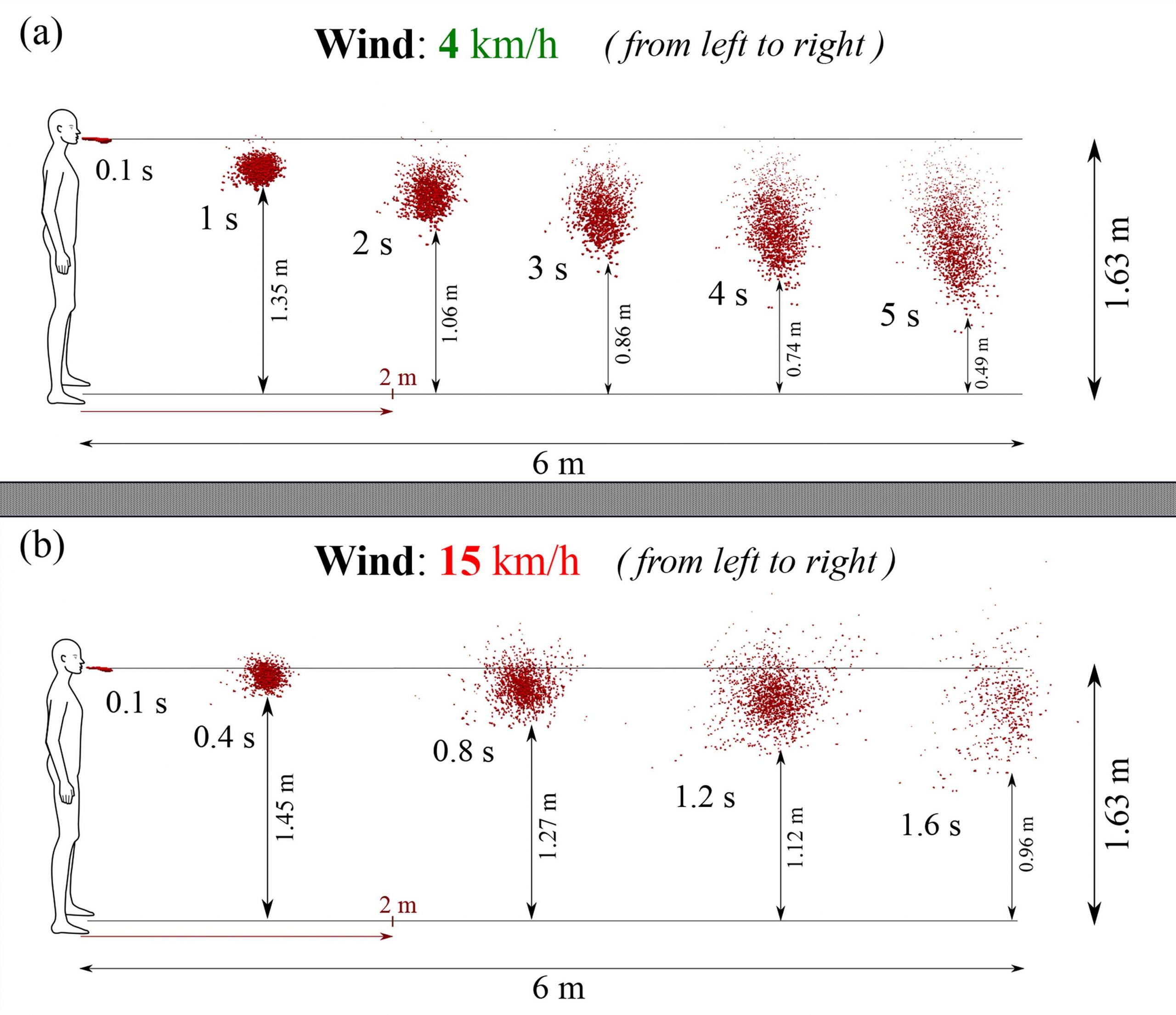
    Saliva droplets can travel large distances, depending on environmental conditions such as wind speed, temperature, pressure and humidity. Wind shown blowing left to right at speeds of 4 kph (top) and 15 kph (bottom) can transport saliva droplets up to 6 meters (18 feet). Credit: Image courtesy of the authors

    Current social distancing guidelines of 6 feet may be insufficient, because a mild cough occurring in low wind speeds of 4-15 kph can propel saliva droplets 18 feet.

    Airborne transmission of viruses, like the virus causing COVID-19, is not well understood, but a good baseline for study is a deeper understanding of how particles travel through the air when people cough.

    In a paper published in Physics of Fluids, from AIP Publishing, Talib Dbouk, and Dimitris Drikakis discovered that with even a slight breeze of 4 kph (2.5 mph), saliva travels 18 feet (5.5 meters) in 5 seconds.

    “The droplet cloud will affect both adults and children of different heights,” Drikakis said. “Shorter adults and children could be at higher risk if they are located within the trajectory of the traveling saliva droplets.”

    Saliva is a complex fluid, and it travels suspended in a bulk of surrounding air released by a cough. Many factors affect how saliva droplets travel, including the size and number of droplets, how they interact with one another and the surrounding air as they disperse and evaporate, how heat and mass are transferred, and the humidity and temperature of the surrounding air.

    To study how saliva moves through the air, Dbouk and Drikakis created a computational fluid dynamics simulation that examines the state of every saliva droplet moving through the air in front of a coughing person. Their simulation considered the effects of humidity, dispersion forces, interactions of molecules of saliva and air, and how the droplets change from liquid to vapor and evaporate.

    The computational domain in the simulation is a grid representing the space in front of a coughing person. The analysis involved running partial differential equations on 1,008 saliva droplets and solving approximately 3.7 million equations in total.

    “Each cell holds information about variables like pressure, fluid velocity, temperature, droplet mass, droplet position, etc.,” Dbouk said. “The purpose of the mathematical modeling and simulation is to take into account all the real coupling or interaction mechanisms that may take place between the main bulk fluid flow and the saliva droplets, and between the saliva droplets themselves.”

    Further studies are needed to determine the effect of ground surface temperature on the behavior of saliva in air and to examine indoor environments, where air conditioning significantly affects the particle movement through the air.

    “This work is vital, because it concerns health and safety distance guidelines, advances the understanding of spreading and transmission of airborne diseases, and helps form precautionary measures based on scientific results,” said Drikakis.

    Reference: “On coughing and airborne droplet transmission to humans” by Talib Dbouk and Dimitris Drikakis, 19 May 2020, Physics of Fluids.
    DOI: 10.1063/5.0011960

    Never miss a breakthrough: Join the SciTechDaily newsletter.
    Follow us on Google and Google News.

    American Institute of Physics Biomechanics COVID-19 Popular Public Health Virology
    Share. Facebook Twitter Pinterest LinkedIn Email Reddit

    Related Articles

    Cloth COVID Masks Filter Less Than 10% of Particles – Inferior for Protection Against Airborne Viral Spread

    Tree Pollen Facilitates COVID-19 Virus Spread – Carries SARS-CoV-2 Particles Farther

    Collapsing COVID: MIT Says Ultrasound Can Damage Coronaviruses

    Deactivating COVID-19 Virus Cough Droplets With UV-C Lamps

    Disposable Helmet Designed to Retain Cough Droplets, Minimize COVID-19 Transmission

    Rapid Spread of Coronavirus Outbreak Fueled by ‘Stealth Transmission’

    MIT COVID-19 Diagnostic Could Aid Efforts to Detect and Prevent the Spread of Coronavirus

    Scientific Estimates of Spread of Coronavirus Much Higher Than Official Reports

    “Snake Pneumonia” – Coronavirus Outbreak in China Traced to Snakes by Genetic Analysis

    1 Comment

    1. Barry on May 20, 2020 1:12 am

      If a light water spray (as used in restaurants for cooling) is used in shopping malls, would this spray force the droplets from the cough or sneeze to the floor more rapidly?

      Reply
    Leave A Reply Cancel Reply

    • Facebook
    • Twitter
    • Pinterest
    • YouTube

    Don't Miss a Discovery

    Subscribe for the Latest in Science & Tech!

    Trending News

    This Strange New Magnetism Could Change How Computers Work

    Scientists Decode a 12,000-Year-Old Mystery Hidden in Ancient Spear Points

    Rare Mutation May Shield the Brain From Alzheimer’s Damage

    James Webb Telescope Detects the Fingerprints of Catastrophic Planetary Collisions

    New Fat-Dissolving Shot Cuts Hidden Visceral Fat in Early Human Trials

    Scientists Discover “Pac-Man Enzyme” That Eats Plastic

    Study Finds Exercise May Be a Surprisingly Powerful Treatment for Pain

    New Research Reveals Dinosaurs May Have Eaten Seaweed

    Follow SciTechDaily
    • Facebook
    • Twitter
    • YouTube
    • Pinterest
    • Newsletter
    • RSS
    SciTech News
    • Biology News
    • Chemistry News
    • Earth News
    • Health News
    • Physics News
    • Science News
    • Space News
    • Technology News
    Recent Posts
    • Just 1,000 More Steps a Day Linked to Better Mental Health in Teens
    • Scientists Find a Surprising Blood Sugar Benefit to Eating With a Loved One
    • Why Too Much Cannabis Can Flip an Anxiety Switch in the Brain
    • Scientists Uncover Two Hidden Forms of Disorder in Next-Generation Semiconductors
    • Biofluorescence Discovered in Fire Salamanders for the First Time
    Copyright © 1998 - 2026 SciTechDaily. All Rights Reserved.
    • Science News
    • About
    • Contact
    • Editorial Board
    • Privacy Policy
    • Terms of Use

    Type above and press Enter to search. Press Esc to cancel.