
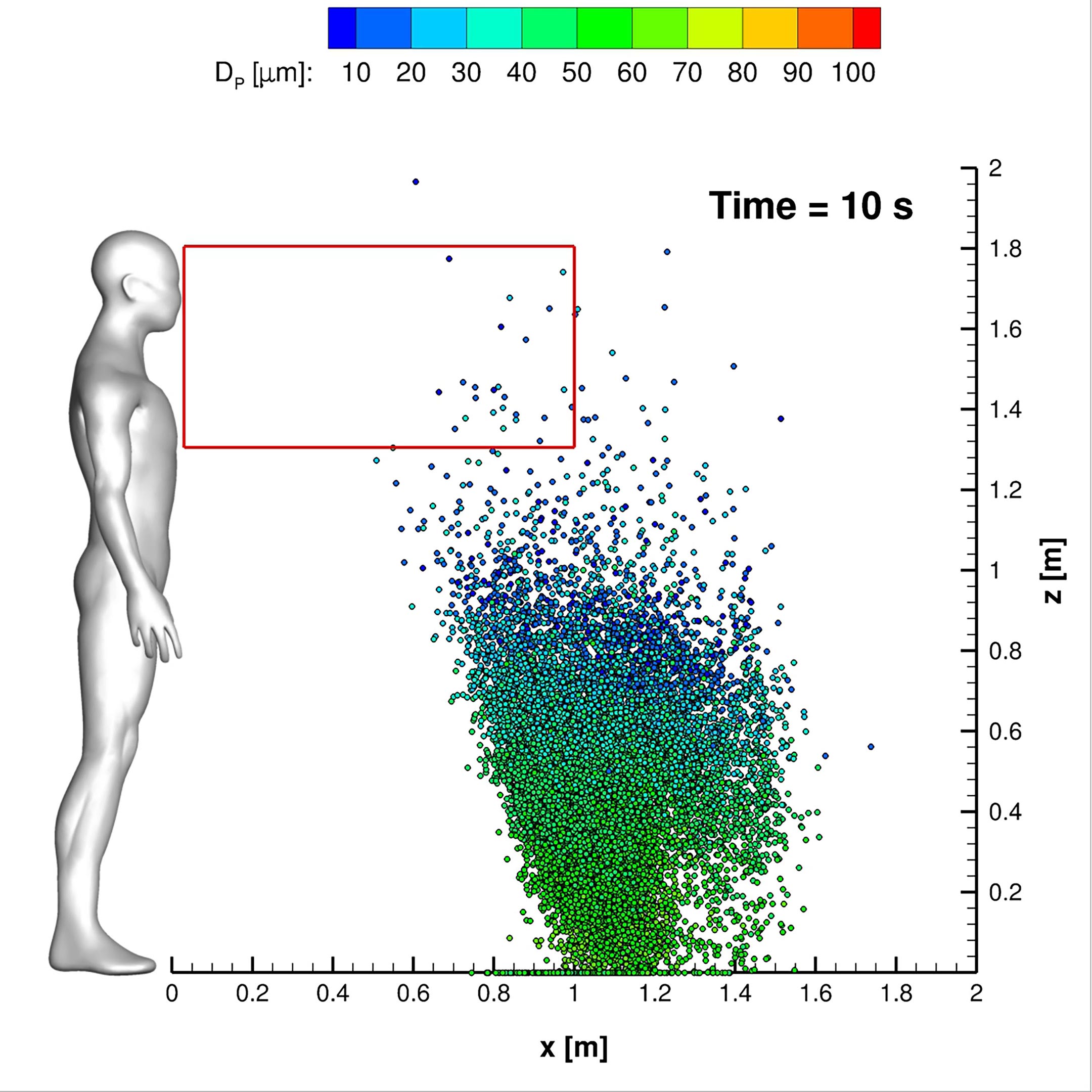
Using supercomputer numerical modeling of saliva droplets’ diffusion produced by coughs, researchers in Italy explore deactivating COVID-19 virus particles via UV-C light.
One of the primary ways the COVID-19 virus is transmitted is via airborne diffusion of saliva microdroplets, so it is paramount to find methods to kill the virus in airborne microdroplets.
The extreme confusion that abounded at the beginning of the pandemic about safe social distances, mask wearing, and social behavior inspired Marche Polytechnic University researchers, who happen to be intrigued by saliva droplet diffusion, to search for answers and ways to help.
In Physics of Fluids, from AIP Publishing, Valerio D’Alessandro and colleagues describe using a supercomputer to do numerical modeling of cough droplets irradiated by UV-C light. They also report exploring the social distances required to prevent virus transmission.
The researchers zeroed in on the evolution of a saliva droplet cloud, accounting for the inertia, buoyancy, and weight of each droplet and its aerodynamic interaction with the environment.
Why UV-C Light Holds Promise
“We are interested in the possibility of deactivating virus particles via UV-C light,” D’Alessandro said. “So, we explored the interaction of saliva droplets with an external source of UV-C radiation, a lamp.”
UV-C is a well-established germicidal technique, because it interferes with virus RNA replication.
“UV-A and UV-B also kill germs and are present within the sun’s rays, but with these, it takes 15 to 20 minutes to kill a virus,” said D’Alessandro. “The sun’s rays disinfect surfaces during the summer, which is one reason why transmission is reduced then, but it can’t be used for real-time disinfection. That’s why we decided to explore the effect of UV-C radiation on viruses.”
The researchers’ work addresses key points still not completely understood. First, they determined that 1 meter (3.2 feet) of social distancing is not completely safe to avoid virus transmission. This is particularly important, because this is the social distancing rule in Italy and its schools.
“While 1 meter of distance can suffice in a one-on-one situation, you can still get hit with cough droplets from the chest down,” D’Alessandro said. “It’s necessary to avoid touching your eyes, nose, or mouth with your hands. We found 2 meters (6.5 feet) to be a much safer distance.”
D’Alessandro and colleagues stress that the largest droplets travel about 1 meter. Over this distance they discovered only smaller droplets, which transport a reduced amount of the virus.
“It’s important to emphasize that these results were obtained without any background wind, and if this is present, the distance is almost doubled,” he said. “So we need to wear face masks, especially when in close proximity.”
UV-C Disinfection Reduces Transmission Risk
They also found “it is possible to reduce the contamination risk by about 50% when irradiating saliva droplet clouds with UV-C radiation — without providing a dangerous dose to people,” said D’Alessandro. “This is critically important, because disinfection systems based on UV-C are not always acceptable. UV-C kills the virus, but higher doses for humans can be dangerous.”
High exposures to UV-C are known to cause skin and eye tumors.
“Our work helps correct the understanding of safe social distancing,” said D’Alessandro. “Also, our computations can help to design new real-time disinfection devices based on UV-C that can reduce the risk of COVID-19 transmission and other viruses within particular situations, such as for supermarket cashiers or people in similar situations.”
Reference: “Eulerian–Lagrangian modeling of cough droplets irradiated by ultraviolet–C light in relation to SARS-CoV-2 transmission” by V. D’Alessandro, M. Falone, L. Giammichele and R. Ricci, 9 March 2021, Physics of Fluids.
DOI: 10.1063/5.0039224
Never miss a breakthrough: Join the SciTechDaily newsletter.
Follow us on Google and Google News.