
Close Menu
    Facebook X (Twitter) Instagram
    SciTechDaily
    • Biology
    • Chemistry
    • Earth
    • Health
    • Physics
    • Science
    • Space
    • Technology
    Facebook X (Twitter) Pinterest YouTube RSS
    SciTechDaily
    Home»Space»Search for Extraterrestrial Life Boosted by New Exoplanet Climate ‘Decoder’
    Space

    Search for Extraterrestrial Life Boosted by New Exoplanet Climate ‘Decoder’

    By Cornell UniversityMay 19, 20203 Comments3 Mins Read
    Facebook Twitter Pinterest Telegram LinkedIn WhatsApp Email Reddit
    Share
    Facebook Twitter LinkedIn Pinterest Telegram Email Reddit
    Different Suns
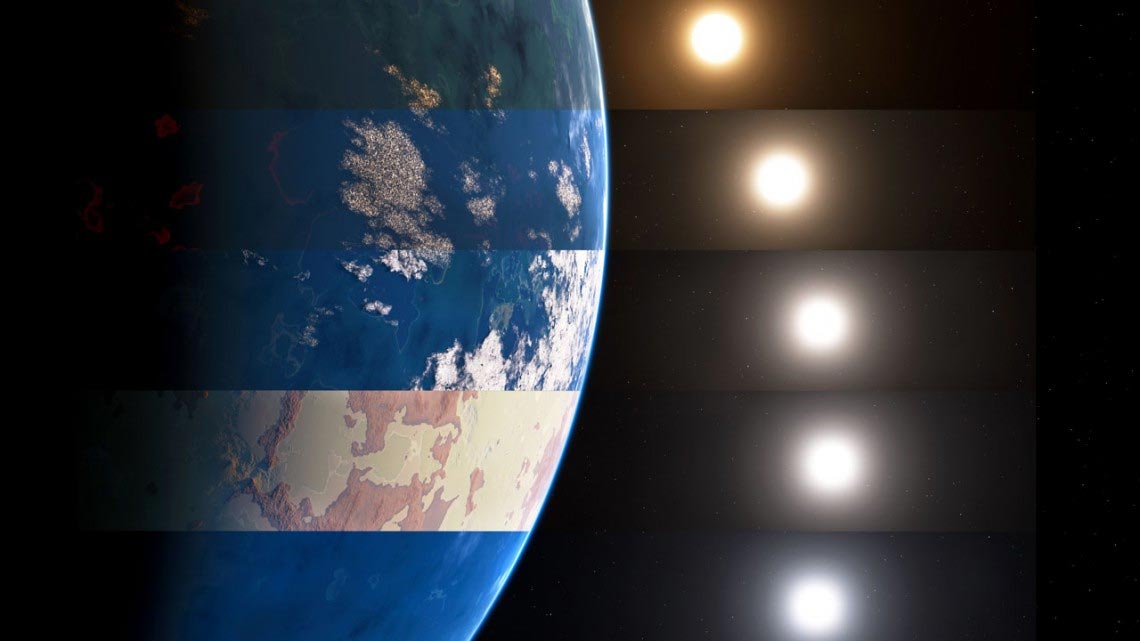
    In this artistic rendering, different kinds of suns are shown as they interact with various Earth-like surfaces in distant solar systems. The combinations create an array of climates. Thus, in the search for exoplanets, astronomers can be guided by color for possible habitable planets. Credit: Jack Madden/Cornell

    After examining a dozen types of suns and a roster of planet surfaces, Cornell astronomers have developed a practical model – an environmental color “decoder” – to tease out climate clues for potentially habitable exoplanets in galaxies far away.

    “We looked at how different planetary surfaces in the habitable zones of distant solar systems could affect the climate on exoplanets,” said Jack Madden, Ph.D. ’20, who works in the lab of Lisa Kaltenegger, associate professor of astronomy and director of Cornell’s Carl Sagan Institute.

    “Reflected light on the surface of planets plays a significant role not only on the overall climate,” Madden said, “but also on the detectable spectra of Earth-like planets.”

    Madden and Kaltenegger are co-authors of “How Surfaces Shape the Climate of Habitable Exoplanets,” released on May 18, 2020, in the Monthly Notices of the Royal Astronomical Society.

    In their research, they combine detail of a planet’s surface color and the light from its host star to calculate a climate. For instance, a rocky, black basalt planet absorbs light well and would be very hot, but add sand or clouds and the planet cools; and a planet with vegetation and circling a reddish K-star will likely have cool temperatures because of how those surfaces reflect their suns’ light.

    “Think about wearing a dark shirt on a hot summer day. You’re going to heat up more, because the dark shirt is not reflecting light. It has a low albedo (it absorbs light) and it retains heat,” Madden said. “If you wear a light color, such as white, its high albedo reflects the light – and your shirt keeps you cool.

    It’s the same with stars and planets, Kaltenegger said.

    “Depending on the kind of star and the exoplanet’s primary color – or the reflecting albedo – the planet’s color can mitigate some of the energy given off by the star,” Kaltenegger said. “What makes up the surface of an exoplanet, how many clouds surround the planet, and the color of the sun can change an exoplanet’s climate significantly.”

    Madden said forthcoming instruments like the Earth-bound Extremely Large Telescope will allow scientists to gather data in order to test a catalog of climate predictions.

    “There’s an important interaction between the color of a surface and the light hitting it,” he said. “The effects we found based on a planet’s surface properties can help in the search for life.”

    Reference: “How surfaces shape the climate of habitable exoplanets” by Jack Madden and Lisa Kaltenegger, 11 February 2020, Monthly Notices of the Royal Astronomical Society.
    DOI: 10.1093/mnras/staa387

    The Brinson Foundation and the Carl Sagan Institute supported this research.

    Never miss a breakthrough: Join the SciTechDaily newsletter.
    Follow us on Google and Google News.

    Astrobiology Astronomy Cornell University Exoplanet Popular
    Share. Facebook Twitter Pinterest LinkedIn Email Reddit

    Related Articles

    Webb Space Telescope Shocks Astronomers With Surprising Exoplanet Atmospheric Composition

    Alien Life in These Star-Systems Could Have Spotted Earth After Human Civilization Blossomed

    Astronomers Could Spot Clues to Alien Life Orbiting Long-Dead Stars

    Extreme Solar Events and the Search for Habitable Exoplanets

    “They’re out There” – Exoplanet Axis Study Boosts Hopes of Complex Life

    New Modeling Reveals that Tilted Orbits Could Make More Worlds Habitable

    Habitable Zones Near Red Dwarf Stars Smaller than Previously Thought

    “Habitable Zone” Might Help Extreme Life Forms Survive on Exoplanets

    Astronomers Obtain Precise Measurements of the Two Kepler-16 Stars

    3 Comments

    1. Raul Medina on May 19, 2020 7:13 am

      How far are those stars and exoplanets are?

      Reply
    2. Libby Rebecca Woodhead on May 19, 2020 10:52 am

      Why would anyone want humans on their planets your whole world was pedophiles. Human trafficking. They don’t care trust me they would laugh at all of us.

      Reply
    3. david wayne ferrin on May 19, 2020 12:10 pm

      Wow, the atmosphere scatters lights wavelengths, so it depends on what the atmosphere is made of, not how the light is reflecting, if it contains 69.03% nitrogen, 13.11% oxygen, 2.05% argon, 15.81% carbon dioxide, the wavelengths of whatever light from whatever Star would look and do different things.
      The reason that the Sun looks yellow to us is because the Earth’s atmosphere scatters higher wavelength colors, like red, orange and yellow less easily. Hence, these wavelengths are what we see, which is why the Sun appears yellow. the atmosphere acts like a blue filter.

      Reply
    Leave A Reply Cancel Reply

    • Facebook
    • Twitter
    • Pinterest
    • YouTube

    Don't Miss a Discovery

    Subscribe for the Latest in Science & Tech!

    Trending News

    Scientists Uncover Potential Brain Risks of Popular Fish Oil Supplements

    Scientists Discover a Surprising Way To Make Bread Healthier and More Nutritious

    After 60 Years, Scientists Uncover Unexpected Brain Effects of Popular Diabetes Drug Metformin

    New Research Uncovers Hidden Side Effects of Popular Weight-Loss Drugs

    Scientists Rethink Extreme Warming After Surprising Ocean Discovery

    Landmark Study Links Never Marrying to Significantly Higher Cancer Risk

    Researchers Discover Unknown Beetle Species Just Steps From Their Lab

    Largest-Ever Study Finds Medicinal Cannabis Ineffective for Anxiety, Depression, PTSD

    Follow SciTechDaily
    • Facebook
    • Twitter
    • YouTube
    • Pinterest
    • Newsletter
    • RSS
    SciTech News
    • Biology News
    • Chemistry News
    • Earth News
    • Health News
    • Physics News
    • Science News
    • Space News
    • Technology News
    Recent Posts
    • Scientists Finally Crack Decades-Old Mystery of “Breathing” Lasers
    • “Like Liquid Metal”: Scientists Create Strange Shape-Shifting Material
    • Early Warning Signals of Esophageal Cancer May Be Hiding in Plain Sight
    • Researchers Have Discovered a THC-Free Cannabis Compound That May Replace Opioids
    • Common Blood Pressure Drug Shows Surprising Power Against Deadly Antibiotic-Resistant Superbug
    Copyright © 1998 - 2026 SciTechDaily. All Rights Reserved.
    • Science News
    • About
    • Contact
    • Editorial Board
    • Privacy Policy
    • Terms of Use

    Type above and press Enter to search. Press Esc to cancel.