
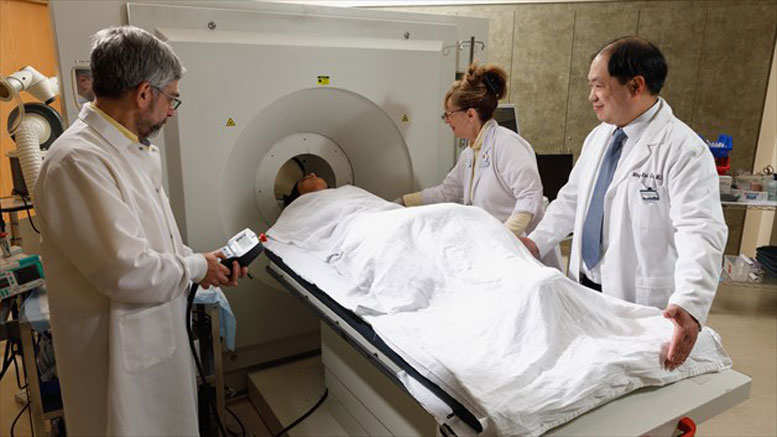
Using a new technique called vibrational spectroscopy, doctors at Yale have developed a novel way to scan for Alzheimer’s disease.
Deep within our brains is a dense forest of 100 billion nerve cells. Each of those cells has about 15,000 dendrites that branch out to connect with dendrites from other nerve cells, generating more than 100 trillion points of connection. Electrical signals race from cell to cell at a rate of 200 times a second, triggering thoughts, memories, actions, and feelings. These signals create pathways that transmit 4 billion pieces of information. All of this occurs in the time it takes to blink.
But imagine that the roots of this complex and intensely active forest begin to tangle. Gunk begins to build up between the “trees,” slowing down electrical activity, causing nerve cells to shrivel and die. It’s easy to picture how a once lively and vibrant ecosystem would begin to go silent.
This is what happens in the brain of a patient with Alzheimer’s disease.
Scientists believe that tangles inside cells (called tau tangles) and the plaque that builds up between them (called amyloid protein) cause the condition that affects 5.5 million Americans, but they still don’t know the exact reasons these changes occur. Nor do they have a concrete way to confirm that this is what’s happening in the brain of a particular patient, which is one way doctors would be able to make a definitive diagnosis. This is why doctors currently diagnose patients by ruling out all other possible causes of dementia-like symptoms. But the only way to know for sure if a patient has Alzheimer’s is to analyze brain tissue after the patient has died of amyloid protein and tau tangles.
Researchers, including several here at Yale Medicine, are looking for ways to diagnose the disease through biomarkers—physical characteristics in blood or tissue samples that are unique to Alzheimer’s patients. Recent research published in the Proceedings of the National Academy of Sciences describes a new technique called vibrational spectroscopy that shows great promise. Vibrational spectroscopy uses reflection of light off a diamond core as a way to visually confirm specific characteristics within blood plasma that are typical for people with Alzheimer’s. The researchers reported that diagnosis using this technique was 90 percent effective when compared against standard clinical diagnosis (which involves a combination of taking patient history, physical and neurological testing, brain imaging, etc.).
Even more excitingly, this method was able to differentiate between blood from an Alzheimer’s patient and one with Lewy Body dementia (LBD). Although LBD is the second leading cause of dementia, it’s often misdiagnosed because the symptoms are so similar to other degenerative brain disorders. “It’s difficult to distinguish between the two clinically,” explains Christopher van Dyck, MD, a psychiatrist at Yale Medicine and director of the Alzheimer’s Disease Research Unit. A misdiagnosis can be dangerous because certain types of medications that are helpful to people with Alzheimer’s can cause severe complications, such as neuroleptic sensitivity, irreversible parkinsonism or neuroleptic malignant syndrome.
Dr. van Dyck’s own research is at the forefront of developing techniques to diagnose Alzheimer’s through biomarkers. His team partnered with the PET imaging center at Yale Medicine’s radiology department to use neuroimaging to detect the amyloid protein and tau tangles that are characteristic in the brains of Alzheimer’s patients. The amyloid part of the technique was approved by the FDA in 2012. Since then, it has revolutionized clinical research. While a positive scan showing amyloid protein doesn’t necessarily mean that a patient has Alzheimer’s, a negative scan definitively shows that the patient does not have Alzheimer’s. Now, many patients who want to enroll in clinical trials for Alzheimer’s medication are required to have a positive result from an amyloid PET scan first.
The PET scan technique has also allowed doctors to diagnose the disease earlier than previously possible. The earlier the diagnosis of Alzheimer’s disease is made, the earlier doctors can prescribe medications, such as cholinesterase inhibitors, which work best on patients with mild to moderate Alzheimer’s. These drugs can help delay or prevent symptoms from getting worse by preventing the brain from breaking down a chemical called acetylcholine, which plays an important role in memory. “Alzheimer’s causes progressive, irreversible brain damage. The earlier you catch it, the more effective our interventions will be,” says Dr. van Dyck.
In the rapidly moving world inside our brains, every second matters.
Reference: “Differential diagnosis of Alzheimer’s disease using spectrochemical analysis of blood” by Maria Paraskevaidi, Camilo L. M. Morais, Kássio M. G. Lima, Julie S. Snowden, Jennifer A. Saxon, Anna M. T. Richardson, Matthew Jones, David M. A. Mann, David Allsop, Pierre L. Martin-Hirsch and Francis L. Martin, 5 September 2017, PNAS.
DOI: 10.1073/pnas.1701517114
Never miss a breakthrough: Join the SciTechDaily newsletter.
Follow us on Google and Google News.