
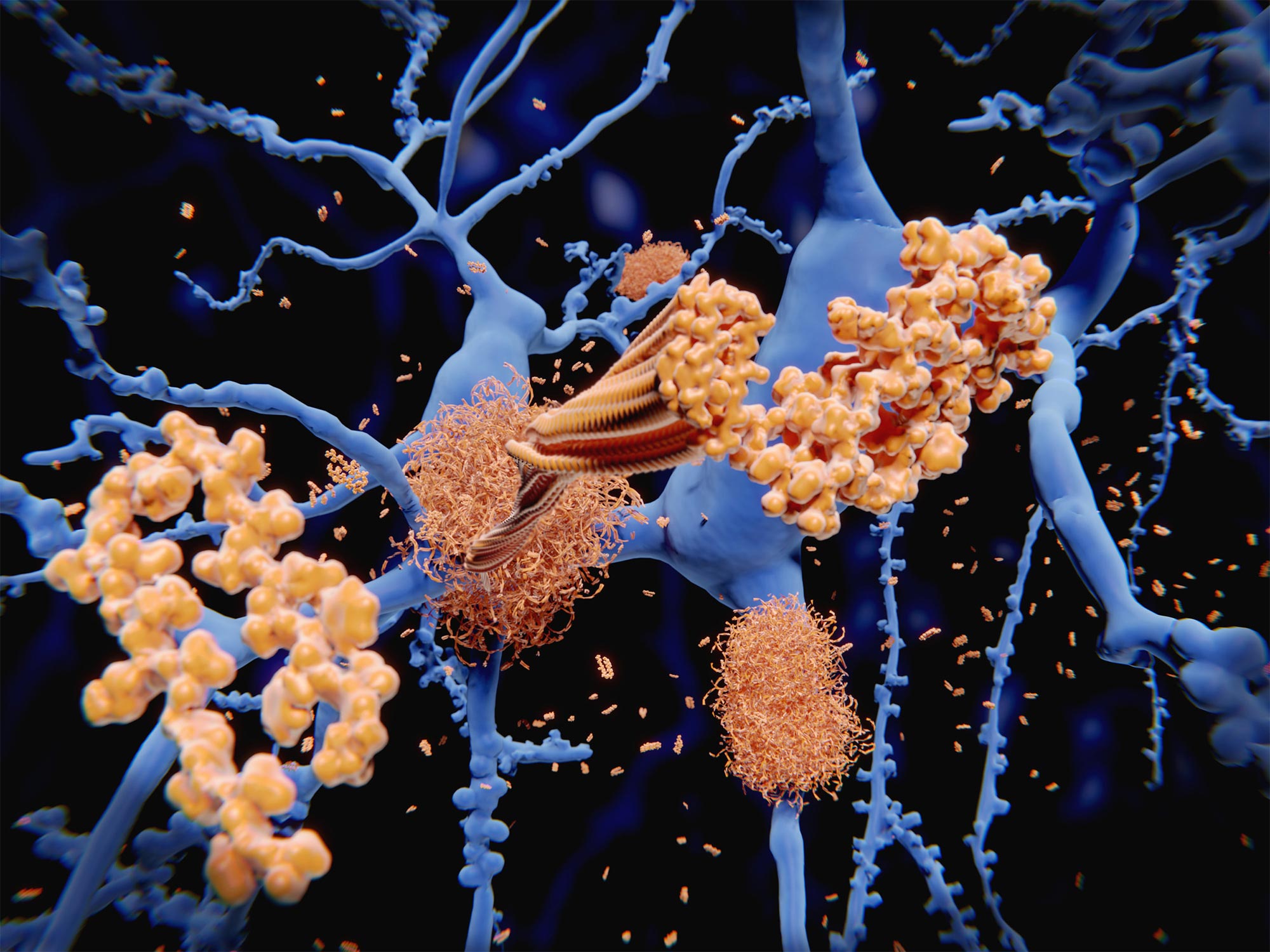
New photo-oxygenation catalyst targets amyloid structure, recruits brain immune system cells.
A small, light-activated molecule recently tested in mice represents a new approach to eliminating clumps of amyloid protein found in the brains of Alzheimer’s disease patients. If perfected in humans, the technique could be used as an alternative approach to immunotherapy and used to treat other diseases caused by similar amyloids.
Researchers injected the molecule directly into the brains of live mice with Alzheimer’s disease and then used a specialized probe to shine light into their brains for 30 minutes each day for one week. Chemical analysis of the mouse brain tissue showed that the treatment significantly reduced amyloid protein. Results from additional experiments using human brain samples donated by Alzheimer’s disease patients supported the possibility of future use in humans.
“The importance of our study is developing this technique to target the amyloid protein to enhance clearance of it by the immune system,” said Yukiko Hori, a lecturer at the University of Tokyo and co-first author of the research recently published in Brain.
The small molecule that the research team developed is known as a photo-oxygenation catalyst. It appears to treat Alzheimer’s disease via a two-step process.
Molecular Destabilization via Oxygenation
First, the catalyst destabilizes the amyloid plaques. Oxygenation, or adding oxygen atoms, can make a molecule unstable by changing the chemical bonds holding it together. Laundry detergents or other cleaners known as “oxygen bleach” use a similar chemical principle.
The catalyst is designed to target the folded structure of amyloid and likely works by cross-linking specific portions called histidine residues. The catalyst is inert until it is activated with near-infrared light, so in the future, researchers imagine that the catalyst could be delivered throughout the body by injection into the bloodstream and targeted to specific areas using light.
Microglia Clean Up Destabilized Amyloid
Second, the destabilized amyloid is then removed by microglia, immune cells of the brain that clear away damaged cells and debris outside healthy cells. Using mouse cells growing in a dish, researchers observed microglia engulfing oxygenated amyloid and then breaking it down in acidic compartments inside the cells.
“Our catalyst binds to the amyloid-specific structure, not to a unique genetic or amino acid sequence, so this same catalyst can be applied to other amyloid depositions,” said Professor Taisuke Tomita, who led the project at the University of Tokyo.
The American Society of Clinical Oncology estimates that each year in the U.S., 4,000 people are diagnosed with diseases caused by amyloid outside of the brain, collectively known as amyloidosis.
Importance of Eliminating Existing Amyloid Plaques
The photo-oxygenation catalyst should be capable of removing amyloid protein, regardless of when or where it formed in the body. Although some existing Alzheimer’s disease treatments can slow the formation of new amyloid plaques, eliminating existing plaques is especially important in Alzheimer’s disease because amyloid begins aggregating years before symptoms appear.
The research team is now working to modify the design of the catalyst so it can be activated by shining light through the skull.
Reference: “Photo-oxygenation by a biocompatible catalyst reduces amyloid-β levels in Alzheimer’s disease mice” by Shuta Ozawa, Yukiko Hori, Yusuke Shimizu, Atsuhiko Taniguchi, Takanobu Suzuki, Wenbo Wang, Yung Wen Chiu, Reiko Koike, Satoshi Yokoshima, Tohru Fukuyama, Sho Takatori, Youhei Sohma, Motomu Kanai and Taisuke Tomita, 14 April 2021, Brain.
DOI: 10.1093/brain/awab058
This research is a peer-reviewed experimental studying using mice and human tissue samples. Human temporal cortex brain samples used in this research came from the Alzheimer’s Disease Core Center (ADCC) and the Center for Neurodegenerative Disease Research (CNDR) at the University of Pennsylvania in the U.S.
Never miss a breakthrough: Join the SciTechDaily newsletter.
Follow us on Google and Google News.
4 Comments
Which drugs can l use for memory
If dementia and Alzheimer’s disease can be treated by that then have it done! Quite something how some dementias can be reversed if it’s due to depression, lack of B vitamins especially high in thiamine and alcohol dementia can be treated but other dementias cannot be reversed and will progress until that person is a vegetable. Just doesn’t make any sense…some scientists say an extract in maple syrup could hold the key as well but by 2050 I’m sure science will progress their technology of artificial brain cell add ons to improve memory, concentration and motor skills but it will still not replace our soul of where we are in our brains…that would never be replaced by artificial science
My Mom was diagnosed with early onset dementia at age 54. She passed at age 62. She was very high strung and a perfectionist. She taught 2nd grade elementary for 27 years. Never smoked. Never did drugs. She was plagued with depression and suicidal thoughts which i never knew about until she was already gone. I read that i now have a 4x greater chance at getting this same disease since my Mom was so young when she was diagnosed. Watching her decline was one of the hardest things to see. People would say that my mom wasnt there or didnt know anyone or know anything that was going on around her.
I know that my mom may not have known their names but she felt their love and knew she was safe and that means the world to a person that doesnt have ant memories and cant provide for themselves.
She called me by my name 3 days before she quit getting out of bed amd basically just gave up.
I hope this light therapy can begin a path to curing this horrific disease. Thats all i wanted to say.
Kristen
This treatment is not uniquely able to reverse plaque.
The Vialight people in Canada have research showing that they reveal light can I also have that kind of affect by applying the correct light frequencies pulse that 40 Hz.