
Close Menu
    Facebook X (Twitter) Instagram
    SciTechDaily
    • Biology
    • Chemistry
    • Earth
    • Health
    • Physics
    • Science
    • Space
    • Technology
    Facebook X (Twitter) Pinterest YouTube RSS
    SciTechDaily
    Home»Space»Astrophysical Anomalies: The Curious Case of the Spider Galaxy
    Space

    Astrophysical Anomalies: The Curious Case of the Spider Galaxy

    By ESA/HubbleMarch 18, 2024No Comments2 Mins Read
    Facebook Twitter Pinterest Telegram LinkedIn WhatsApp Email Reddit
    Share
    Facebook Twitter LinkedIn Pinterest Telegram Email Reddit
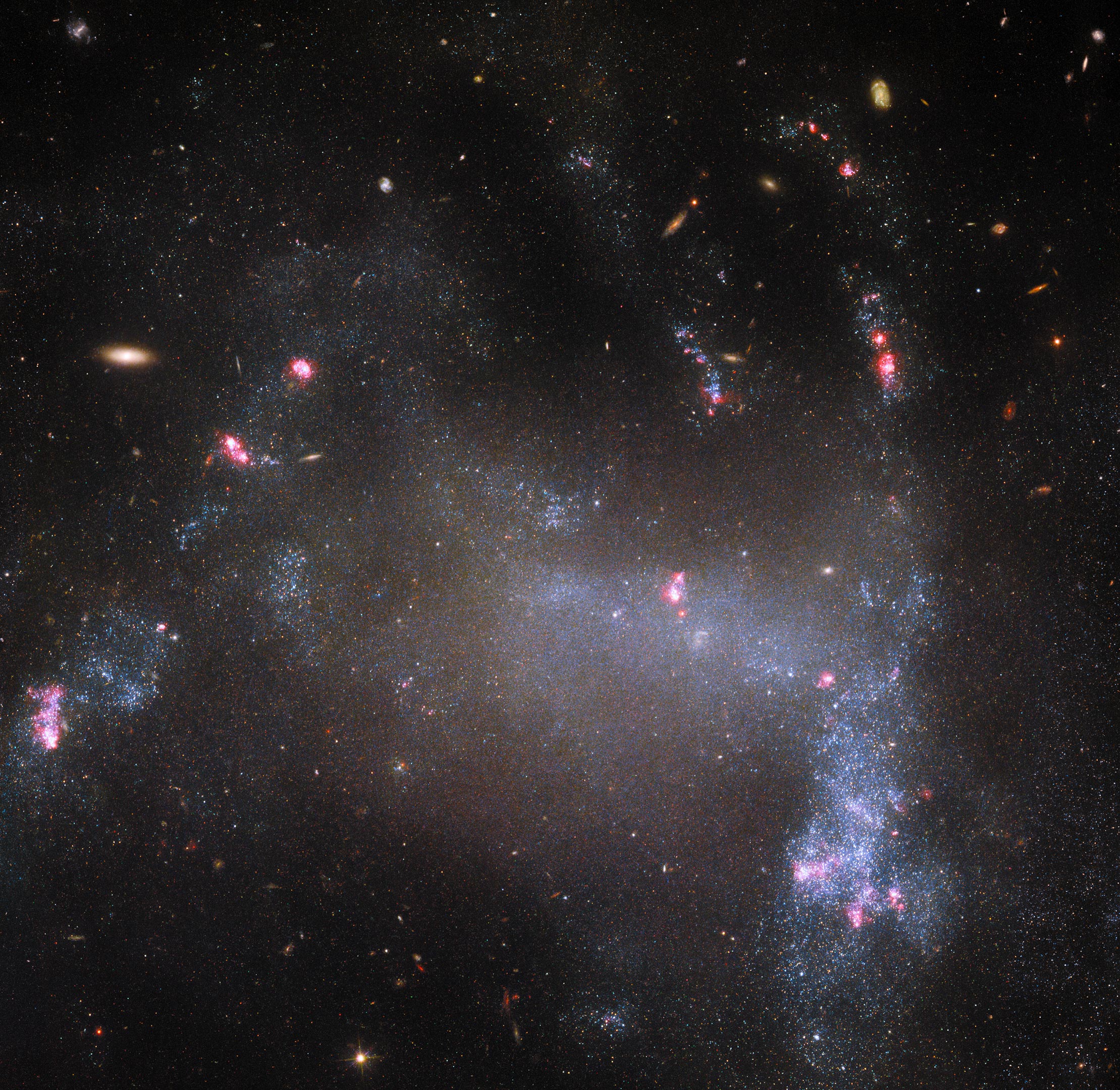
    Irregular Galaxy UGC 5829
    Hubble Space Telescope image of UGC 5829, also known as the Spider Galaxy. It is an irregular galaxy recognized for its spider-like arms, located 30 million light-years away. Credit: ESA/Hubble & NASA, R. Tully, M. Messa

    The Spider Galaxy, located 30 million light-years away, is cataloged under several names, distinguishing it from the similarly nicknamed but distant Spiderweb Galaxy.

    This gauzy-looking celestial body is UGC 5829, an irregular galaxy that lies about 30 million light-years away. Despite there not being many observations of this relatively faint galaxy, it has the distinction of having a descriptive soubriquet: the Spider Galaxy.

    Perhaps the distorted galactic arms with their glowing, star-forming tips bring to mind the clawed legs of an arachnid. Somewhat confusingly, there is another, very similarly nicknamed but otherwise entirely distinct, galaxy known as the Spiderweb Galaxy.

    This galaxy has also been more extensively imaged (notably by Hubble), despite the fact that it lies about 300 times further from Earth than the Spider Galaxy does.

    Cataloging Galaxies

    Fortunately, correct galaxy identification does not depend on casual given names. Rather, known galaxies are recorded in at least one catalog — and often in several — such as the Uppsala General Catalogue of Galaxies, which gives the Spider Galaxy its more formal title of UGC 5829.

    This same galaxy also has several different designations in various other catalogs: it is, for example, LEDA 31923 in the Lyon-Meudon Extragalactic Database; MCG+06-24-006 in the Morphological Catalogue of Galaxies; and SDSS J104242.78+342657.3 in the Sloan Digital Sky Survey Catalogue. The Spiderweb Galaxy isn’t recorded in all of the same catalogs — each is necessarily limited in scope — but it is included in the LEDA catalog as LEDA 2826829.

    It is evidently simpler to not conflate the dull but distinct names LEDA 31923 and LEDA 2826829, than the fun but easily confused Spider and Spiderweb!

    Never miss a breakthrough: Join the SciTechDaily newsletter.
    Follow us on Google and Google News.

    Astronomy European Space Agency Hubble Space Telescope
    Share. Facebook Twitter Pinterest LinkedIn Email Reddit

    Related Articles

    A Diamond Necklace of Cosmic Proportions

    Hubble Snaps a Stunning Close-Up of a Magnificent Spiral Galaxy

    Extraordinary Hubble Image: Light Bends From the Beyond

    Hubble Space Telescope Sees Volcanic Activity Reforming the Atmosphere on a Rocky Exoplanet

    Hubble Spies a Luminous Heart With Dark Tendrils

    Spectacular Return to the Veil Nebula

    Hubble Spots a Peculiar Sight: Unusual Spiral Galaxy With a Heavy Arm

    A Flash of Life: Hubble Spies an Unusual Planetary Nebula

    Through the Cosmic Clouds: Hubble Spots a Beautiful Stellar Nursery

    Leave A Reply Cancel Reply

    • Facebook
    • Twitter
    • Pinterest
    • YouTube

    Don't Miss a Discovery

    Subscribe for the Latest in Science & Tech!

    Trending News

    NASA’s Voyager 1 Is About to Become the First Spacecraft One Light-Day From Earth

    A Woman Who Lived 30,000 Years Ago Is Changing What We Know About Ice Age Europe

    A Rare Radioactive Element Reveals a Hidden Secret About the Heaviest Atoms

    Breakthrough Cancer Treatment Wipes Out Deadly Brain Tumors in Every Mouse Tested

    Something Remarkable Is Happening to Dogs Living Near Chernobyl’s Nuclear Plant

    Hubble Uncovers a Mysterious 93-Billion-Mile Structure Hiding in a Nearby Star System

    Earth’s Oceans Were Slowly Suffocating Millions of Years Before a Devastating Mass Extinction

    Why Are Men Twice As Likely To Develop Parkinson’s? Scientists Discover a Hidden Clue in the Brain

    Follow SciTechDaily
    • Facebook
    • Twitter
    • YouTube
    • Pinterest
    • Newsletter
    • RSS
    SciTech News
    • Biology News
    • Chemistry News
    • Earth News
    • Health News
    • Physics News
    • Science News
    • Space News
    • Technology News
    Recent Posts
    • Scientists Finally Crack a 1,600-Year-Old Roman Glass Mystery
    • Scientists Discover Something Unexpected 90 Kilometers Beneath Earth
    • Popular Dairy Alternatives Could Be Leaving You Short of Essential Nutrients
    • A Healthier Form of Salt Could Prevent Nearly 3 Million Deaths Every Year, Scientists Say
    • Scientists Engineer Rice That Fights Back Against a Devastating Crop Disease
    Copyright © 1998 - 2026 SciTechDaily. All Rights Reserved.
    • Science News
    • About
    • Contact
    • Editorial Board
    • Privacy Policy
    • Terms of Use

    Type above and press Enter to search. Press Esc to cancel.