
A Department of Energy-funded project between Argonne and the University of Illinois Urbana-Champaign explores coupling magnetism and microwaves for quantum discoveries.
The U.S. Department of Energy (DOE) has recently funded both DOE’s Argonne National Laboratory and the University of Illinois Champaign-Urbana (UIUC) in a new project related to quantum information science. The Argonne team will bring to the project its expertise in coupling superconducting and magnetic systems. The UIUC team will contribute its world-class capabilities for developing new magnetic materials for quantum systems.
“Quantum information science promises new and different ways in which scientists can process and manipulate information for sensing, data transfer, and computing,” said Valentine Novosad, a senior scientist in Argonne’s Materials Science division. “UIUC is a perfect partner for us to realize breakthrough discoveries in this area.”
In the emerging field of quantum information science, microwaves may play a fundamental role because their physical properties enable them to provide desired quantum functionality at temperatures near to absolute zero (minus 460 degrees Fahrenheit) — a necessity because heat creates errors in quantum operations. However, microwaves are susceptible to noise, which is unwanted energy that disturbs signal and data transmission.
“Quantum information science promises new and different ways in which scientists can process and manipulate information for sensing, data transfer and computing.” Valentine Novosad, Materials Science division
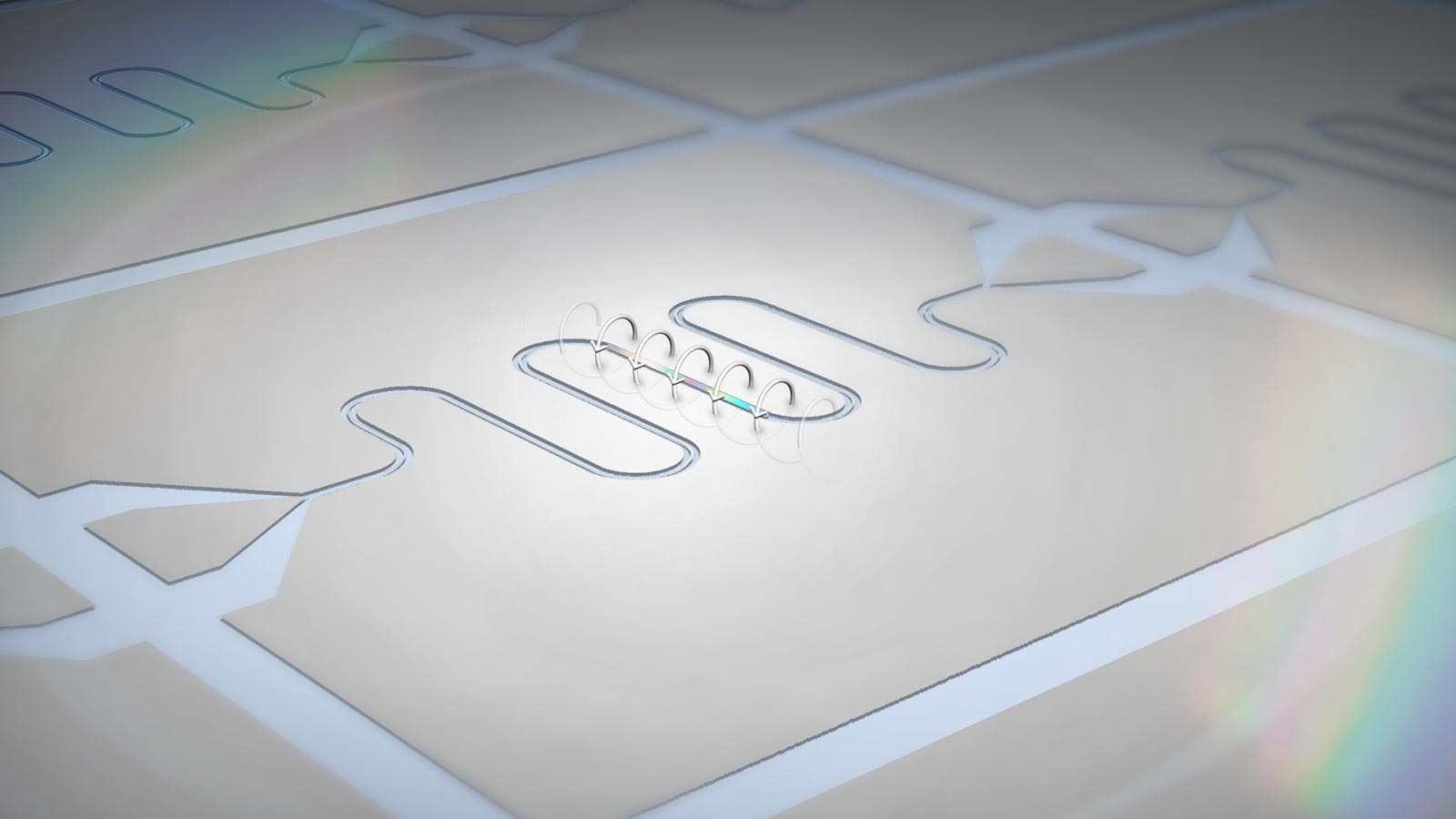
The research team will be exploring whether magnons could partner with microwave photons to ensure that microwaves can only travel in one direction, thereby essentially eliminating noise. Magnons are the fundamental excitations of magnets. By contrast, microwave photons result from electronic excitations producing waves like those in a microwave oven.
Superconducting Circuits as Quantum Interfaces
The Argonne scientists will build upon their earlier efforts to create a superconducting circuit integrated with magnetic elements. The magnons and photons talk to each other through this superconducting device. Superconductivity — the complete absence of electrical resistance — allows coupling of magnons and microwave photons at near to absolute zero.
“This capability presents unique opportunities for manipulating quantum information,” explained Yi Li, a postdoctoral appointee in Argonne’s Materials Science division.
In the past, Argonne has played major roles in the development of superconducting detectors and sensors for understanding the workings of the universe at the most fundamental level. “We will benefit from the valuable knowledge gained in these highly successful projects in cosmology and particle physics,” Novosad said.
The UIUC researchers will be searching for magnets that work at ultracold temperatures. They will be testing known and new material systems to find candidates that can handle an ultracold environment and operate in a real quantum device.
“Many magnets work well with microwaves at room temperature,” said Axel Hoffmann, Founder Professor in Engineering at UIUC and the leader of this project. “We need materials that work also well at much lower temperatures, which may completely change their properties.”
Integrated Magnetic Quantum Circuits
“If we are successful within these three years, we will have magnetic structures directly integrated with quantum circuitry,” Hoffmann said. “This work could also apply to non-quantum devices for sensing and communication, such as in Wi-Fi or Bluetooth technologies.”
This new project is another example of how Argonne and UIUC are leading the way toward a quantum future. Argonne not only conducts cross-disciplinary research within its large portfolio of QIS projects but also leads Q-NEXT, one of five QIS research centers DOE established in August 2020. Similarly, UIUC supports a wide range of quantum information projects, such as Q-NEXT, through the Illinois Quantum Information Science and Technology (IQUIST) Center.
The DOE Office of Basic Energy Sciences is funding this 3-year project at $4.2 million. Earlier Argonne research related to superconducting devices had been funded by the DOE Nuclear Physics and High Energy Physics programs.
In addition to Hoffmann, Li, and Novosad, the team includes Wolfgang Pfaff, André Schleife and Jian-Min Zuo of UIUC.
Never miss a breakthrough: Join the SciTechDaily newsletter.
Follow us on Google and Google News.