
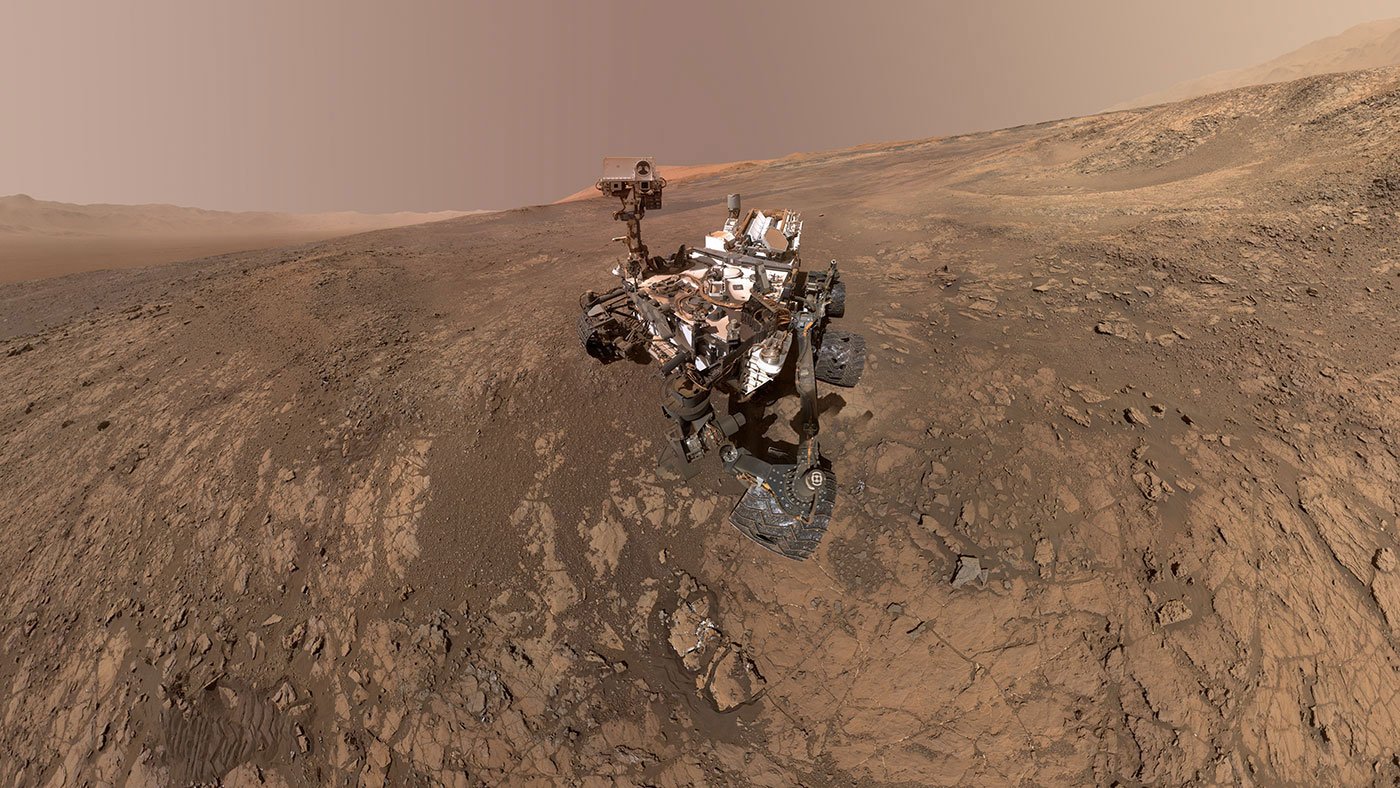
Scientists will compare thermophysical properties from rover to orbital data and analog measurements gathered on Earth to understand rock record.
Launched in 2011, NASA’s Mars Science Laboratory (MSL) Curiosity Rover arrived on Mars in 2012 to explore the Gale Crater, acquiring rock, soil, and air samples to help scientists characterize the geology of Mars and understand what the planet’s crust is made of.
Part of NASA’s long-term effort to explore the Red Planet using robots, Curiosity was designed to discover whether Mars ever had the right environmental conditions to support microbial life forms. Early in its mission, Curiosity found evidence of past habitable environments on Mars, so scientists continue to explore the rock record using the advanced instruments on board the rover.
Even before he joined NAU’s Department of Astronomy and Planetary Science in 2016, Christopher Edwards was already a participating scientist on the MSL team, funded through a grant of $470,000. In addition to funding his research, the grant enabled him to build the Mars Rover Operations and Analysis Laboratory on NAU’s Flagstaff campus, where faculty researchers and students use sophisticated equipment to help command the day-to-day activities of the rover.
Now, after associate professor Edwards has spent more than five years producing successful results on MSL, NASA has reselected him as a participating scientist, awarding him $325,000 for the next three years. He and his team, all part of the Planetary Instrumentation eXperimentation and Exploration Laboratory (PIXEL), will use this opportunity to continue working on rover operations while expanding their geological research.
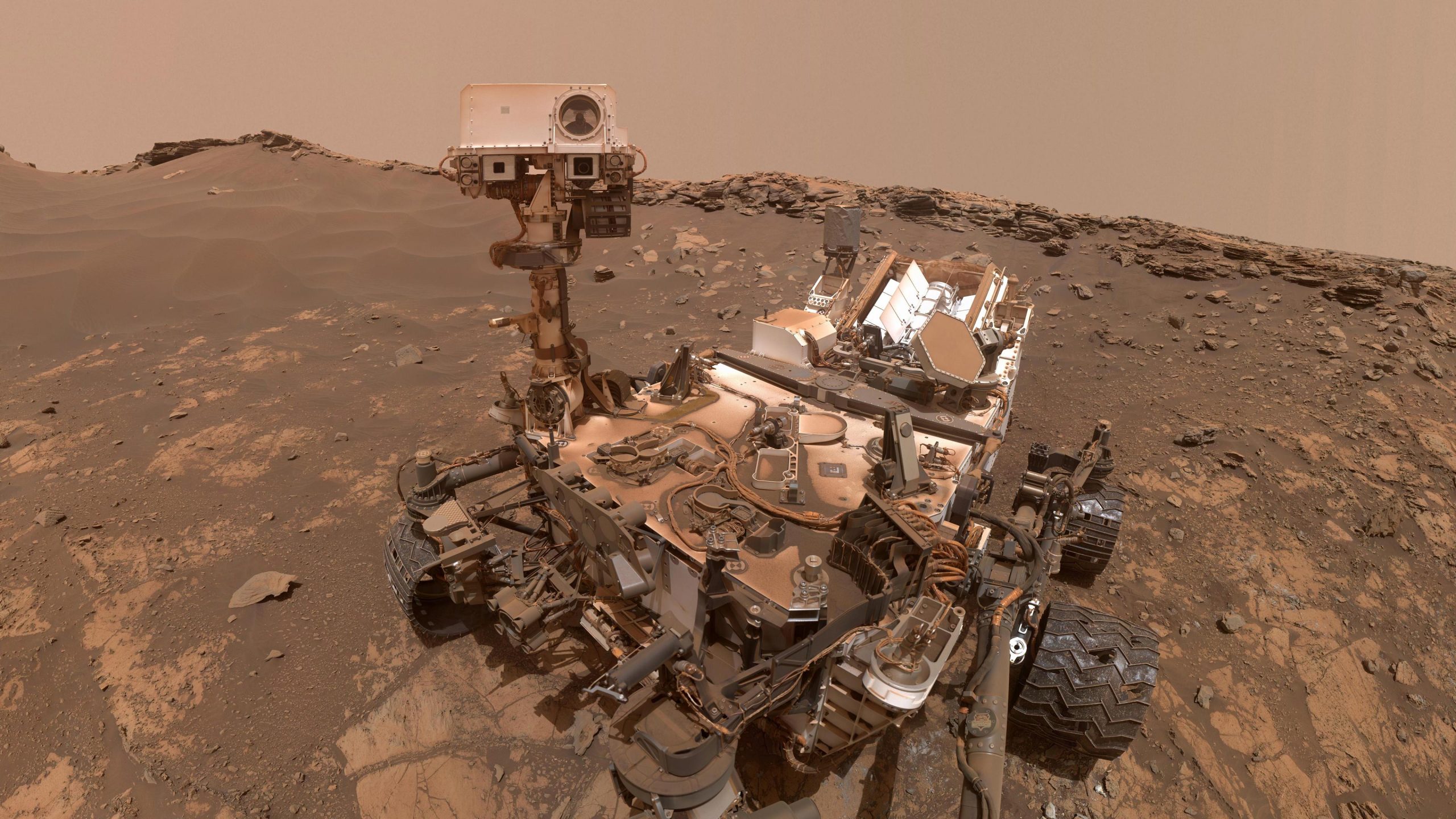
“I’m very happy that we’re able to continue to be involved in this NASA flagship mission,” Edwards said. “It’s a great opportunity for our group to remain engaged with Curiosity’s exciting science. I anticipate this work will enable us to attract additional funding for related research in the future, and when that happens, we can offer more opportunities to our students.”
Exploring Gale Crater’s Sedimentary Rocks
The team’s original objective was to investigate the geologic history of the sedimentary rocks of Gale Crater using ground-based imaging and thermal infrared measurements collected by the rover. As they studied this data, they encountered many different types of sediment, from sand dunes to solid rock. Although they are all common on Mars, determining their geologic origin and history remains a significant challenge.
For the second of the project, the team will link data from the rover, including high-resolution images, thermal infrared data as well as ground temperature sensors, to orbital data collected by the Mars Odyssey Orbiter spacecraft, to better understand how different types of rock on Mars were formed. They will also compare data to measurements collected here on Earth, at sites that serve as analogs to Mars.
“Basically, we’re trying to understand how well we could link the orbital data that covers nearly the entire planet of Mars with the images and thermal infrared data on the ground,” Edwards said.
Using very high-resolution, globally available imagery—in which one pixel represents an area the size of a football field—they are studying individual grains of sand to show how well these microscopic images match the rover-based thermal data and then, ultimately, the orbital data.
“We’re proposing in this second project to take what we learned about our ability to reliably ground truth these data and extend it to more complicated surfaces,” Edwards said. “Ultimately, we will link the geological and depositional history of these thermal imaging units to orbital datasets, improving our understanding of past depositional conditions across Mars.”
Edwards Team Focused on Three Areas of Research
Postdoctoral scholar Valerie Payre is focused on the geochemistry of rocks in Gale crater and conducting operations—running the Rover and deciding where it will go.
“I’m looking at the composition and mineralogy of both volcanic and sedimentary rocks in Gale Crater,” Payre said. “My overall objective is to understand the provenance of volcanic minerals and rocks and constrain how they could have formed. Using orbital visible and near infrared spectroscopy, I hope to detect diverse volcanic rocks in the most ancient terrains of Mars, including silica-rich rocks and feldspar-rich terrains like those analyzed in Gale Crater.
“I am very excited to continue the adventure on the MSL team to further understand geological processes that shaped and formed sedimentary rocks as we go up into Mount Sharp. I can’t wait to see how far we can use volcanic minerals contained within sedimentary rocks to constrain magmatic processes that happened in the vicinity of Gale Crater, especially as we are finally reaching the sulfate-bearing unit!”
Ph.D. candidate Ari Koeppel’s research is focused on the surface-related aspects of the project. He uses analog sites on Earth, for example, at Sunset Crater, to improve how surface temperatures on Mars are interpreted.
“I use drone data paired with weather station data to study the daily temperature cycle of a range of different types of rocks and sediments that are also present on Mars,” Koeppel said. “We hope this work will produce a model that will allow us to accurately make geologic interpretations using temperature data from Mars’ satellites and rovers to shed insight into things like water abundance, ice abundance and past habitability. We can then use data from MSL on the ground to confirm how effective the model is, and adjust it as needed. This is a particularly exciting time to use MSL data as a ground truth to our model because the rover is just beginning to explore an enigmatic region of Gale Crater that hosts a layered sulfate deposit, which may be remnants of ancient lakes or springs.”
Ph.D. candidate Aaron Weintraub is studying paleobedforms and is focused on the orbital side of the project. Although they look like sand dunes, paleobedforms have some of the same features as solid rock.
“My role on the MSL team is to collect data from the rover as it drives across the surface of the Greenheugh pediment, a great example of paleobedforms on Mars,” Weintraub said. “The data will enable me to perform what we call a ground truth, where the incredibly high-resolution rover instruments will be able to check the accuracy of our results from orbiting spacecrafts. This ground truth will help constrain and improve the orbital methodology we use to study these mysterious features all over Mars. I will use these in situ rover observations to characterize the thermophysical and mineralogical properties of these bedforms, and my hope is to determine if this site is an actual paleobedform.
“Although my work in this phase is only one small facet of a much larger picture, it still helps fit into the story of life on Mars and the evolution of planetary surfaces. By understanding how these unique features form and remain preserved, we can understand the environmental conditions present over their lifetime. This is important because it will help us to understand whether the conditions necessary to support life were long lived, transient or nonexistent. I’m excited to be part of such an impactful mission, and I hope my contributions help advance our understanding of the Red Planet.”
Never miss a breakthrough: Join the SciTechDaily newsletter.
Follow us on Google and Google News.